School of Life Science, Beijing University of Chinese Medicine, Beijing, China.
School of Basic Medical Sciences, Beijing University of Chinese Medicine, 11 Beisanhuandong Road, Chaoyang District, Beijing, 100029, China.
J Nanobiotechnology. 2021 Aug 28;19(1):257. doi: 10.1186/s12951-021-00908-2.
Cerebral infarction and cerebral hemorrhage, also known as "stroke", is one of the leading cause of death. At present, there is no real specific medicine for stroke. Crinis Carbonisatus (named Xue-yu-tan in Chinese), produced from carbonized hair of healthy human, and has been widely applied to relieve pain and treat epilepsy, stroke and other diseases in China for thousands of years.
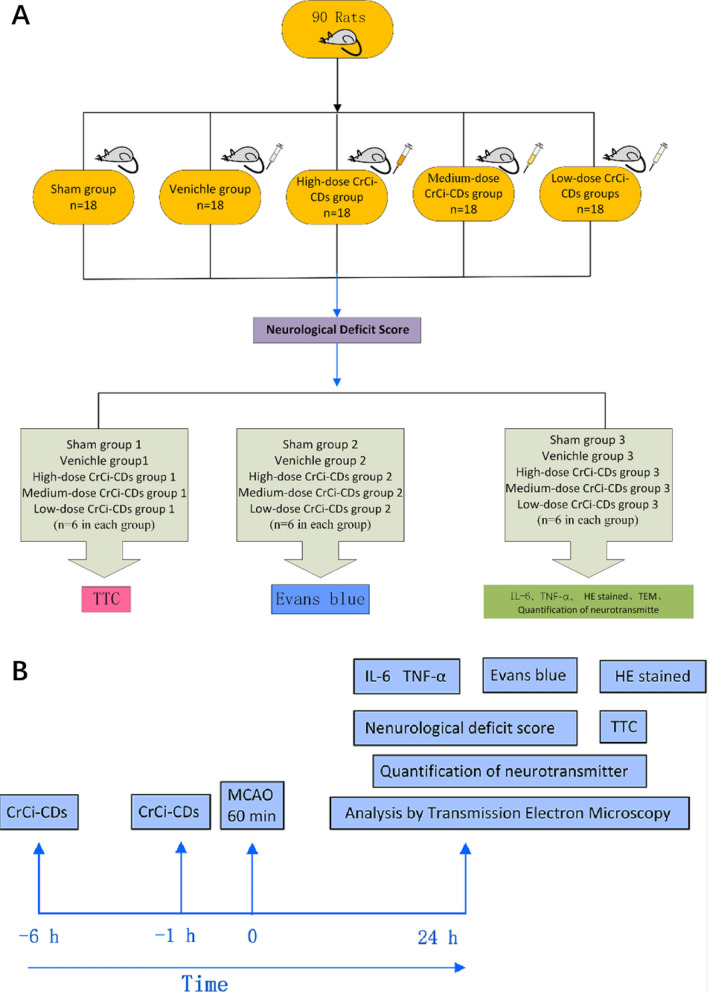
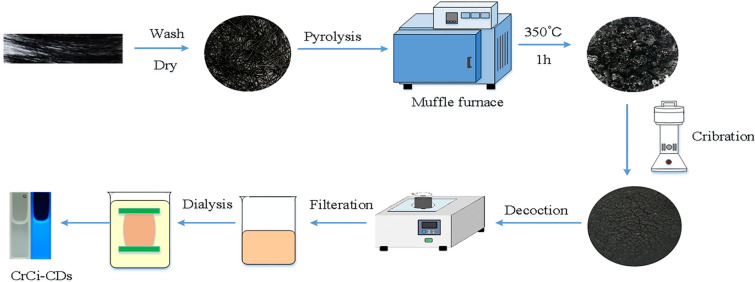
In this work, a new species of carbon dots derived from Crinis Carbonisatus (CrCi-CDs) were separated and identified. And the neuroprotective effect of carbon dots from CrCi were evaluated using the middle cerebral artery occlusion (MCAO) model. Neurological deficit score and infarction volume was assessed, evans blue content of ischemic hemispheres was measured, the concentrations of inflammatory factors, tumor necrosis factor-α (TNF-α), interleukin-6 (IL-6) in the cortex were measured, and the levels of neurotransmitters in the brain were determined. Preconditioning of CrCi-CDs significantly reduced ischemic lesion volume and blood-brain-barrier (BBB) permeability, improved neurologic deficits, decreased the level of TNF-α and IL-6 in MCAO rats, inhibited excitatory neurotransmitters aspartate (Asp) and glutamate (Glu), and increased the level of 5-hydroxytryptamine (5-HT). The RNA-Sequencing results reveal that further potential mechanisms behind the activities may be related to the anti-inflammation effects and inhibition of neuroexcitatory toxicity.
CrCi-CDs performs neuroprotective effect on cerebral ischemia and reperfusion injury, and the mechanisms may correlate with its anti-inflammatory action, which suggested that CrCi-CDs have potential value in clinical therapy on the acute apoplexy cases in combination with thrombolytic drugs.
脑梗死和脑出血,又称“中风”,是主要的死亡原因之一。目前,中风还没有真正特效的药物。血余炭,由健康人的头发碳化而成,在中国已有数千年的历史,被广泛用于缓解疼痛和治疗癫痫、中风等疾病。
本工作中,从血余炭中分离并鉴定出一种新型碳点(CrCi-CDs)。采用大脑中动脉闭塞(MCAO)模型评价碳点的神经保护作用。通过神经功能缺损评分和脑梗死体积评估、缺血半影区伊文思蓝含量测定、皮质炎症因子肿瘤坏死因子-α(TNF-α)、白细胞介素-6(IL-6)浓度测定以及脑内神经递质水平测定,研究了 CrCi-CDs 的预处理对脑缺血再灌注损伤的影响。结果表明,CrCi-CDs 预处理可显著降低脑梗死体积和血脑屏障(BBB)通透性,改善神经功能缺损,降低 MCAO 大鼠皮质 TNF-α和 IL-6 水平,抑制兴奋性神经递质天冬氨酸(Asp)和谷氨酸(Glu),增加 5-羟色胺(5-HT)水平。RNA-seq 结果显示,其作用机制可能与抗炎作用和抑制神经兴奋毒性有关。
CrCi-CDs 对脑缺血再灌注损伤具有神经保护作用,其机制可能与其抗炎作用有关,提示 CrCi-CDs 与溶栓药物联合应用于急性中风病例的临床治疗具有潜在价值。