Chinn Sedona, Hart P Sol
Department of Life Sciences Communication, University of Wisconsin-Madison, 1545 Observatory Drive, Madison, WI 53706 USA.
Department of Communication and Media, University of Michigan, 5417 North Quad, 105 South State Street, Ann Arbor, MI 48109 USA.
Clim Change. 2021;167(3-4):47. doi: 10.1007/s10584-021-03200-2. Epub 2021 Aug 21.
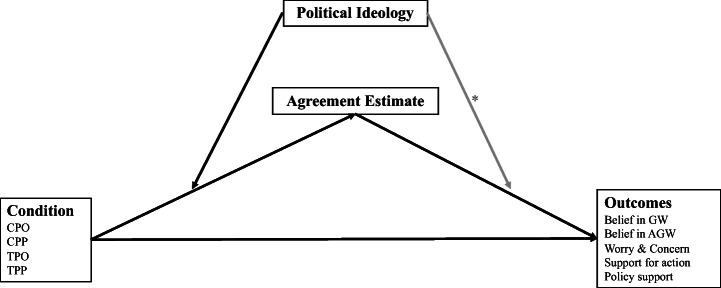
There are inconsistent findings concerning the efficacy of consensus messages to persuade individuals to hold scientifically supported positions on climate change. In this experiment, we tested the impact of consensus messages on skeptics' climate beliefs and attitudes and investigated how the decision to pretest initial climate beliefs and attitudes prior to consensus message exposure may influence results. We found that although consensus messages led individuals to report higher scientific agreement estimates, total effects on key variables were likely an artifact of study design; consensus messages only affected climate attitudes and beliefs when they were measured both before and after message exposure. In the absence of a pretest, we did not observe significant total effects of consensus messages on climate outcomes. These results highlight the limitations of consensus messaging strategies at reducing political polarization and the importance of experimental designs that mimic real-world contexts.
The online version contains supplementary material available at 10.1007/s10584-021-03200-2.
关于共识信息在说服个人对气候变化持有科学支持立场方面的有效性,存在不一致的研究结果。在本实验中,我们测试了共识信息对怀疑论者气候信念和态度的影响,并调查了在接触共识信息之前对初始气候信念和态度进行预测试的决定如何可能影响结果。我们发现,尽管共识信息使个体报告的科学共识估计值更高,但对关键变量的总体影响可能是研究设计的人为因素;只有在信息暴露前后都进行测量时,共识信息才会影响气候态度和信念。在没有预测试的情况下,我们没有观察到共识信息对气候结果的显著总体影响。这些结果凸显了共识信息传递策略在减少政治两极分化方面的局限性,以及模拟现实世界背景的实验设计的重要性。
在线版本包含可在10.1007/s10584-021-03200-2获取的补充材料。