Pärtel Jaak, Pärtel Meelis, Wäldchen Jana
Hugo Treffner Gymnasium, Munga 12, Tartu 51007, Estonia.
Institute of Ecology and Earth Sciences, University of Tartu, Lai 40, Tartu 51005, Estonia.
AoB Plants. 2021 Jul 27;13(4):plab050. doi: 10.1093/aobpla/plab050. eCollection 2021 Aug.
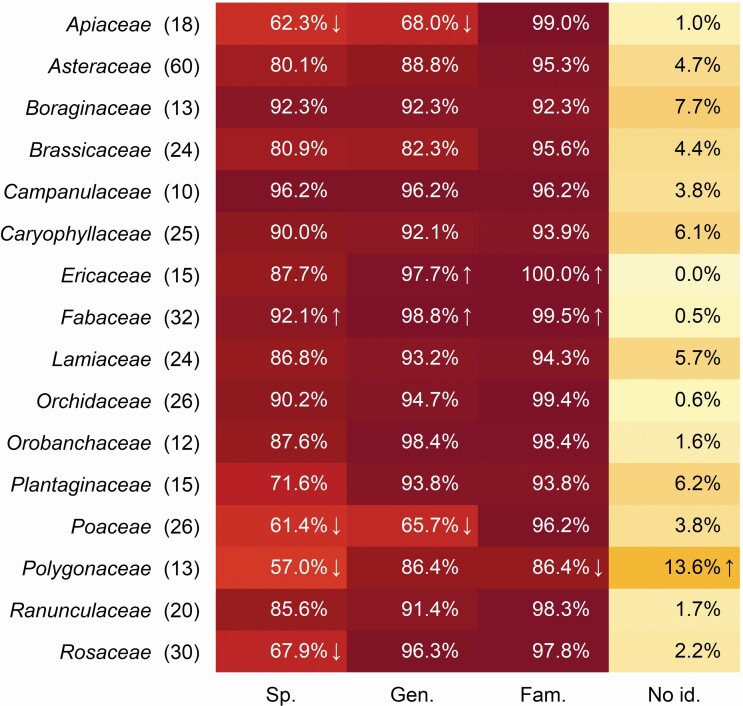
Automated image-based plant identification has experienced rapid development and has been already used in research and nature management. However, there is a need for extensive studies on how accurately automatic plant identification works and which characteristics of observations and study species influence the results. We investigated the accuracy of the application, a research-based tool for automated plant image identification. Our study was conducted in Estonia, Northern Europe. Photos originated from the Estonian national curated biodiversity observations database, originally without the intention to use them for automated identification (1496 photos, 542 species) were examined. was also directly tested in field conditions in various habitats, taking images of plant organs as guided by the application (998 observations, 1703 photos, 280 species). Identification accuracy was compared among species characteristics: plant family, growth forms and life forms, habitat type and regional frequency. We also analysed image characteristics (plant organs, background, number of species in focus), and the number of training images that were available for particular species to develop the automated identification algorithm. From database images 79.6 % of species were correctly identified by ; in the field conditions species identification accuracy reached 85.3 %. Overall, the correct genus was found for 89 % and the correct plant family for 95 % of the species. Accuracy varied among different plant families, life forms and growth forms. Rare and common species and species from different habitats were identified with equal accuracy. Images with reproductive organs or with only the target species in focus were identified with greater success. The number of training images per species was positively correlated with the identification success. Even though a high accuracy has been already achieved for , allowing its usage for research and practices, our results can guide further improvements of this application and automated plant identification in general.
基于图像的植物自动识别技术发展迅速,已应用于研究和自然管理领域。然而,对于自动植物识别的准确程度以及观测特征和研究物种的哪些特性会影响结果,仍需进行大量研究。我们调查了一种基于研究的植物图像自动识别工具的应用准确性。我们的研究在北欧的爱沙尼亚进行。照片来自爱沙尼亚国家精心策划的生物多样性观测数据库,这些照片最初并非用于自动识别(1496张照片,542个物种),我们对其进行了检查。该工具还在各种栖息地的野外条件下进行了直接测试,按照该工具的指导拍摄植物器官的图像(998次观测,1703张照片,280个物种)。我们比较了不同物种特征(植物科、生长形式和生活形式、栖息地类型和区域频率)之间的识别准确性。我们还分析了图像特征(植物器官、背景、聚焦物种数量)以及可用于特定物种开发自动识别算法的训练图像数量。从数据库图像中,该工具正确识别了79.6%的物种;在野外条件下,物种识别准确率达到85.3%。总体而言,89%的物种找到了正确的属,95%的物种找到了正确的植物科。不同植物科、生活形式和生长形式的准确率各不相同。珍稀物种和常见物种以及来自不同栖息地的物种识别准确率相同。聚焦于生殖器官或仅聚焦于目标物种的图像识别成功率更高。每个物种的训练图像数量与识别成功率呈正相关。尽管该工具已经取得了较高的准确率,可用于研究和实践,但我们的结果可以指导该应用以及一般植物自动识别技术的进一步改进。