Center for Life Course Health Research, Faculty of Medicine, University of Oulu, Oulu, Finland.
Medical Research Center Oulu, University of Oulu and Oulu University Hospital, Oulu, Finland.
Front Public Health. 2021 Aug 11;9:709778. doi: 10.3389/fpubh.2021.709778. eCollection 2021.
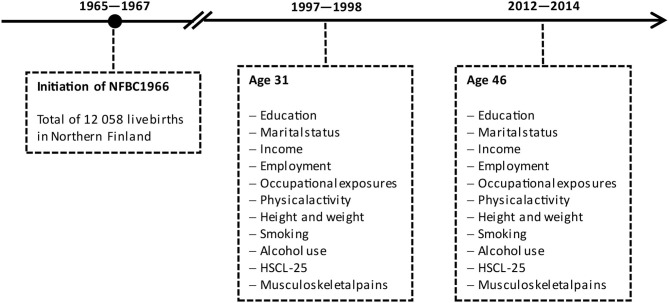
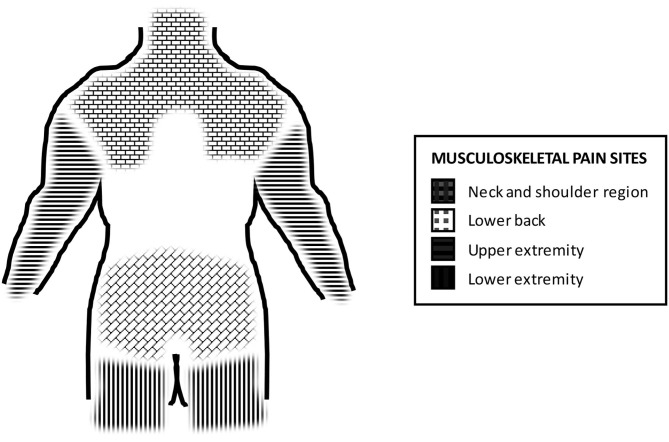
Multisite pain is commonly chronic and often lacks its initial role as a potential tissue damage signal. Chronic pain among working-age individuals is a risk for disability and imposes a major burden on health care systems and society. As effective treatments for chronic pain are largely lacking, better identification of the factors associated with pain over working years is needed. Members of the Northern Finland Birth Cohort 1966 participated in data collection at the ages of 31 ( = 4,028) and 46 ( = 3,429). Using these two time points, we performed a multivariable analysis of the association of socioeconomic, occupational, psychological and lifestyle factors (i.e., low education, living alone, low household income, unemployment, occupational physical exposures [hard physical labor, leaning forward, back twisting, constant moving, lifting loads of ≥ 1 kg], physical inactivity, regular smoking, regular drinking, overweight, and psychiatric symptoms) with the number of musculoskeletal pain sites (i.e., upper extremity, lower extremity, lower back, and the neck-shoulder region; totalling 0-4 pain sites). The data were analyzed using generalized estimating equations. At the age of 31, multisite pain was reported by 72.5% of men and 78.6% of women. At the age of 46, the prevalence of multisite pain was 75.7% among men and 82.7% among women. Among men, the number of pain sites was positively associated with age (rate ratio 1.05, 95% confidence interval 1.01-1.08), low household income (1.05, 1.01-1.08), unemployment (1.13, 1.06-1.19), any occupational exposure (1.17, 1.12-1.22), regular smoking (1.06, 1.02-1.11), and psychiatric symptoms (1.21, 1.17-1.26). Among women, the number of pain sites was positively associated with age (1.06, 1.04-1.10), unemployment (1.10, 1.05-1.15), any occupational exposure (1.10, 1.06-1.13), regular smoking (1.06, 1.02-1.10), overweight (1.08, 1.05-1.11), and psychiatric symptoms (1.19, 1.15-1.22); living alone was negatively associated with the number of pain sites (0.95, 0.91-0.99). Of the studied predictors, psychiatric symptoms, occupational physical exposures and unemployment were most strongly associated with multisite pain among both sexes. The results of this study deepen the understanding of the underlying factors of and comorbidities behind multisite pain, and help develop pain relief and rehabilitation strategies for working-age individuals with multisite pain.
多部位疼痛通常为慢性疼痛,且常常缺乏作为潜在组织损伤信号的作用。在处于工作年龄段的人群中,慢性疼痛是残疾的一个风险因素,并给医疗保健系统和社会带来了重大负担。由于缺乏有效的慢性疼痛治疗方法,因此需要更好地确定与工作年限相关的疼痛相关因素。
芬兰北部出生队列 1966 年的参与者分别在 31 岁(=4028)和 46 岁(=3429)时参加了数据收集。利用这两个时间点,我们对社会经济、职业、心理和生活方式因素(即低教育水平、独居、低家庭收入、失业、职业体力劳动暴露[体力劳动、前倾、扭背、持续移动、举重物≥1kg]、缺乏体力活动、经常吸烟、经常饮酒、超重和精神症状)与肌肉骨骼疼痛部位数量(即上肢、下肢、下背部和颈部-肩部区域;共计 0-4 个疼痛部位)之间的关联进行了多变量分析。使用广义估计方程对数据进行了分析。
在 31 岁时,72.5%的男性和 78.6%的女性报告有多部位疼痛。在 46 岁时,男性多部位疼痛的患病率为 75.7%,女性为 82.7%。在男性中,疼痛部位的数量与年龄呈正相关(比率比 1.05,95%置信区间 1.01-1.08)、低家庭收入(1.05,1.01-1.08)、失业(1.13,1.06-1.19)、任何职业暴露(1.17,1.12-1.22)、经常吸烟(1.06,1.02-1.11)和精神症状(1.21,1.17-1.26)。在女性中,疼痛部位的数量与年龄呈正相关(1.06,1.04-1.10)、失业(1.10,1.05-1.15)、任何职业暴露(1.10,1.06-1.13)、经常吸烟(1.06,1.02-1.10)、超重(1.08,1.05-1.11)和精神症状(1.19,1.15-1.22);独居与疼痛部位数量呈负相关(0.95,0.91-0.99)。在所研究的预测因素中,精神症状、职业体力劳动暴露和失业与两性的多部位疼痛关系最为密切。这项研究的结果加深了对多部位疼痛潜在因素和共病的理解,并有助于为多部位疼痛的工作年龄段人群制定缓解疼痛和康复策略。