
使用机器学习算法对人干细胞衍生胰岛类器官移植进行3D磁粒子成像
3D Magnetic Particle Imaging of Human Stem Cell-Derived Islet Organoid Transplantation Using a Machine Learning Algorithm.
作者信息
Sun Aixia, Hayat Hasaan, Liu Sihai, Tull Eliah, Bishop Jack Owen, Dwan Bennett Francis, Gudi Mithil, Talebloo Nazanin, Dizon James Raynard, Li Wen, Gaudet Jeffery, Alessio Adam, Aguirre Aitor, Wang Ping
机构信息
Precision Health Program, Michigan State University, East Lansing, MI, United States.
Department of Radiology, College of Human Medicine, Michigan State University, East Lansing, MI, United States.
出版信息
Front Cell Dev Biol. 2021 Aug 12;9:704483. doi: 10.3389/fcell.2021.704483. eCollection 2021.
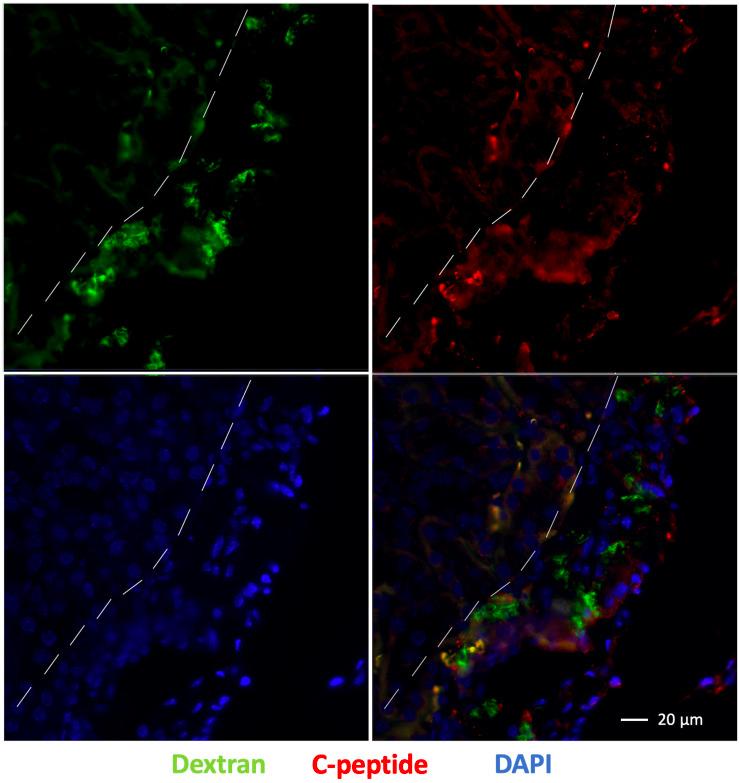
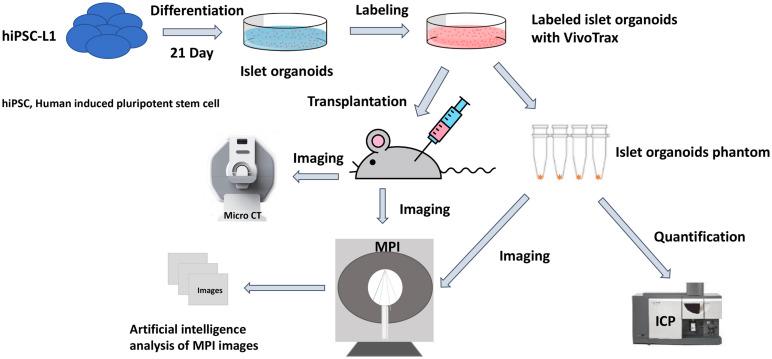
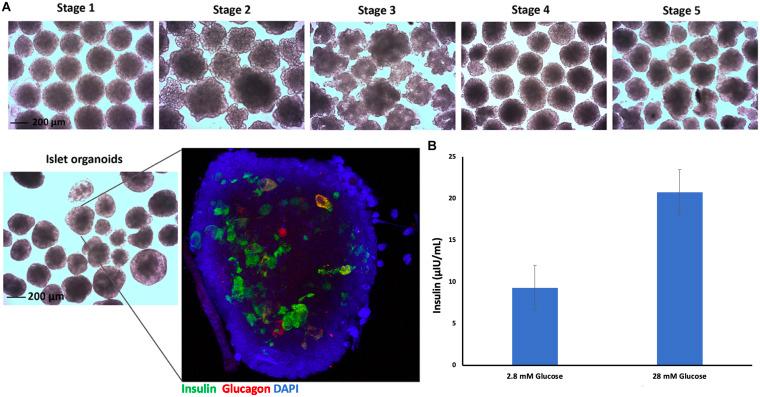
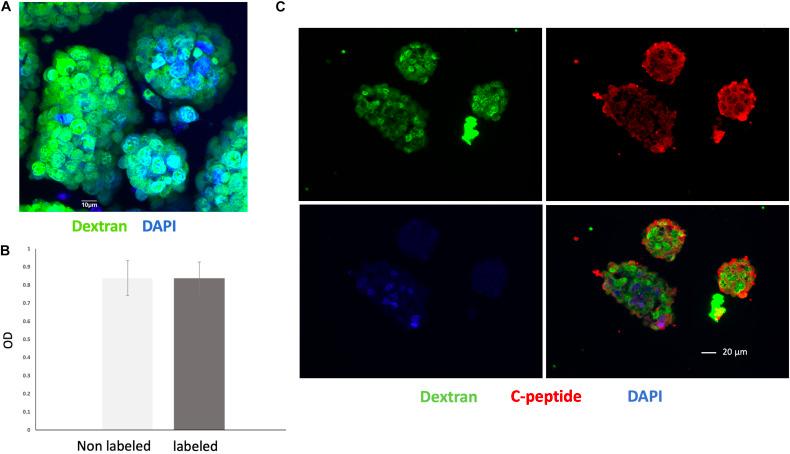
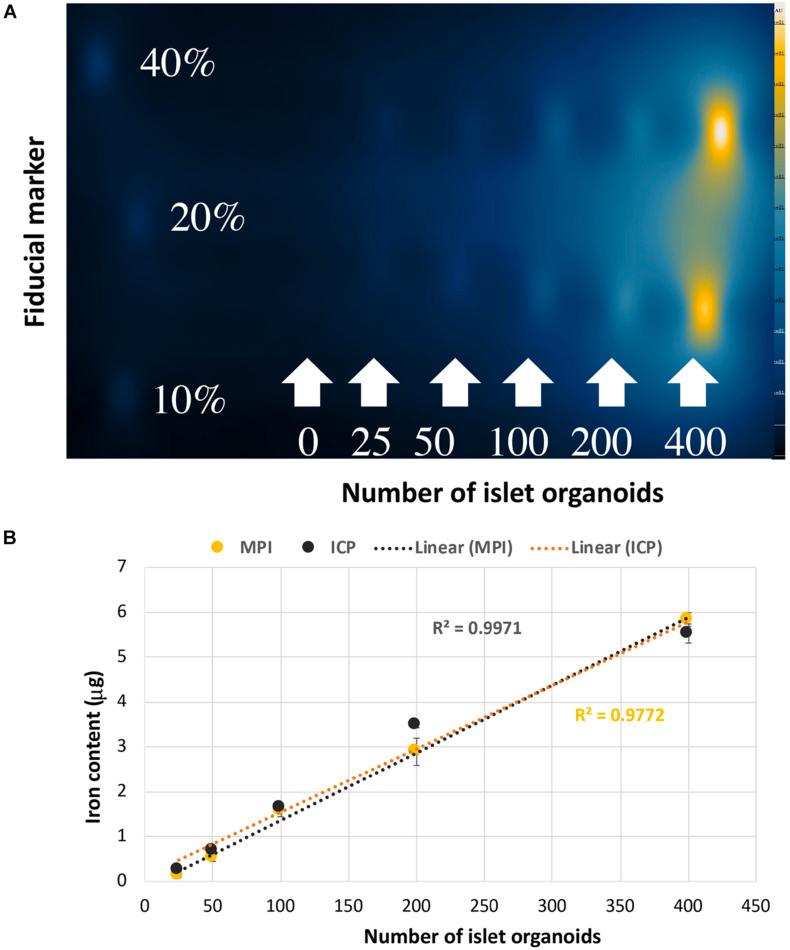
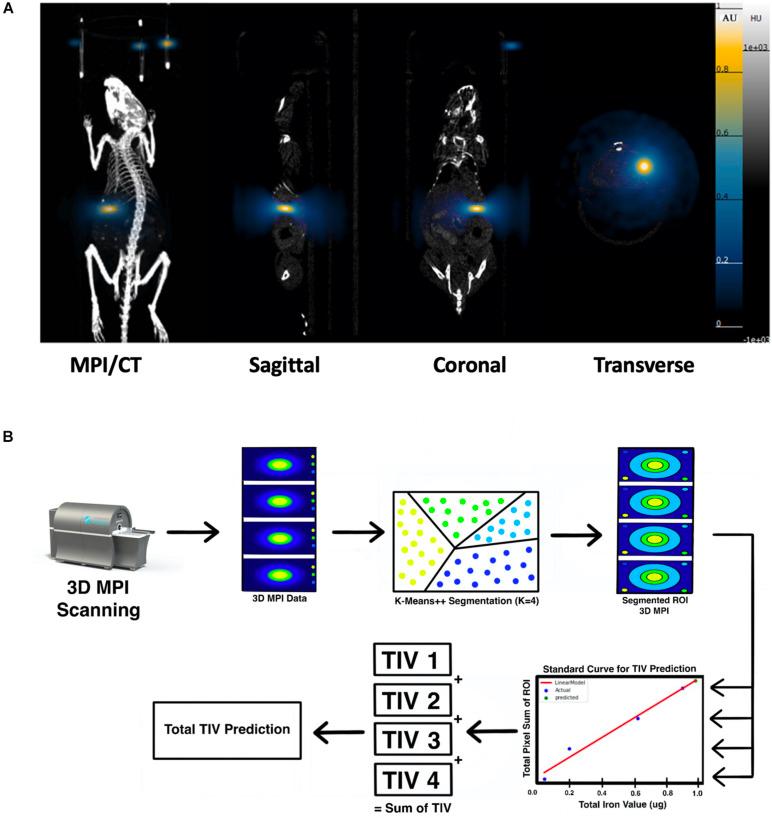
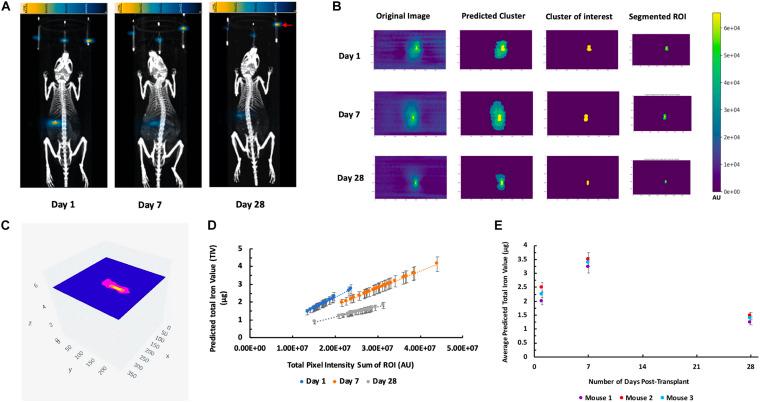
Stem cell-derived islet organoids constitute a promising treatment of type 1 diabetes. A major hurdle in the field is the lack of appropriate method to determine graft outcome. Here, we investigate the feasibility of tracking of transplanted stem cell-derived islet organoids using magnetic particle imaging (MPI) in a mouse model. Human induced pluripotent stem cells-L1 were differentiated to islet organoids and labeled with superparamagnetic iron oxide nanoparticles. The phantoms comprising of different numbers of labeled islet organoids were imaged using an MPI system. Labeled islet organoids were transplanted into NOD/scid mice under the left kidney capsule and were then scanned using 3D MPI at 1, 7, and 28 days post transplantation. Quantitative assessment of the islet organoids was performed using the ++ algorithm analysis of 3D MPI. The left kidney was collected and processed for immunofluorescence staining of C-peptide and dextran. Islet organoids expressed islet cell markers including insulin and glucagon. Image analysis of labeled islet organoids phantoms revealed a direct linear correlation between the iron content and the number of islet organoids. The ++ algorithm showed that during the course of the study the signal from labeled islet organoids under the left kidney capsule decreased. Immunofluorescence staining of the kidney sections showed the presence of islet organoid grafts as confirmed by double staining for dextran and C-peptide. This study demonstrates that MPI with machine learning algorithm analysis can monitor islet organoids grafts labeled with super-paramagnetic iron oxide nanoparticles and provide quantitative information of their presence .
干细胞来源的胰岛类器官是1型糖尿病一种很有前景的治疗方法。该领域的一个主要障碍是缺乏确定移植结果的合适方法。在此,我们研究了在小鼠模型中使用磁粒子成像(MPI)追踪移植的干细胞来源的胰岛类器官的可行性。将人诱导多能干细胞-L1分化为胰岛类器官,并用超顺磁性氧化铁纳米颗粒进行标记。使用MPI系统对包含不同数量标记胰岛类器官的模型进行成像。将标记的胰岛类器官移植到NOD/scid小鼠左肾包膜下,然后在移植后1天、7天和28天使用3D MPI进行扫描。使用3D MPI的++算法分析对胰岛类器官进行定量评估。收集左肾并进行C肽和葡聚糖的免疫荧光染色处理。胰岛类器官表达包括胰岛素和胰高血糖素在内的胰岛细胞标志物。对标记的胰岛类器官模型的图像分析显示铁含量与胰岛类器官数量之间存在直接线性关系。++算法显示,在研究过程中,左肾包膜下标记的胰岛类器官的信号减弱。肾切片的免疫荧光染色显示存在胰岛类器官移植物,葡聚糖和C肽双重染色证实了这一点。这项研究表明,结合机器学习算法分析的MPI可以监测用超顺磁性氧化铁纳米颗粒标记的胰岛类器官移植物,并提供其存在的定量信息。
 Zotero 插件