Sun Xu, Andoh Eugenia Ama, Yu Hao
Department of Industrial Engineering, UiT The Arctic University of Norway, Lodve Langesgate 2, Narvik 8514, Norway.
Transp Res Interdiscip Perspect. 2021 Sep;11:100453. doi: 10.1016/j.trip.2021.100453. Epub 2021 Aug 24.
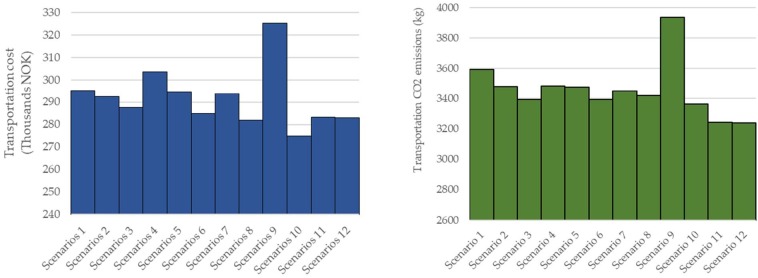
Since December 2020, the vaccines from several manufacturers, e.g., Pfizer/BioNTech, Moderna, etc., have been approved for mass vaccination to control the COVID-19 pandemic, which has caused more than 100 million infections and 2.4 million deaths. These vaccines are produced and transported in large quantities to suffice the needs of several countries. Before arriving at the end-users, the vaccines need to be stored at extremely low temperatures and distributed through reliable cold chain logistics networks. Thus, the timely and cost-effective distribution of COVID-19 vaccines via cold chain logistics has become a complex operational challenge. In this paper, we develop a simulation-based approach combining both route optimization and dynamic simulation to improve the logistics performance for COVID-19 vaccine distribution. A state-of-the-art simulation package called anyLogistix is used to perform a real-world case study in Norway. With the data of periodic vaccine demands, customer and warehouse locations, vehicle-related costs and emissions, and expected service levels, implications are obtained based on the analysis of several scenarios. Our experimental results reveal that the service level, cost-effectiveness, environmental performance, and equity of a cold chain vaccine logistics system can be significantly influenced by the fleet size, the fleet composition, the type of vehicle used, and the route optimization. Thus, these factors need to be holistically considered in the planning of an effective COVID-19 vaccine distribution system.
自2020年12月以来,辉瑞/生物科技公司、莫德纳公司等几家制造商生产的疫苗已获批用于大规模接种,以控制新冠疫情,该疫情已导致超过1亿人感染和240万人死亡。这些疫苗被大量生产和运输,以满足多个国家的需求。在到达最终用户之前,疫苗需要在极低温度下储存,并通过可靠的冷链物流网络进行分发。因此,通过冷链物流及时且经济高效地分发新冠疫苗已成为一项复杂的运营挑战。在本文中,我们开发了一种基于模拟的方法,将路线优化和动态模拟相结合,以提高新冠疫苗分发的物流绩效。我们使用一个名为anyLogistix的先进模拟软件包在挪威进行了一个实际案例研究。根据定期疫苗需求、客户和仓库位置、车辆相关成本和排放以及预期服务水平的数据,通过对几种情景的分析得出了相关结论。我们的实验结果表明,冷链疫苗物流系统的服务水平、成本效益、环境绩效和公平性会受到车队规模、车队构成、所用车辆类型和路线优化的显著影响。因此,在规划有效的新冠疫苗分发系统时,需要全面考虑这些因素。