Department of Integrative Biology, University of California at Berkeley, Berkeley, CA 94720, USA.
Graduate Group in Science and Mathematics Education (SESAME), University of California at Berkeley, Berkeley, CA 94720, USA.
Integr Comp Biol. 2021 Nov 17;61(5):1966-1980. doi: 10.1093/icb/icab187.
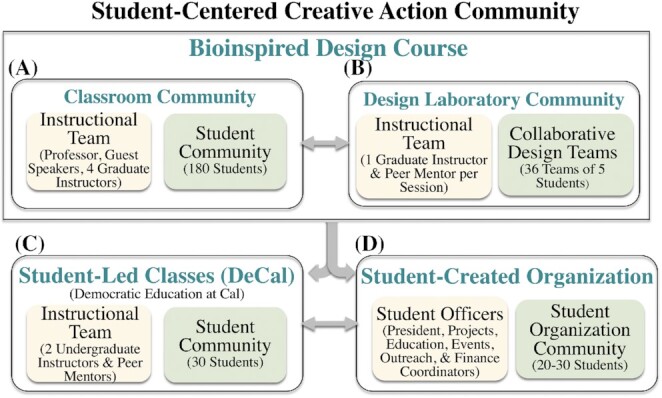
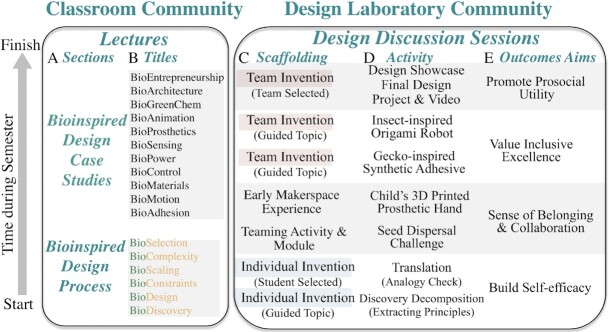
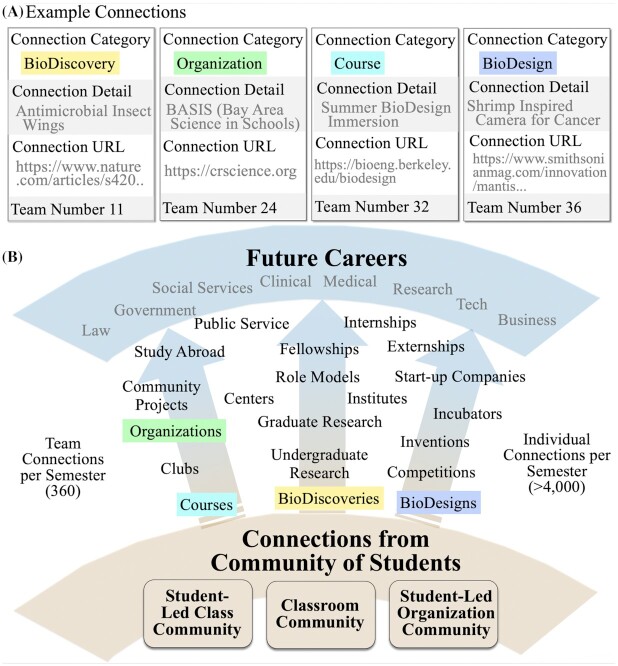
The goal of our Eyes Toward Tomorrow Program is to enrich the future workforce with STEM by providing students with an early, inspirational, interdisciplinary experience fostering inclusive excellence. We attempt to open the eyes of students who never realized how much their voice is urgently needed by providing an opportunity for involvement, imagination, invention, and innovation. Students see how what they are learning, designing, and building matters to their own life, community, and society. Our program embodies convergence by obliterating artificially created, disciplinary boundaries to go far beyond STEM or even STEAM by including artists, designers, social scientists, and entrepreneurs collaborating in diverse teams using scientific discoveries to create inventions that could shape our future. Our program connects two recent revolutions by amplifying Bioinspired Design with the Maker Movement and its democratizing effects empowering anyone to innovate and change the world. Our course is founded in original discovery. We explain the process of biological discovery and the importance of scaling, constraints, and complexity in selecting systems for bioinspired design. By spotlighting scientific writing and publishing, students become more science literate, learn how to decompose a biology research paper, extract the principles, and then propose a novel design by analogy. Using careful, early scaffolding of individual design efforts, students build the confidence to interact in teams. Team building exercises increase self-efficacy and reveal the advantages of a diverse set of minds. Final team video and poster project designs are presented in a public showcase. Our program forms a student-centered creative action community comprised of a large-scale course, student-led classes, and a student-created university organization. The program structure facilitates a community of learners that shifts the students' role from passive knowledge recipients to active co-constructors of knowledge being responsible for their own learning, discovery, and inventions. Students build their own shared database of discoveries, classes, organizations, research openings, internships, and public service options. Students find next step opportunities so they can see future careers. Description of our program here provides the necessary context for our future publications on assessment that examine 21st century skills, persistence in STEM, and creativity.
我们的“明日之眼”项目旨在通过为学生提供早期的、激励性的跨学科体验,培养包容性卓越,从而用 STEM 丰富未来的劳动力。我们试图通过提供参与、想象、发明和创新的机会,让那些从未意识到自己的声音是多么迫切需要的学生睁开眼睛。学生们看到了他们所学、所设计和所建造的东西如何与他们自己的生活、社区和社会息息相关。我们的项目通过消除人为创造的、学科之间的界限来体现融合,通过让艺术家、设计师、社会科学家和企业家在不同的团队中合作,利用科学发现创造可能塑造我们未来的发明,从而远远超越 STEM 甚至 STEAM。我们的项目通过放大仿生设计与创客运动及其赋权给任何人进行创新和改变世界的民主化效应来连接最近的两次革命。我们的课程建立在原创发现的基础上。我们解释生物发现的过程以及在选择仿生设计系统时进行缩放、约束和复杂性的重要性。通过突出科学写作和出版,学生们变得更具科学素养,学会如何分解生物学研究论文,提取原理,然后通过类比提出新的设计。通过对个人设计工作的早期精心构建,学生们建立起在团队中互动的信心。团队建设练习提高了自我效能感,并揭示了多元化思维的优势。最终的团队视频和海报项目设计在公开展示中呈现。我们的项目形成了一个以学生为中心的创意行动社区,由一个大规模的课程、学生主导的课程和一个学生创建的大学组织组成。项目结构促进了学习者社区的形成,将学生的角色从被动的知识接受者转变为知识的积极共同构建者,对自己的学习、发现和发明负责。学生们构建自己的共享发现、课程、组织、研究机会、实习和公共服务选项数据库。学生们寻找下一步的机会,以便能够看到未来的职业道路。对我们未来关于评估的出版物的描述提供了必要的背景,这些出版物考察了 21 世纪技能、在 STEM 中的坚持和创造力。