Department of Computer Science, Masdar Institute, Khalifa University of Science and Technology, Abu Dhabi, P.O. Box 54224, UAE.
Computer Science, New York University, Abu Dhabi, P.O. Box 129188, UAE.
Nat Commun. 2018 Dec 4;9(1):5163. doi: 10.1038/s41467-018-07634-8.
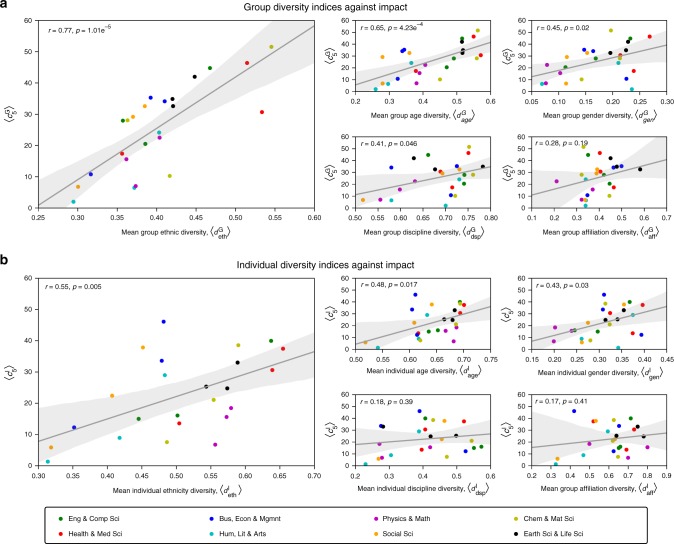
Inspired by the social and economic benefits of diversity, we analyze over 9 million papers and 6 million scientists to study the relationship between research impact and five classes of diversity: ethnicity, discipline, gender, affiliation, and academic age. Using randomized baseline models, we establish the presence of homophily in ethnicity, gender and affiliation. We then study the effect of diversity on scientific impact, as reflected in citations. Remarkably, of the classes considered, ethnic diversity had the strongest correlation with scientific impact. To further isolate the effects of ethnic diversity, we used randomized baseline models and again found a clear link between diversity and impact. To further support these findings, we use coarsened exact matching to compare the scientific impact of ethnically diverse papers and scientists with closely-matched control groups. Here, we find that ethnic diversity resulted in an impact gain of 10.63% for papers, and 47.67% for scientists.
受多样性带来的社会和经济效益的启发,我们分析了超过 900 万篇论文和 600 万科研人员的数据,以研究研究影响力与五类多样性(族裔、学科、性别、隶属关系和学术年龄)之间的关系。我们使用随机基线模型,确定了族裔、性别和隶属关系方面的同质性的存在。然后,我们研究了多样性对科学影响力的影响,这反映在引用中。值得注意的是,在所考虑的类别中,族裔多样性与科学影响力的相关性最强。为了进一步分离族裔多样性的影响,我们再次使用随机基线模型,发现多样性与影响力之间存在明显联系。为了进一步支持这些发现,我们使用粗化精确匹配来比较族裔多样化的论文和科学家与匹配对照组的科学影响力。在这里,我们发现族裔多样性使论文的影响力提高了 10.63%,使科学家的影响力提高了 47.67%。