Department of Preventive Medicine and Biostatics, Uniformed Services University, Bethesda, Maryland.
Henry M. Jackson Foundation, Bethesda, Maryland.
Am J Trop Med Hyg. 2021 Aug 30;105(4):896-902. doi: 10.4269/ajtmh.20-1318.
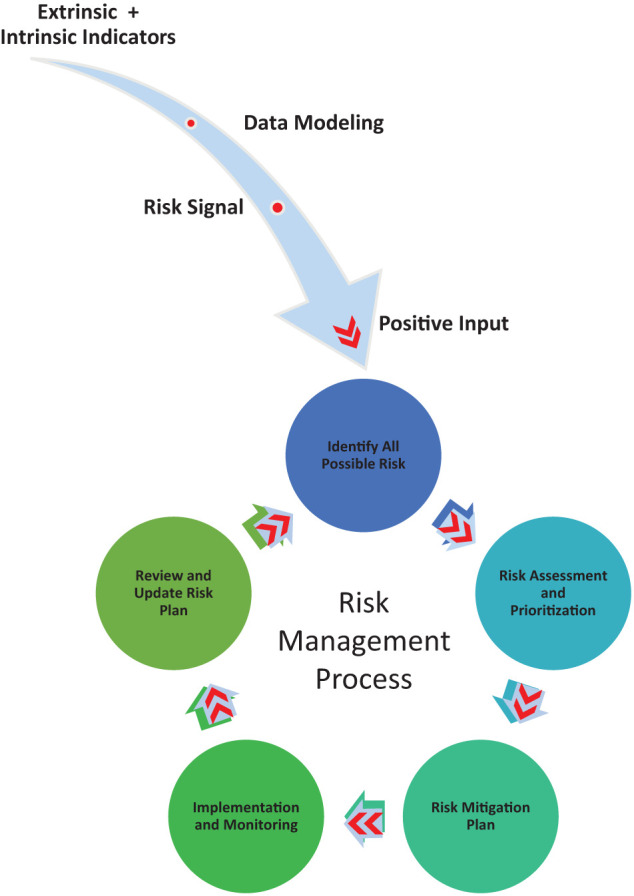
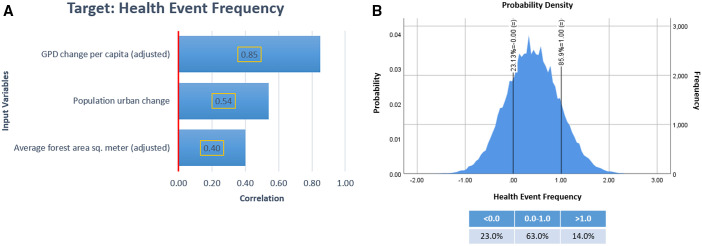
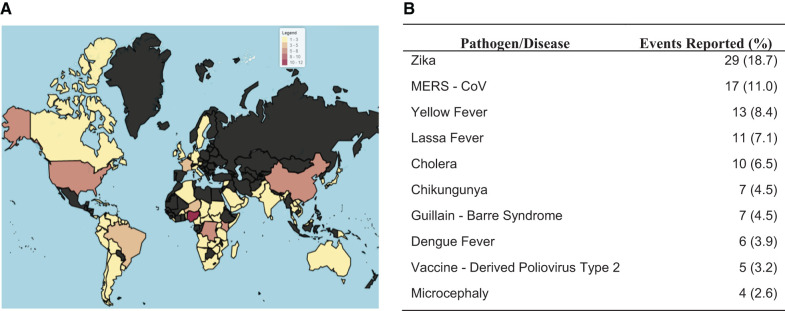
Health events emerge from host, community, environment, and pathogen factors-forecasting epidemics is a complex task. We describe an exploratory analysis to identify economic risk factors that could aid epidemic risk assessment. A line list was constructed using the World Health Organization Disease Outbreak News (2016-2018) and economic indicators from the World Bank. Poisson regression employing forward imputations was used to establish relationships with the frequency with which countries reported public health events. Economic indicators demonstrated strong performance appropriate for further assessment in surveillance programming. In our analysis, three economic indicators were significantly associated to event reporting: how much the country's urban population changed, its average forest area, and a novel economic indicator we developed that assessed how much the gross domestic product changed per capita. Other economic indicators performed less well: changes in total, female, urban, and rural population sizes; population density; net migration; change in per cent forest area; total forest area; and another novel indicator, change in percent of trade as a fraction of the total economy. We then undertook a further analysis of the start of the current COVID-19 pandemic that revealed similar associations, but confounding by global disease burden is likely. Continued development of forecasting approaches capturing information relevant to whole-of-society factors (e.g., economic factors as assessed in our study) could improve the risk management process through earlier hazard identification and inform strategic decision processes in multisectoral strategies to preventing, detecting, and responding to pandemic-threat events.
健康事件源自宿主、社区、环境和病原体因素——预测疫情是一项复杂的任务。我们描述了一项探索性分析,以确定可能有助于疫情风险评估的经济风险因素。使用世界卫生组织疾病暴发新闻(2016-2018 年)和世界银行的经济指标构建了一个病例列表。采用向前插补的泊松回归来建立与各国报告公共卫生事件频率的关系。经济指标表现出良好的性能,适合在监测规划中进一步评估。在我们的分析中,有三个经济指标与事件报告显著相关:国家城市人口变化量、平均森林面积以及我们开发的一个新经济指标,评估人均国内生产总值变化量。其他经济指标表现不佳:总人口、女性人口、城市人口和农村人口规模的变化;人口密度;净移民;森林面积百分比变化;森林总面积;以及另一个新指标,贸易占经济总量的百分比变化。然后,我们对当前 COVID-19 大流行的开始进行了进一步分析,结果显示出类似的关联,但可能存在全球疾病负担的混杂因素。通过更早地识别危害并为预防、检测和应对大流行威胁事件的多部门战略中的战略决策过程提供信息,继续开发捕捉与整个社会因素相关的预测方法(例如,我们研究中评估的经济因素),可以改善风险管理过程。