Tahmo Nancy B, Wirsiy Frankline Sevidzem, Nnamdi Dum-Buo, Tongo Marcel, Lawler James V, Broadhurst M Jana, Wondji Charles S, Brett-Major David M
University of Nebraska Medical Center, Omaha, Nebraska, USA.
Africa Centres for Disease Control and Prevention (Africa CDC), Addis Ababa, Ethiopia.
IJID Reg. 2022 Dec 17;7:84-109. doi: 10.1016/j.ijregi.2022.12.001. eCollection 2023 Jun.
Population factors such as urbanization, socio-economic, and environmental factors are driving forces for emerging/re-emerging zoonotic diseases in Cameroon. To inform preparedness and prioritization efforts, this study mapped out epidemiological data (including prevalence) of zoonotic diseases occurring in Cameroon between 2000 and 2022 by demographic factors.
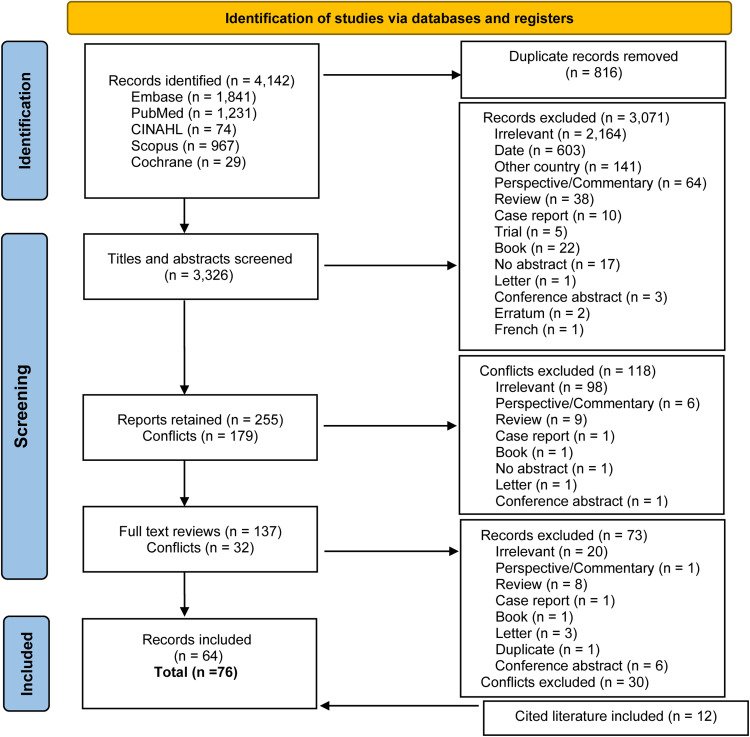
Following the PRISMA guidelines, a protocol was registered in the PROSPERO database (CRD42022333059). Independent reviewers searched the PubMed, Embase, CINAHL, Cochrane, and Scopus databases on May 30, 2022 for relevant articles; duplicates were removed, and the titles, abstracts, and full texts were screened to identify eligible articles.
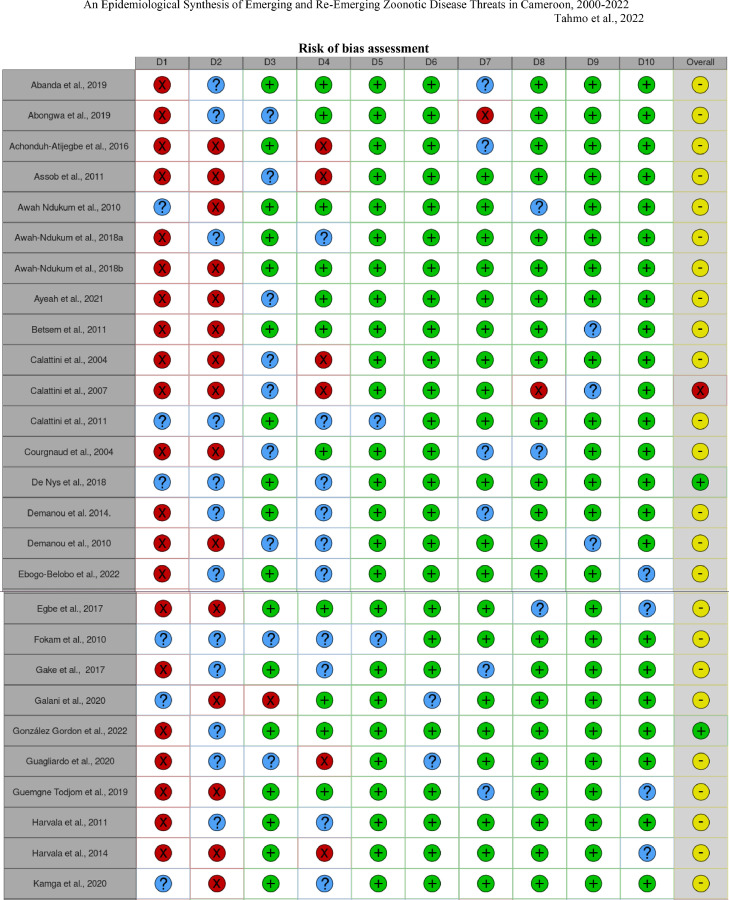
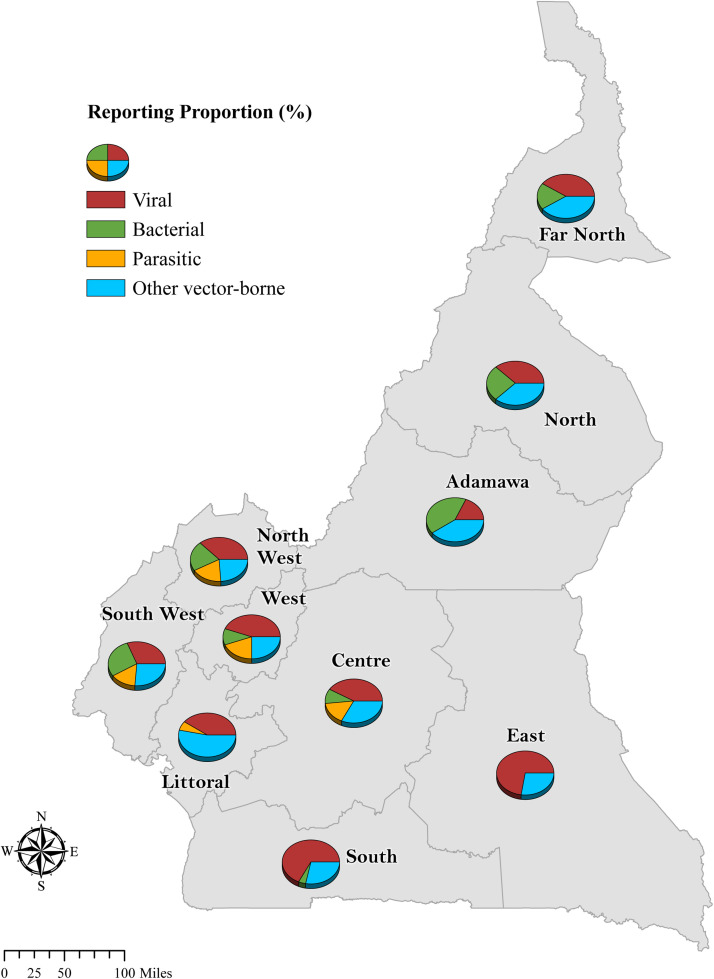
Out of 4142 articles identified, 64 eligible articles were retrieved in the database search and an additional 12 from the cited literature ( = 76). Thirty-five unique zoonoses (viral, bacterial, and parasitic) were indexed, including Cameroon priority zoonoses: anthrax, bovine tuberculosis, Ebola and Marburg virus disease, highly pathogenic avian influenza, and rabies. The number of studies varied by region, ranging from 12 in the Far North to 32 in the Centre Region. The most reported were as follows: brucellosis (random-effects pooled estimate proportion (effect size), ES 0.05%, 95% confidence interval (CI) 0.03-0.07; = 6), dengue (ES 0.13%, 95% CI 0.06-0.22; = 12), avian and swine influenza virus (ES 0.10%, 95% CI 0.04-0.20; = 8), and toxoplasmosis (ES 0.49%, 95% CI 0.35-0.63; = 11), although values were greater than 75%, thus there was high inter-study heterogeneity ( < 0.01).
This understanding of the distribution of emerging and re-emerging zoonotic threats in Cameroon is vital to effective preventive and resource prioritization measures.
城市化、社会经济和环境等人口因素是喀麦隆新出现/再次出现的人畜共患疾病的驱动因素。为了为防范和优先排序工作提供信息,本研究按人口因素梳理了2000年至2022年期间喀麦隆发生的人畜共患疾病的流行病学数据(包括患病率)。
遵循PRISMA指南,在PROSPERO数据库(CRD42022333059)中登记了一项方案。2022年5月30日,独立评审人员在PubMed、Embase、CINAHL、Cochrane和Scopus数据库中搜索相关文章;去除重复项,并对标题、摘要和全文进行筛选以确定符合条件的文章。
在识别出的4142篇文章中,数据库搜索检索到64篇符合条件的文章,从引用文献中又获取了12篇(共76篇)。索引了35种独特的人畜共患病(病毒、细菌和寄生虫),包括喀麦隆的重点人畜共患病:炭疽、牛结核病、埃博拉和马尔堡病毒病、高致病性禽流感和狂犬病。研究数量因地区而异,从远北地区的12项到中部地区的32项不等。报告最多的如下:布鲁氏菌病(随机效应合并估计比例(效应大小),ES 0.05%,95%置信区间(CI)0.03 - 0.07;n = 6)、登革热(ES 0.13%,95% CI 0.06 - 0.22;n = 12)、禽流感和猪流感病毒(ES 0.10%,95% CI 0.04 - 0.20;n = 8)和弓形虫病(ES 0.49%,95% CI 0.35 - 0.63;n = 11),尽管I²值大于75%,因此研究间存在高度异质性(P < 0.01)。
了解喀麦隆新出现和再次出现的人畜共患威胁的分布情况对于有效的预防措施和资源优先排序措施至关重要。