Song Yang, Hao Dake, Jiang Huan, Huang Mingguang, Du Qingjun, Lin Yi, Liu Fei, Chen Bin
Division of Orthopaedics and Traumatology, Department of Orthopaedics, Nanfang Hospital, Southern Medical University, Guangzhou, 510515, People's Republic of China.
Division of Traumatology and Joint, Department of Orthopaedics, Shunde Hospital, Southern Medical University, Foshan, 528308, People's Republic of China.
J Inflamm Res. 2021 Aug 24;14:4079-4088. doi: 10.2147/JIR.S310831. eCollection 2021.
Post-traumatic osteoarthritis (PTOA) is an inflammatory condition that occurs following mechanical joint trauma and that results in joint degeneration. This study sought to evaluate the regulatory function of nuclear factor erythroid 2-related factor 2 (Nrf2) in a murine model of anterior cruciate ligament transection (ACLT)-induced PTOA and in an in vitro model of synoviocyte inflammation induced by LPS treatment with the goal of exploring the role of chitinase 3-like-1 (CHI3L1) in this pathogenic context.
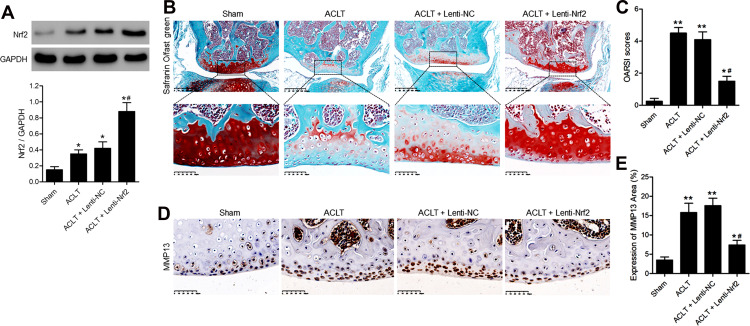
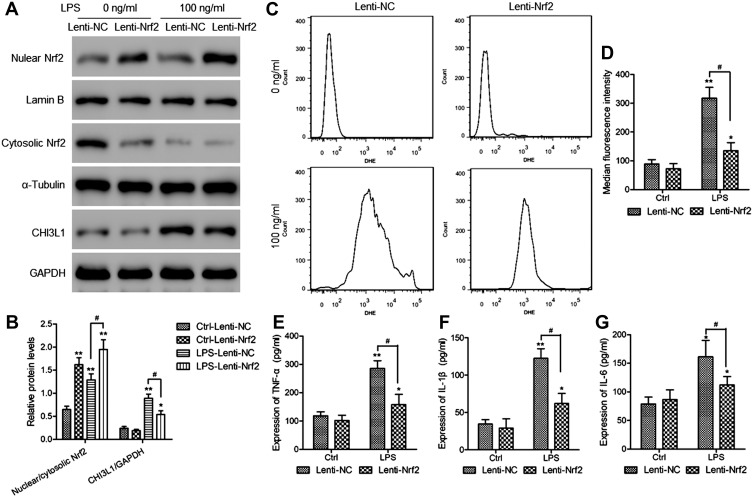
PTOA model mice were intra-articularly injected with Nrf2 overexpression lentiviral vector, and safranin O-fast green staining as well as the Osteoarthritis Research Society International (OARSI) Scoring System were used to evaluate the severity of cartilage damage. Protein expression in the synovial tissue was evaluated by Western blotting, immunohistochemical staining, and ELISA. Additionally, murine synoviocytes were infected with Nrf2 overexpression lentivirus and stimulated with LPS. The levels of inflammatory cytokines were detected by ELISA. ROS levels were measured using dihydroethidium (DHE) dye.
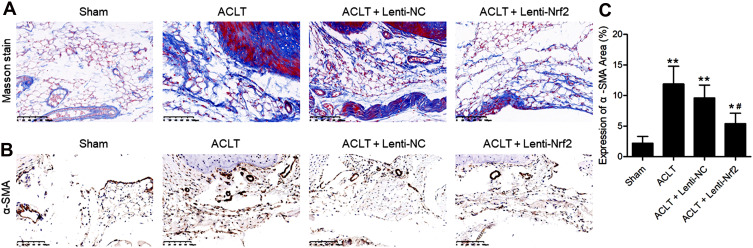
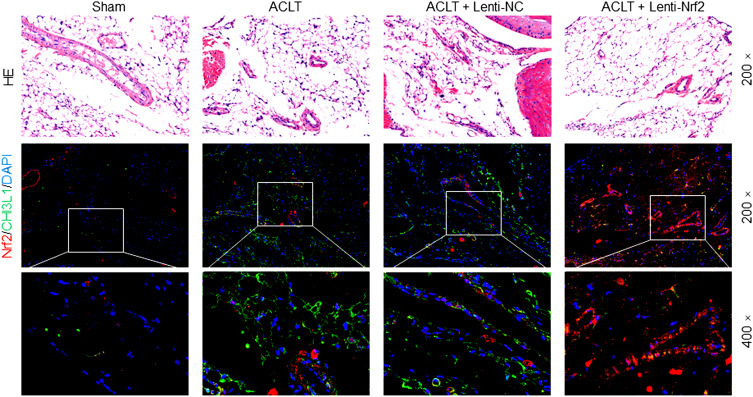
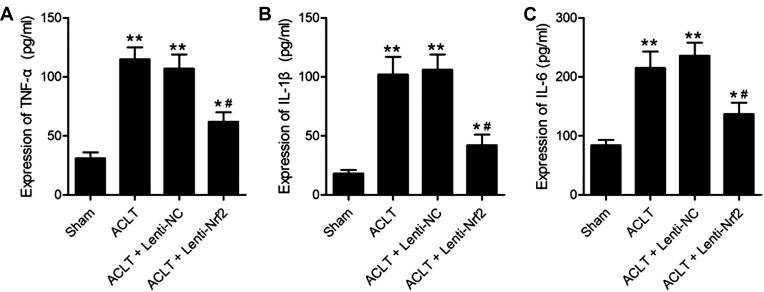
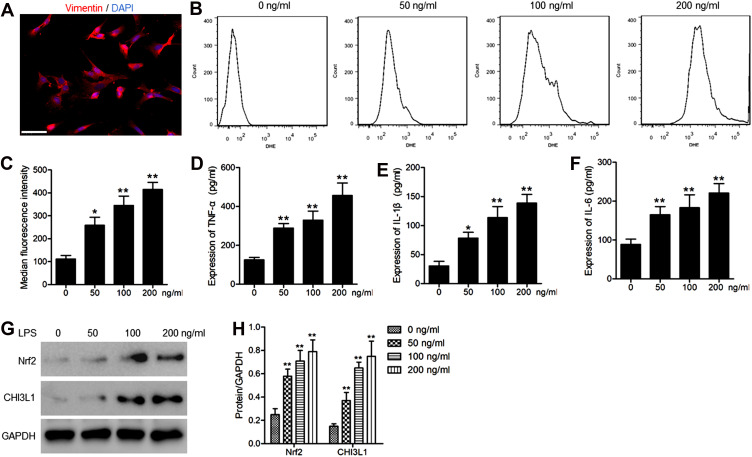
We determined that the overexpression of Nrf2 was sufficient to reduce cartilage degradation in the context of PTOA in vivo, and we observed a significant decrease in the expression of matrix metalloproteinase 13 (MMP13) in the articular cartilage of samples from mice overexpressing Nrf2 relative to control mice. Synovial CHI3L1 expression and serum TNF-α, IL-1β, and IL-6 levels were reduced in animals overexpressing this transcription factor relative to PTOA model controls. Consistent with these findings, murine synoviocytes treated with LPS exhibited dose-dependent increases in ROS, TNF-α, IL-1β, IL-6, Nrf2, and CHI3L1 levels, whereas Nrf2 overexpression was sufficient to suppress these increases.
Our data indicated that Nrf2 negatively regulates CHI3L1, suggesting that this signaling axis may regulate PTOA progression and may thus be a viable therapeutic target in individuals affected by this condition.
创伤后骨关节炎(PTOA)是一种在机械性关节创伤后发生的炎症性疾病,可导致关节退变。本研究旨在评估核因子红细胞2相关因子2(Nrf2)在前交叉韧带横断(ACLT)诱导的PTOA小鼠模型以及脂多糖(LPS)处理诱导的滑膜细胞炎症体外模型中的调节功能,以探索几丁质酶3样1(CHI3L1)在这种致病背景下的作用。
向PTOA模型小鼠关节腔内注射Nrf2过表达慢病毒载体,采用番红O-固绿染色以及国际骨关节炎研究学会(OARSI)评分系统评估软骨损伤的严重程度。通过蛋白质免疫印迹、免疫组织化学染色和酶联免疫吸附测定(ELISA)评估滑膜组织中的蛋白质表达。此外,用Nrf2过表达慢病毒感染小鼠滑膜细胞并用LPS刺激。通过ELISA检测炎性细胞因子水平。使用二氢乙锭(DHE)染料测量活性氧(ROS)水平。
我们确定,在体内PTOA背景下,Nrf2的过表达足以减少软骨降解,并且我们观察到相对于对照小鼠,过表达Nrf2的小鼠样本的关节软骨中基质金属蛋白酶13(MMP13)的表达显著降低。相对于PTOA模型对照,过表达该转录因子的动物滑膜CHI3L1表达以及血清肿瘤坏死因子-α(TNF-α)、白细胞介素-1β(IL-1β)和白细胞介素-6(IL-6)水平降低。与这些发现一致,用LPS处理的小鼠滑膜细胞ROS、TNF-α、IL-1β、IL-6、Nrf2和CHI3L1水平呈剂量依赖性增加,而过表达Nrf2足以抑制这些增加。
我们的数据表明Nrf2对CHI3L1具有负调节作用,提示该信号轴可能调节PTOA的进展,因此可能是受这种疾病影响个体的一个可行治疗靶点。