Department of Biochemistry and Molecular Biology, Medical School, Nantong University, Nantong, Jiangsu, China (mainland).
Jiangsu Key Laboratory of Neuroregeneration of Jiangsu and Ministry of Education of China, Co-Innovation Center of Neuroregeneration, Nantong University, Nantong, Jiangsu, China (mainland).
Med Sci Monit. 2021 Sep 2;27:e933084. doi: 10.12659/MSM.933084.
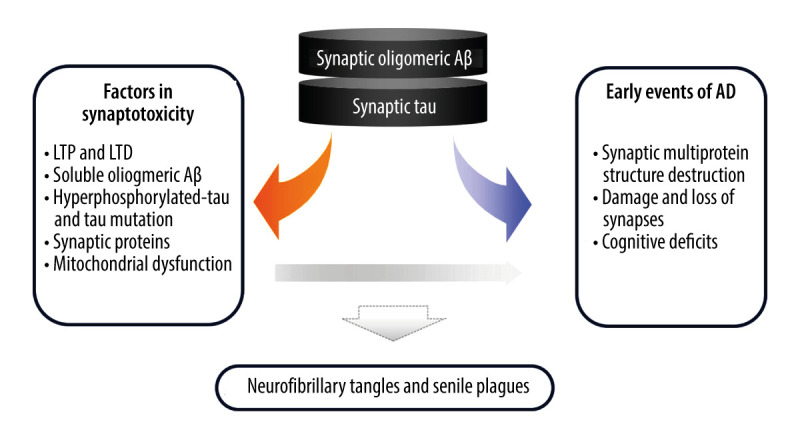
The abnormal accumulation of amyloid-b (Ab) and neurofibrillary tangles (NFTs) containing phosphorylated tau proteins are the main histopathological feature of Alzheimer's disease (AD). Synaptic damage and loss are earlier events than amyloid plaques and NFTs in AD progress and best correlate with cognitive deficits in AD patients. Soluble oligomeric Aß initiates the progression of AD and tau mediates the subsequent synaptic impairments at an early stage of AD. In this review we discuss how Ab or/and tau causes synaptic dysfunction. Ab oligomers gather at synapses and give rise to synaptic death in a variety of ways such as regulating receptors and receptor tyrosine kinases, unbalancing calcium homeostasis, and activating caspases and calcineurin. A large amount of hyperphosphorylated tau exists in the synapse of the AD brain. Aß-triggered synaptic deficits are dependent on tau. Soluble, hyperphosphorylated tau is much more correlated to cognitive decline in AD patients. Tau-targeted therapies have received more attention because the treatments targeting Aß failed in AD. Here, we also review the therapy strategies used to intervene in the very early stages of AD. Soluble hyperphosphorylated tau forms a complex with cell surface receptors, scaffold proteins, or intracellular signaling molecules to damage synaptic function. Therefore, therapeutic strategies targeting synaptic tau at the early stage of AD may ameliorating pathology in AD. This review aims to provide an update on the role of oligomeric Ab and soluble hyperphosphorylated tau in the early pathogenesis of Alzheimer's disease and to develop a new treatment strategy based on this.
淀粉样蛋白-β (Ab) 和含有磷酸化 tau 蛋白的神经原纤维缠结 (NFTs) 的异常积累是阿尔茨海默病 (AD) 的主要组织病理学特征。在 AD 进展中,突触损伤和丢失早于淀粉样斑块和 NFTs,与 AD 患者的认知缺陷相关性最好。可溶性寡聚体 Ab 引发 AD 的进展,tau 介导 AD 早期的随后突触损伤。在这篇综述中,我们讨论了 Ab 或/和 tau 如何导致突触功能障碍。Ab 寡聚体聚集在突触处,并通过多种方式引起突触死亡,例如调节受体和受体酪氨酸激酶、破坏钙稳态以及激活半胱天冬酶和钙调神经磷酸酶。大量过度磷酸化的 tau 存在于 AD 大脑的突触中。Ab 触发的突触缺陷依赖于 tau。可溶性、过度磷酸化的 tau 与 AD 患者的认知能力下降相关性更强。针对 tau 的治疗方法受到了更多关注,因为针对 Ab 的治疗方法在 AD 中失败了。在这里,我们还回顾了用于干预 AD 早期阶段的治疗策略。可溶性过度磷酸化的 tau 与细胞表面受体、支架蛋白或细胞内信号分子形成复合物,从而损害突触功能。因此,针对 AD 早期突触 tau 的治疗策略可能会改善 AD 的病理学。本综述旨在提供有关寡聚体 Ab 和可溶性过度磷酸化 tau 在阿尔茨海默病早期发病机制中的作用的最新信息,并在此基础上制定新的治疗策略。