Division of Medical Mathematics, National Institute of Mathematical Science, Daejeon, Republic of Korea.
Department of Oral and Maxillofacial Surgery, National Health Insurance Service Ilsan Hospital, Goyang, Republic of Korea.
Sci Rep. 2021 Sep 1;11(1):17509. doi: 10.1038/s41598-021-97116-7.
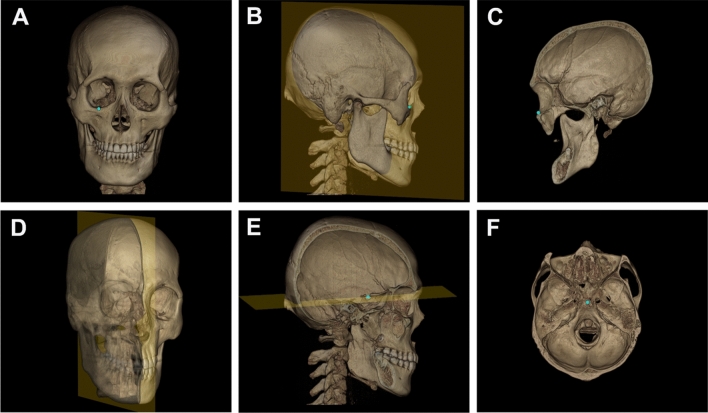
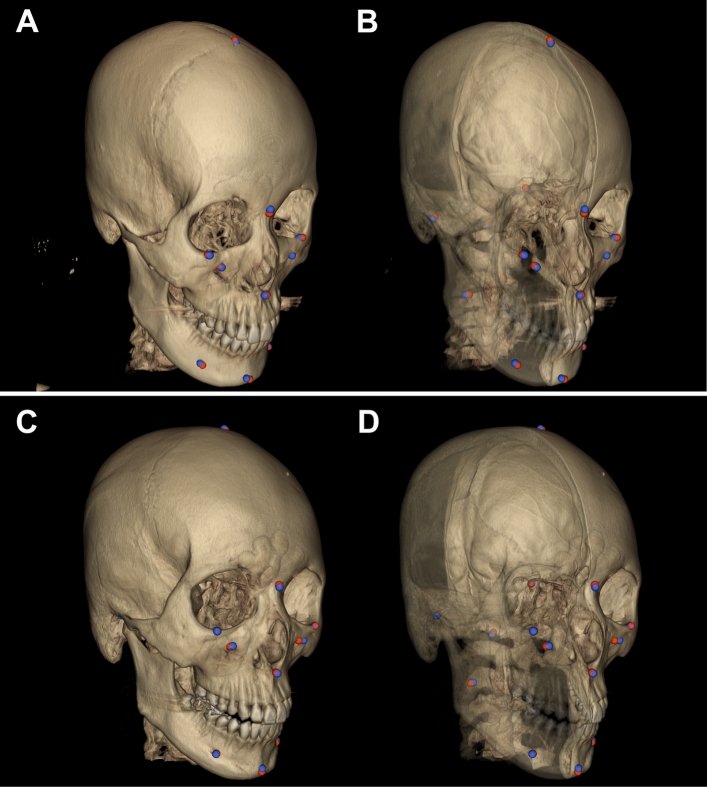
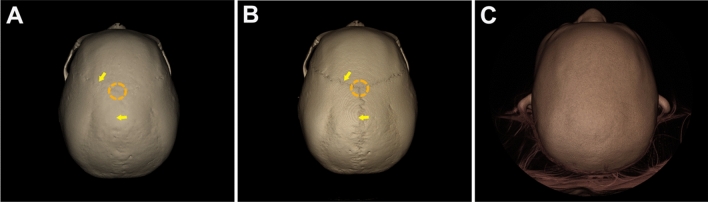
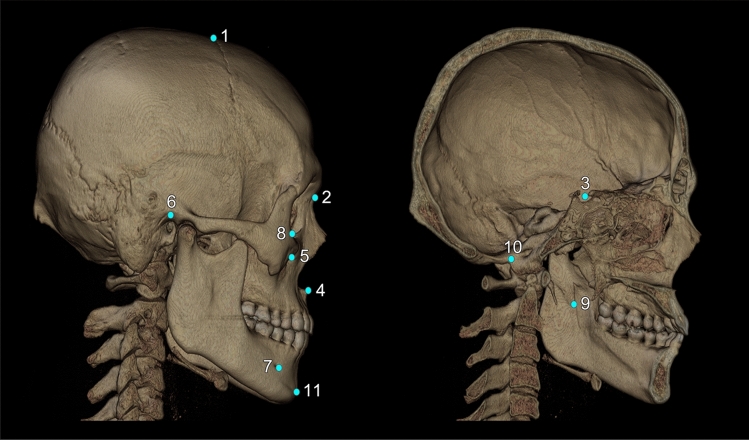
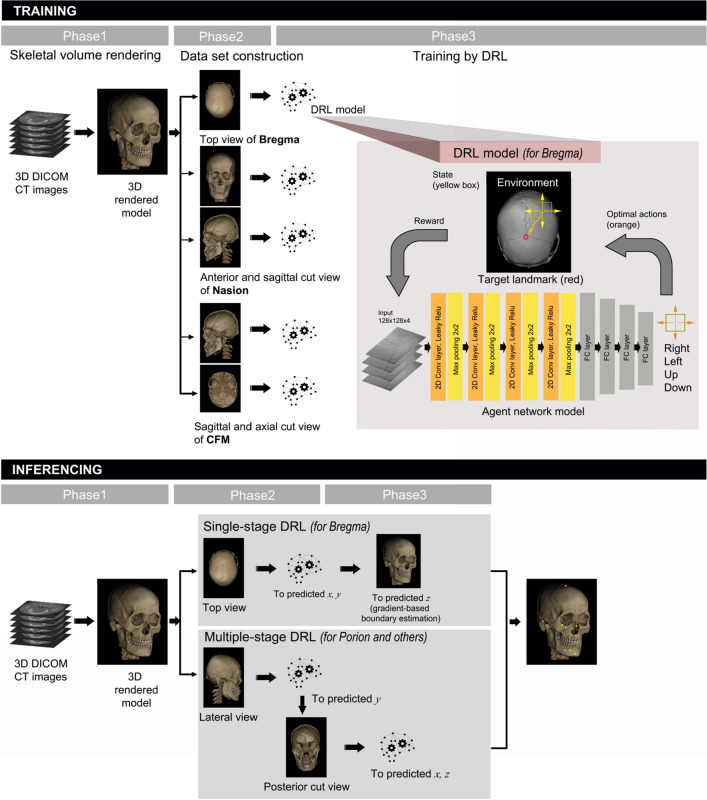
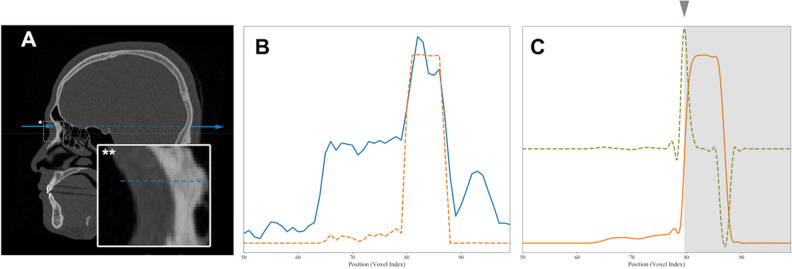
The lengthy time needed for manual landmarking has delayed the widespread adoption of three-dimensional (3D) cephalometry. We here propose an automatic 3D cephalometric annotation system based on multi-stage deep reinforcement learning (DRL) and volume-rendered imaging. This system considers geometrical characteristics of landmarks and simulates the sequential decision process underlying human professional landmarking patterns. It consists mainly of constructing an appropriate two-dimensional cutaway or 3D model view, then implementing single-stage DRL with gradient-based boundary estimation or multi-stage DRL to dictate the 3D coordinates of target landmarks. This system clearly shows sufficient detection accuracy and stability for direct clinical applications, with a low level of detection error and low inter-individual variation (1.96 ± 0.78 mm). Our system, moreover, requires no additional steps of segmentation and 3D mesh-object construction for landmark detection. We believe these system features will enable fast-track cephalometric analysis and planning and expect it to achieve greater accuracy as larger CT datasets become available for training and testing.
手动标志点标注所需的漫长时间延迟了三维(3D)头影测量的广泛采用。我们在这里提出了一种基于多阶段深度强化学习(DRL)和容积再现成像的自动 3D 头影测量标注系统。该系统考虑了标志点的几何特征,并模拟了人类专业标志点模式的顺序决策过程。它主要由构建适当的二维剖切或 3D 模型视图组成,然后使用基于梯度的边界估计或多阶段 DRL 实现单阶段 DRL,以规定目标标志点的 3D 坐标。该系统对于直接临床应用具有足够的检测准确性和稳定性,检测误差和个体间差异均较低(1.96±0.78mm)。此外,我们的系统在进行标志点检测时不需要额外的分割和 3D 网格对象构建步骤。我们相信这些系统功能将能够实现快速的头影测量分析和规划,并期望随着更多的 CT 数据集可用于训练和测试,它将实现更高的准确性。