School of Medicine Rochester Regional Health, University of Rochester, Rochester, New York, USA.
Department of Health and Medical Sciences, Swinburne University of Technology, Melbourne, Victoria, Australia.
Influenza Other Respir Viruses. 2022 Jan;16(1):79-89. doi: 10.1111/irv.12903. Epub 2021 Sep 2.
The hospitalized acute respiratory tract infection (HARTI) study used the Respiratory Intensity and Impact Questionnaire (RiiQ™) Symptom Scale, derived from FluiiQ™, to assess and compare the burden of respiratory infection symptoms for patients with influenza, respiratory syncytial virus (RSV), and human metapneumovirus (hMPV) infection, with or without core risk factors (CRF) (age ≥65; chronic heart, renal, obstructive pulmonary disease; asthma).
This was a prospective cohort study in adult patients hospitalized with acute respiratory tract infection (40 centers, 12 countries) during two consecutive influenza/RSV/hMPV seasons (2017-2019). The RiiQ™ Symptom Scale and EuroQol 5-Dimensions 5-Levels (EQ-5D-5L) were assessed by interview at two timepoints during hospitalization and at 1, 2, and 3 months post-discharge.
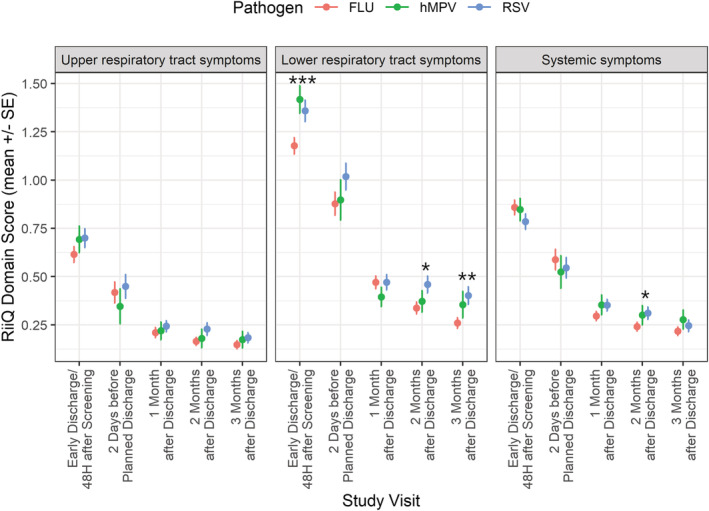
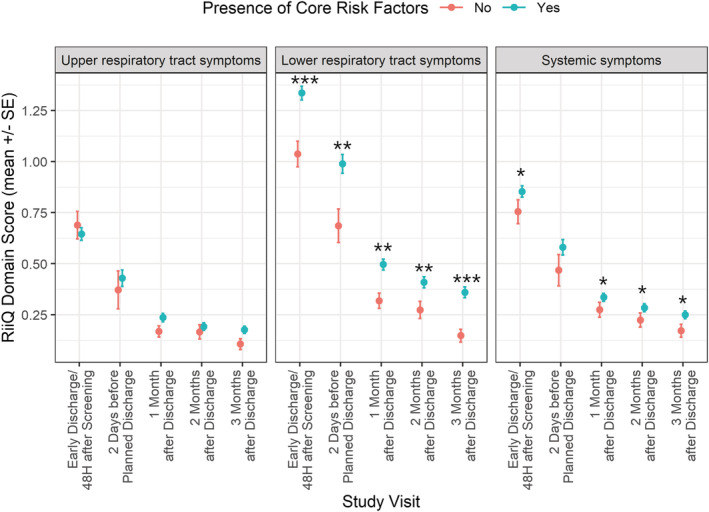
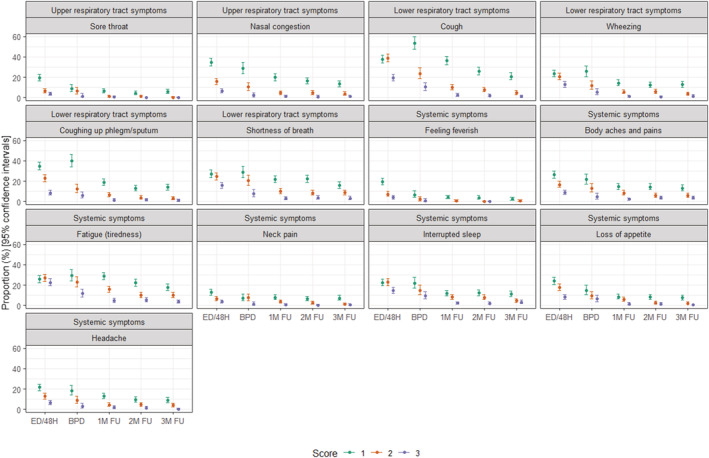
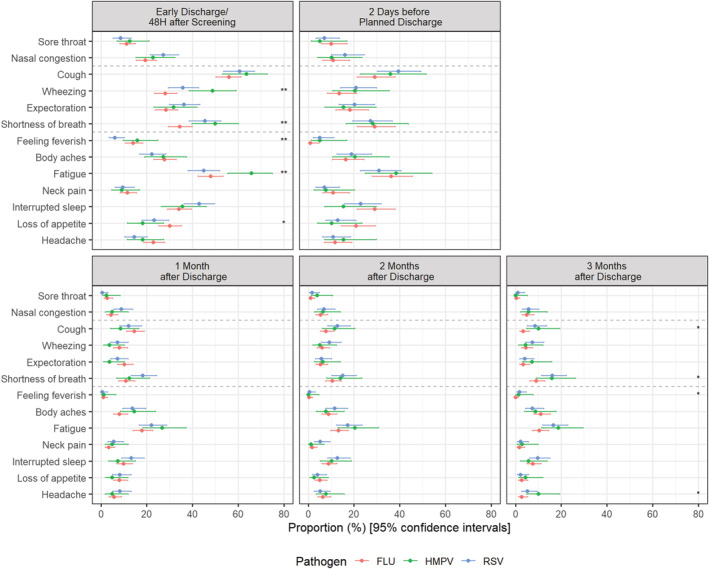
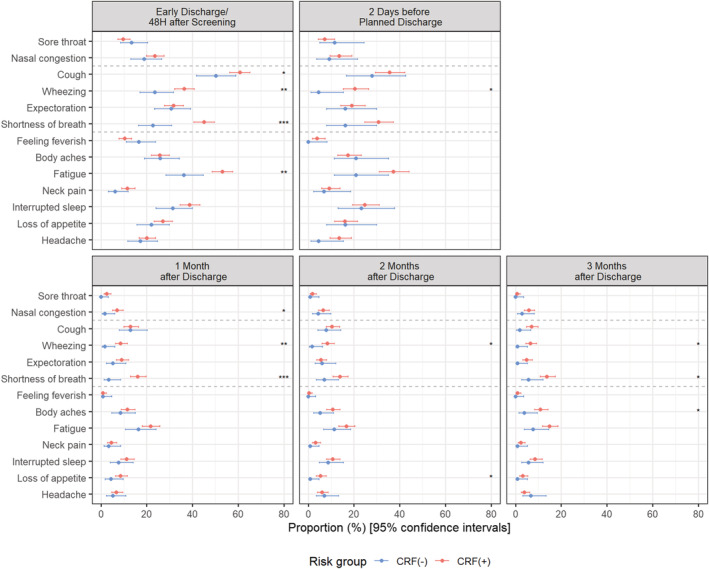
Mean lower respiratory tract (LRT) symptom scores were higher for RSV and hMPV participants compared to influenza at 48 h after enrollment/early discharge (p = 0.001) and 3 months post-discharge (p = 0.007). This was driven by LRT symptoms, including shortness of breath (SOB) (p < 0.01) and wheezing (p < 0.01) during hospitalization, and SOB (p < 0.05) and cough (p < 0.05) post-discharge. Participants with CRF reported more moderate-to-severe SOB (p < 0.05) and wheezing (p < 0.05) compared to CRF(-) participants post-discharge. EQ-5D-5L scores were moderately associated with RiiQ™ LRT and systemic symptoms domains.
Results from the HARTI study suggest that in the study population, LRT symptoms were more severe for RSV and hMPV groups and for patients with CRF. RiiQ™ Symptom Scale scores shows a moderate association with EQ-5D-5L indicating that the RiiQ™ may provide useful insights and offer advantages over other measures for use in interventional RSV adult clinical studies.
住院急性呼吸道感染(HARTI)研究使用源自 FluiiQ 的呼吸强度和影响问卷(RiiQ )症状量表,评估和比较流感、呼吸道合胞病毒(RSV)和人偏肺病毒(hMPV)感染患者的呼吸道感染症状负担,以及是否存在核心风险因素(CRF)(年龄≥65 岁;慢性心脏、肾脏、阻塞性肺病;哮喘)。
这是一项在两个连续的流感/RSV/hMPV 季节(2017-2019 年)期间,在 40 个中心的 12 个国家对因急性呼吸道感染住院的成年患者进行的前瞻性队列研究。在住院期间的两个时间点以及出院后 1、2 和 3 个月通过访谈评估 RiiQ 症状量表和欧洲五维健康量表 5 维度 5 水平(EQ-5D-5L)。
与流感组相比,RSV 和 hMPV 组在入院/早期出院后 48 小时(p=0.001)和出院后 3 个月(p=0.007)时的下呼吸道(LRT)症状评分更高。这是由 LRT 症状驱动的,包括住院期间的呼吸急促(SOB)(p<0.01)和喘息(p<0.01),以及出院后的 SOB(p<0.05)和咳嗽(p<0.05)。有 CRF 的参与者报告出院后更严重的中度至重度 SOB(p<0.05)和喘息(p<0.05)。与 CRF(-)参与者相比,EQ-5D-5L 评分与 RiiQ 的 LRT 和全身症状域中度相关。
HARTI 研究的结果表明,在研究人群中,RSV 和 hMPV 组以及有 CRF 的患者的 LRT 症状更严重。RiiQ 症状量表评分与 EQ-5D-5L 呈中度相关,表明 RiiQ 可能提供有用的见解,并在 RSV 成人临床研究中优于其他措施。