Nutrition and Clinical Services Division, International Centre for Diarrhoeal Disease Research, Bangladesh (icddr,b), Dhaka, Bangladesh.
Office of the Executive Director, International Centre for Diarrhoeal Disease Research, Bangladesh (icddr,b), Dhaka, Bangladesh.
PLoS Negl Trop Dis. 2021 Sep 2;15(9):e0009721. doi: 10.1371/journal.pntd.0009721. eCollection 2021 Sep.
After a multi-country Asian outbreak of cholera due to Vibrio cholerae serogroup O139 which started in 1992, it is rarely detected from any country in Asia and has not been detected from patients in Africa.
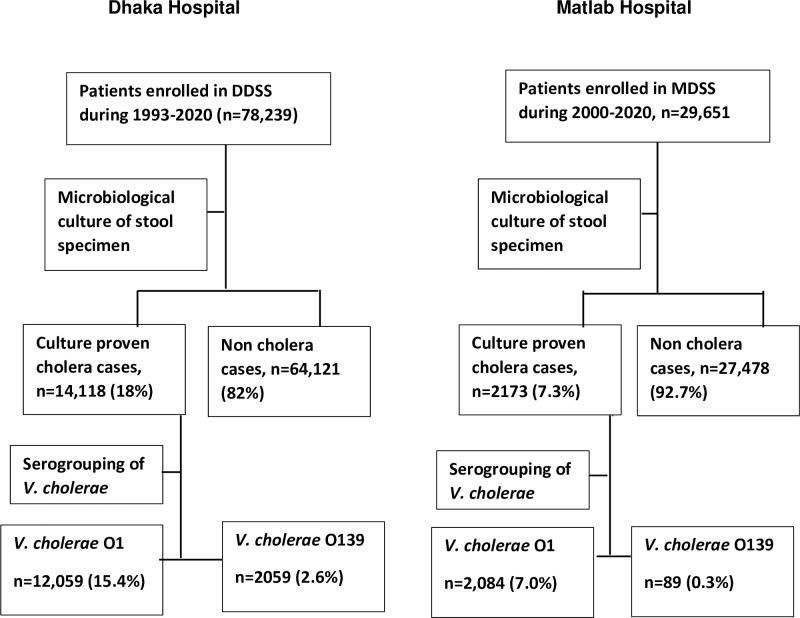
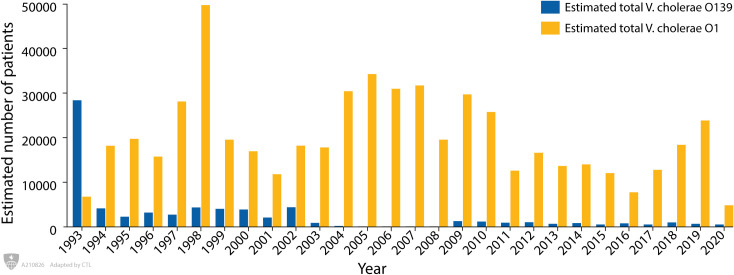
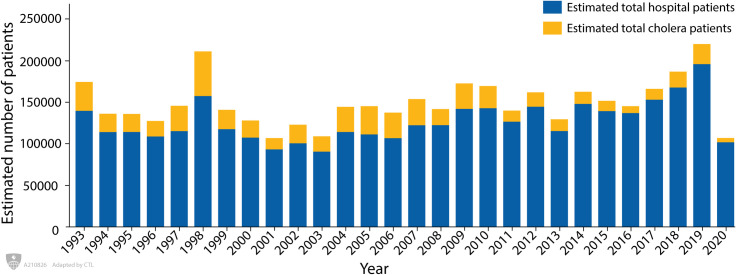
METHODOLOGY/PRINCIPAL FINDINGS: We extracted surveillance data from the Dhaka and Matlab Hospitals of International Centre for Diarrhoeal Disease Research, Bangladesh (icddr,b) to review trends in isolation of Vibrio cholerae O139 in Bangladesh. Data from the Dhaka Hospital is a 2% sample of > 100,000 diarrhoeal patients treated annually. Data from the Matlab Hospital includes all diarrhoeal patients who hail from the villages included in the Matlab Health and Demographic Surveillance System. Vibrio cholerae O139 was first isolated in Dhaka in 1993 and had been isolated every year since then except for a gap between 2005 and 2008. An average of thirteen isolates was detected annually from the Dhaka Hospital during the last ten years, yielding an estimated 650 cases annually at this hospital. During the last ten years, cases due to serogroup O139 represented 0.47% of all cholera cases; the others being due to serogroup O1. No cases with serogroup O139 were identified at Matlab since 2006. Clinical signs and symptoms of cholera due to serogroup O139 were similar to cases due to serogroup O1 though more of the O139 cases were not dehydrated. Most isolates of O139 remained sensitive to tetracycline, ciprofloxacin, and azithromycin, but they became resistant to erythromycin starting in 2009.
CONCLUSIONS/SIGNIFICANCE: Cholera due to Vibrio cholerae serogroup O139 continues to cause typical cholera in Dhaka, Bangladesh.
1992 年,由血清型 O139 霍乱弧菌引起的霍乱在亚洲多国爆发,此后亚洲各国很少发现该血清型,非洲也未检测到该血清型病例。
方法/主要发现:我们从孟加拉国际腹泻病研究中心(icddr,b)的达卡和马特巴医院提取监测数据,以审查孟加拉国 O139 霍乱弧菌分离趋势。达卡医院的数据来自每年 10 万多名腹泻患者的 2%抽样。马特巴医院的数据包括来自马特巴卫生和人口监测系统覆盖的村庄的所有腹泻患者。1993 年首次在达卡分离到 O139 霍乱弧菌,此后每年都有分离,除了 2005 年至 2008 年之间的间隔。过去十年中,达卡医院平均每年检测到 13 株 O139 分离株,估计该医院每年有 650 例病例。过去十年中,O139 血清群引起的病例占所有霍乱病例的 0.47%;其他为 O1 血清群。自 2006 年以来,马特巴医院未发现 O139 血清群病例。O139 血清群引起的霍乱的临床症状与 O1 血清群引起的霍乱相似,尽管 O139 病例中更多的病例没有脱水。大多数 O139 分离株对四环素、环丙沙星和阿奇霉素仍然敏感,但从 2009 年开始,它们对红霉素产生耐药性。
结论/意义:孟加拉国达卡的 O139 霍乱弧菌血清群仍在引起典型霍乱。