Tian Bo Ren, Lin Wei Fan, Zhang Yan
MOE Key Laboratory of Gene Function and Regulation, School of Life Sciences, Sun Yat-sen University, Guangzhou 510006, Guangdong, People's Republic of China.
J Cancer. 2021 Aug 8;12(19):5895-5902. doi: 10.7150/jca.60893. eCollection 2021.
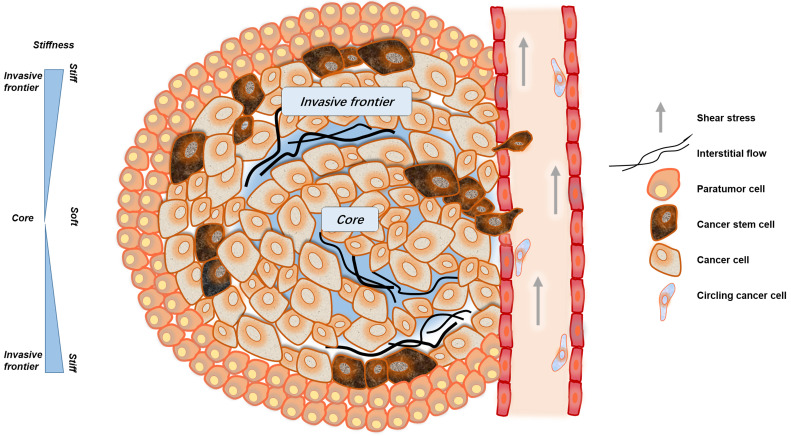
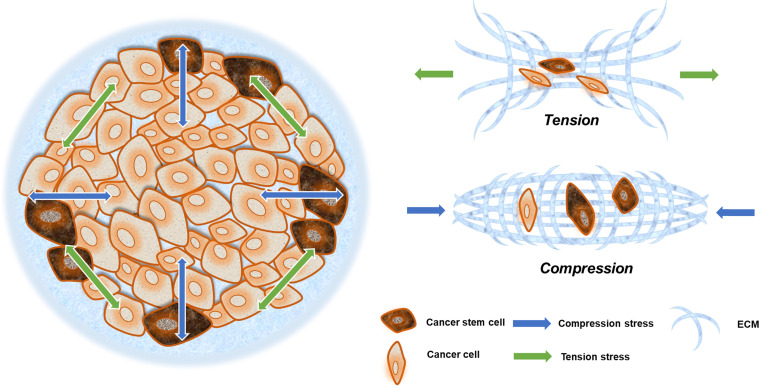
Cancer stem cells (CSCs), dynamic subsets of cancer cells, are responsible for malignant progression. The unique properties of CSCs, including self-renewal, differentiation, and malignancy, closely depend on the tumor microenvironment. Mechanical components in the microenvironment, including matrix stiffness, fluid shear stress, compression and tension stress, affect the fate of CSCs and further influence the cancer process. This paper reviews recent studies of mechanical components and CSCs, and further discusses the intrinsic correlation among them. Regulatory mechanisms of mechanical microenvironment, which act on CSCs, have great potential for clinical application and provide different perspectives to drugs and treatment design.
癌症干细胞(CSCs)是癌细胞的动态亚群,负责恶性进展。CSCs的独特特性,包括自我更新、分化和恶性,紧密依赖于肿瘤微环境。微环境中的机械成分,包括基质硬度、流体剪切应力、压缩和拉伸应力,影响CSCs的命运并进一步影响癌症进程。本文综述了关于机械成分和CSCs的最新研究,并进一步讨论了它们之间的内在关联。作用于CSCs的机械微环境调节机制在临床应用中具有巨大潜力,并为药物和治疗设计提供了不同的视角。