Jung Jae Won, Mille Matthew M, Ky Bonnie, Kenworthy Walter, Lee Choonik, Yeom Yeon Soo, Kwag Aaron, Bosch Walter, MacDonald Shannon, Cahlon Oren, Bekelman Justin E, Lee Choonsik
Department of Physics, East Carolina University, Greenville, NC 27858, United States.
Division of Cancer Epidemiology and Genetics, National Cancer Institute, National Institutes of Health, Rockville, MD 20850, United States.
Phys Imaging Radiat Oncol. 2021 Aug 23;19:138-144. doi: 10.1016/j.phro.2021.08.005. eCollection 2021 Jul.
Quantifying radiation dose to cardiac substructures is important for research on the etiology and prevention of complications following radiotherapy; however, segmentation of substructures is challenging. In this study we demonstrate the application of our atlas-based automatic segmentation method to breast cancer radiotherapy plans for generating radiation doses in support of late effects research.
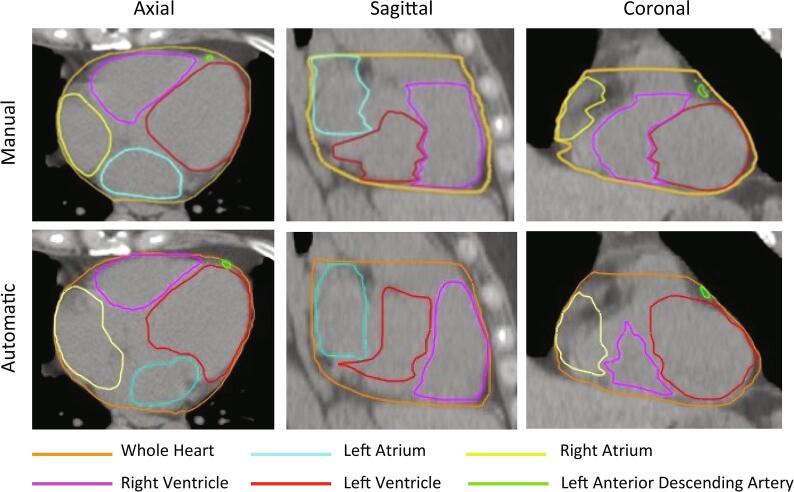
We applied our segmentation method to contour heart substructures on the computed tomography (CT) images of 70 breast cancer patients who received external photon radiotherapy. Two cardiologists provided manual segmentation of the whole heart (WH), left/right atria, left/right ventricles, and left anterior descending artery (LAD). The automatically contours were compared with manual delineations to evaluate similarity in terms of geometry and dose.
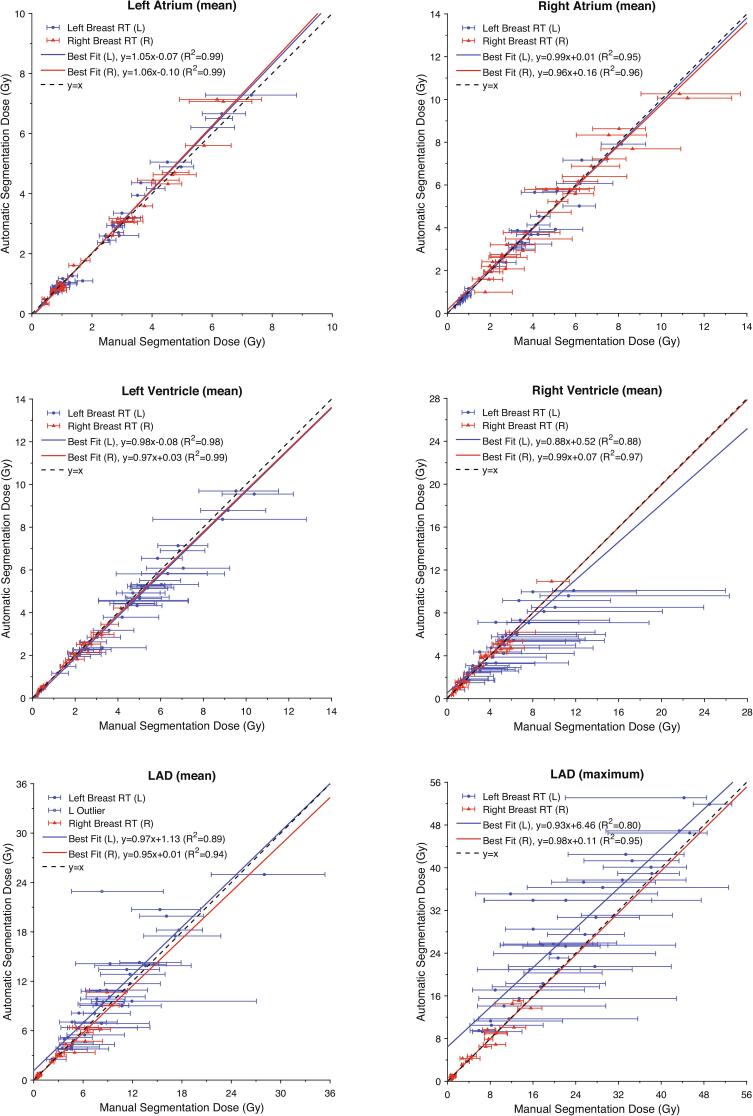
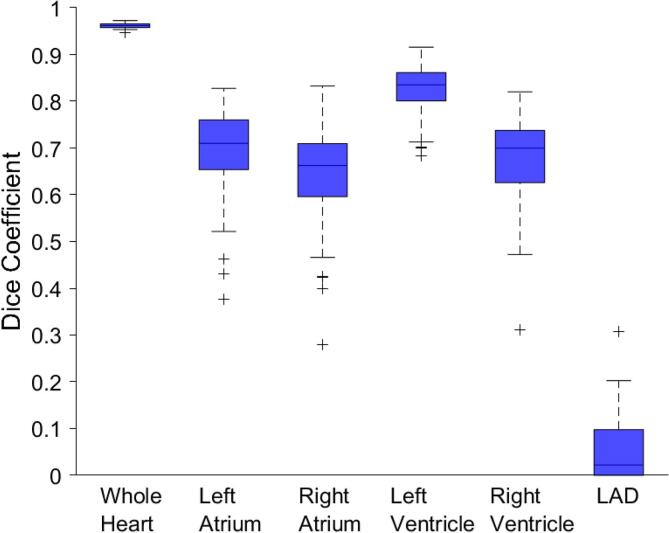
The mean Dice similarity coefficient between manual and automatic segmentations was 0.96 for the WH, 0.65 to 0.82 for the atria and ventricles, and 0.06 for the LAD. The mean average surface distance was 1.2 mm for the WH, 3.4 to 4.1 mm for the atria and ventricles, and 6.4 mm for the LAD. We found the dose to the cardiac substructures based on our automatic segmentation agrees with manual segmentation within expected observer variability. For left breast patients, the mean absolute difference in mean dose was 0.1 Gy for the WH, 0.2 to 0.7 Gy for the atria and ventricles, and 1.8 Gy for the LAD. For right breast patients, these values were 0.0 Gy, 0.1 to 0.4 Gy, and 0.4 Gy, respectively.
Our automatic segmentation method will facilitate the development of radiotherapy prescriptive criteria for mitigating cardiovascular complications.
量化心脏亚结构的辐射剂量对于放射治疗后并发症的病因学及预防研究具有重要意义;然而,亚结构的分割具有挑战性。在本研究中,我们展示了基于图谱的自动分割方法在乳腺癌放射治疗计划中的应用,以生成辐射剂量,支持晚期效应研究。
我们将分割方法应用于70例接受外照射光子放疗的乳腺癌患者的计算机断层扫描(CT)图像上,以勾勒心脏亚结构。两名心脏病专家对整个心脏(WH)、左/右心房、左/右心室以及左前降支动脉(LAD)进行手动分割。将自动勾勒结果与手动描绘结果进行比较,以评估几何形状和剂量方面的相似性。
手动分割与自动分割之间的平均骰子相似系数,对于WH为0.96,对于心房和心室为0.65至0.82,对于LAD为0.06。平均表面距离,对于WH为1.2毫米,对于心房和心室为3.4至4.1毫米,对于LAD为6.4毫米。我们发现基于自动分割得出的心脏亚结构剂量与手动分割结果在预期的观察者变异性范围内一致。对于左乳患者,平均剂量的平均绝对差异,对于WH为0.1 Gy,对于心房和心室为0.2至0.7 Gy,对于LAD为1.8 Gy。对于右乳患者,这些值分别为0.0 Gy、0.1至0.4 Gy和0.4 Gy。
我们的自动分割方法将有助于制定减轻心血管并发症的放射治疗处方标准。