He Baoye, Hamby Rachael, Jin Hailing
Department of Microbiology and Plant Pathology Center for Plant Cell Biology Institute for Integrative Genome Biology University of California Riverside CA USA.
FASEB Bioadv. 2021 Jun 27;3(9):657-664. doi: 10.1096/fba.2021-00040. eCollection 2021 Sep.
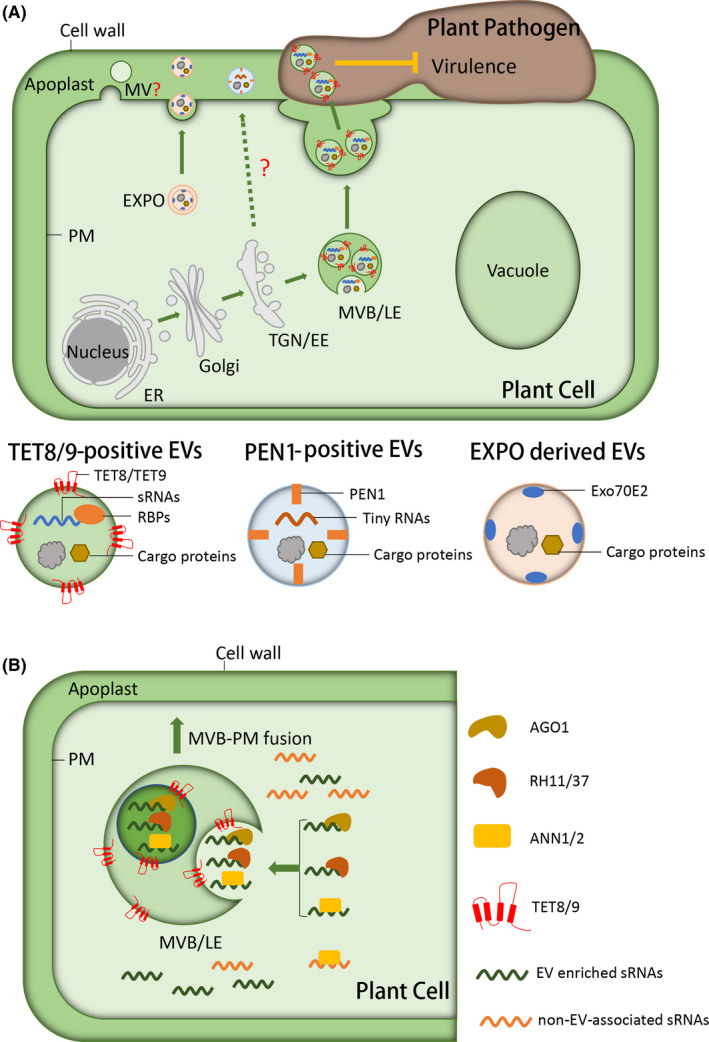
Plants communicate with their interacting microorganisms through the exchange of functional molecules. This communication is critical for plant immunity, for pathogen virulence, and for establishing and maintaining symbioses. Extracellular vesicles (EVs) are lipid bilayer-enclosed spheres that are released by both the host and the microbe into the extracellular environment. Emerging evidence has shown that EVs play a prominent role in plant-microbe interactions by safely transporting functional molecules, such as proteins and RNAs to interacting organisms. Recent studies revealed that plant EVs deliver fungal gene-targeting small RNAs into fungal pathogens to suppress infection via cross-kingdom RNA interference (RNAi). In this review, we focus on the recent advances in our understanding of plant EVs and their role in plant-microbe interactions.
植物通过功能分子的交换与相互作用的微生物进行交流。这种交流对于植物免疫、病原体毒力以及建立和维持共生关系至关重要。细胞外囊泡(EVs)是由宿主和微生物释放到细胞外环境中的脂质双分子层包裹的球体。新出现的证据表明,细胞外囊泡通过将蛋白质和RNA等功能分子安全地运输到相互作用的生物体中,在植物与微生物的相互作用中发挥着重要作用。最近的研究表明,植物细胞外囊泡将靶向真菌基因的小RNA传递到真菌病原体中,通过跨物种RNA干扰(RNAi)抑制感染。在这篇综述中,我们重点关注了我们对植物细胞外囊泡及其在植物与微生物相互作用中的作用的最新认识进展。