Danish Health Authority, Copenhagen, Denmark.
The Parker Institute, Copenhagen University Hospital, Bispebjerg and Frederiksberg, Copenhagen, Denmark.
Prostate Cancer Prostatic Dis. 2022 Sep;25(3):491-506. doi: 10.1038/s41391-021-00450-0. Epub 2021 Sep 6.
Androgen deprivation therapy (ADT) in patients with prostate cancer can have several debilitating side effects. Supervised exercise is recommended to ameliorate these negative effects.
To systematically evaluate the effect of supervised exercise therapy compared to no exercise therapy in patients with prostate cancer undergoing ADT, primarily according to the patient critical outcomes, 'disease-specific quality of life' and 'walking performance' measured at end of treatment.
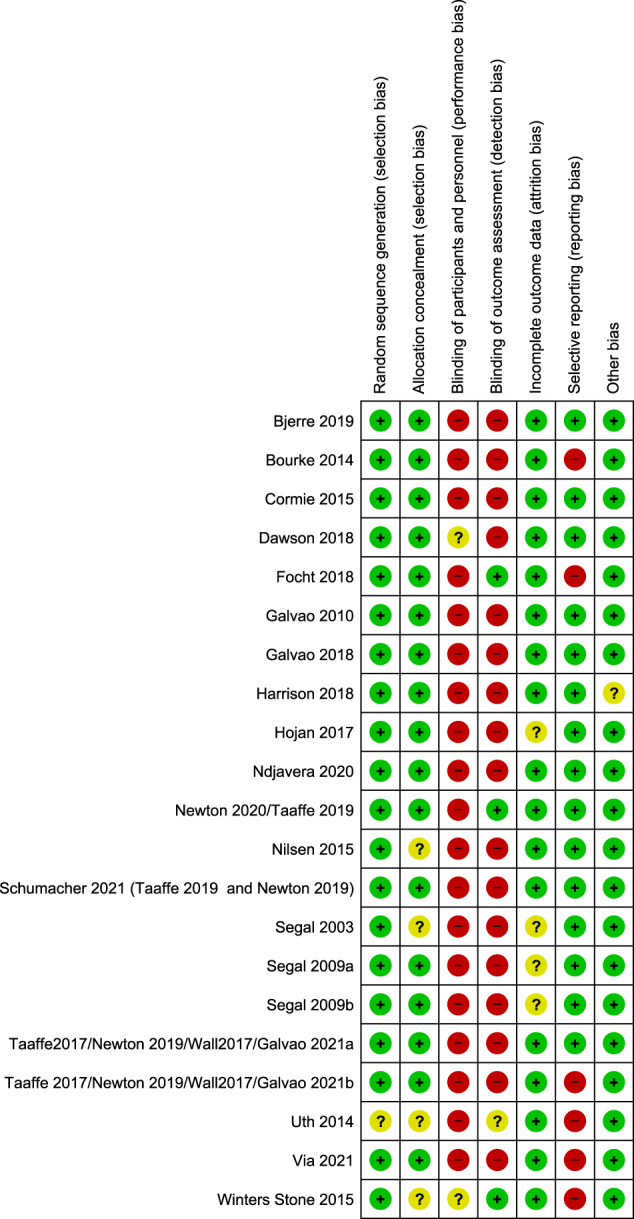
We searched PubMed/Medline, Embase, Cochrane Library, Cinahl and Pedro, to identify randomised controlled trials (RCTs), which investigated the effect of supervised exercise therapy compared to no exercise therapy in patients with prostate cancer receiving ADT, last search: June 2021. Two independent reviewers extracted data, and assessed risk of bias using Cochrane Risk of Bias Tool and evaluated the certainty of evidence using the GRADE-method.
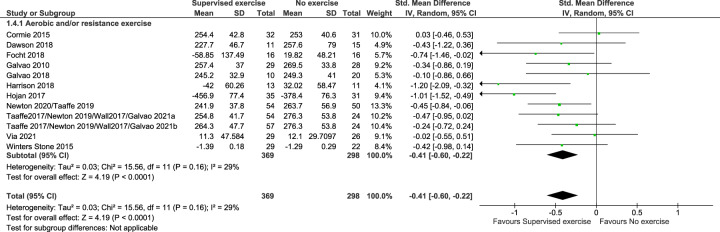
Eigthteen RCTs (n = 1477) comprised patients with prostate cancer stages T1-T4 were included in the meta-analyses. Compared to no exercise therapy, supervised exercise therapy showed clinically relevant improvements in 'disease-specific quality of life' and 'walking performance'. The standardised mean differences were 0.43 (95% confidence interval (CI): 0.29, 0.58) and -0.41 (95% CI: -0.60, -0.22), respectively. The overall certainty of evidence was moderate due to serious risk of bias.
Evidence of moderate quality shows that supervised exercise therapy probably is superior to no exercise therapy in improving 'disease-specific quality of life' and 'walking performance' in patients with prostate cancer undergoing ADT. The results apply to all patients receiving androgen deprivation therapy regardless of cancer stage. The results support a strong recommendation for supervised exercise therapy for managing side effects in this population.
NKR-38-Focused-questions-PICOs-for-updating1.ashx (sst.dk).
前列腺癌患者接受雄激素剥夺疗法(ADT)可能会产生多种使人虚弱的副作用。建议进行监督下的运动以改善这些负面影响。
系统评估监督下的运动疗法与 ADT 期间不进行运动疗法相比,对接受 ADT 的前列腺癌患者的疗效,主要根据治疗结束时测量的患者关键结局,即“疾病特异性生活质量”和“行走能力”。
我们检索了 PubMed/Medline、Embase、Cochrane 图书馆、Cinahl 和 Pedro,以确定比较接受 ADT 的前列腺癌患者监督下的运动疗法与不进行运动疗法的效果的随机对照试验(RCT),最后一次检索时间为 2021 年 6 月。两名独立评审员提取数据,并使用 Cochrane 偏倚风险工具评估偏倚风险,使用 GRADE 方法评估证据确定性。
18 项 RCT(n=1477)纳入了接受 ADT 的前列腺癌 T1-T4 期患者,纳入了荟萃分析。与不进行运动疗法相比,监督下的运动疗法在“疾病特异性生活质量”和“行走能力”方面显示出具有临床意义的改善。标准化均数差值分别为 0.43(95%置信区间:0.29,0.58)和-0.41(95%置信区间:-0.60,-0.22)。由于存在严重的偏倚风险,整体证据确定性为中等。
中等质量的证据表明,监督下的运动疗法可能优于 ADT 期间不进行运动疗法,可改善前列腺癌患者的“疾病特异性生活质量”和“行走能力”。这些结果适用于接受雄激素剥夺治疗的所有患者,无论癌症分期如何。这些结果支持强烈推荐监督下的运动疗法来管理该人群的副作用。
NKR-38-Focused-questions-PICOs-for-updating1.ashx(sst.dk)。