Yang Huan, van der Stel Wanda, Lee Randy, Bauch Caroline, Bevan Sam, Walker Paul, van de Water Bob, Danen Erik H J, Beltman Joost B
Division of Drug Discovery and Safety, Leiden Academic Centre for Drug Research, Leiden University, Leiden, Netherlands.
Cyprotex Discovery Limited, Cheshire, United Kingdom.
Front Pharmacol. 2021 Aug 19;12:679407. doi: 10.3389/fphar.2021.679407. eCollection 2021.
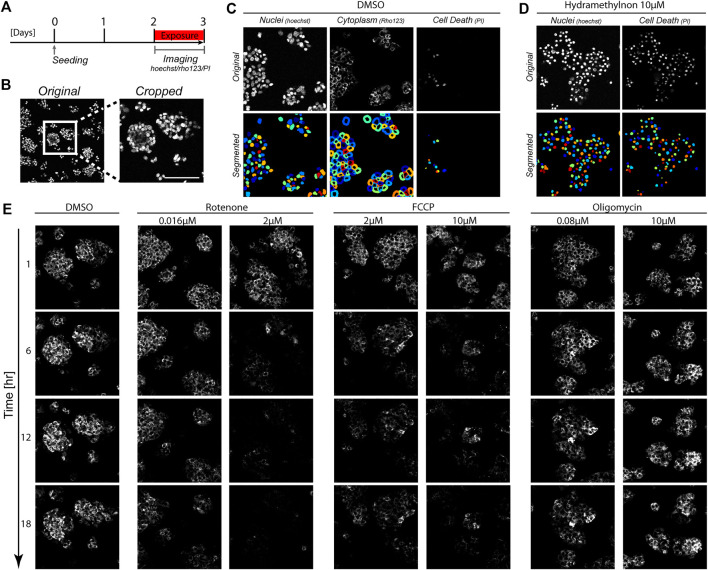
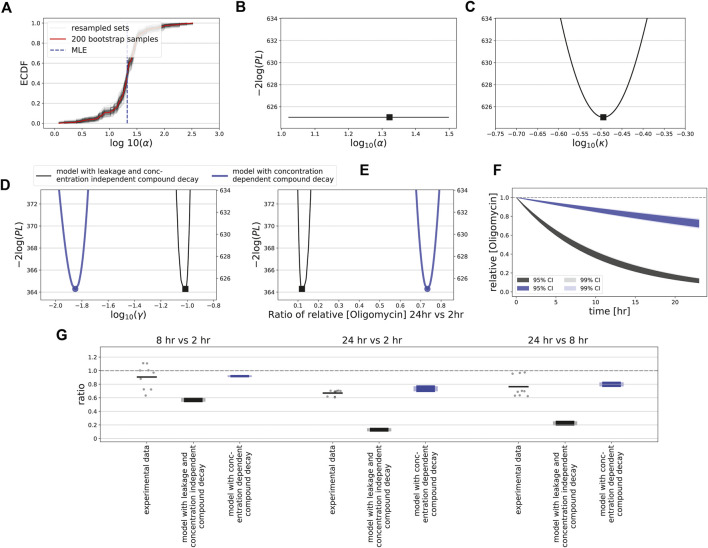
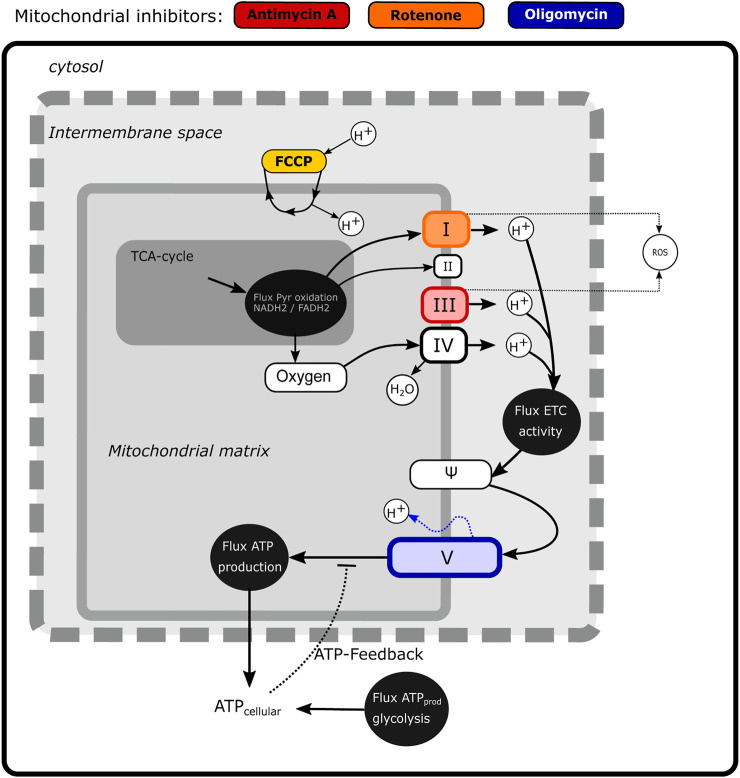
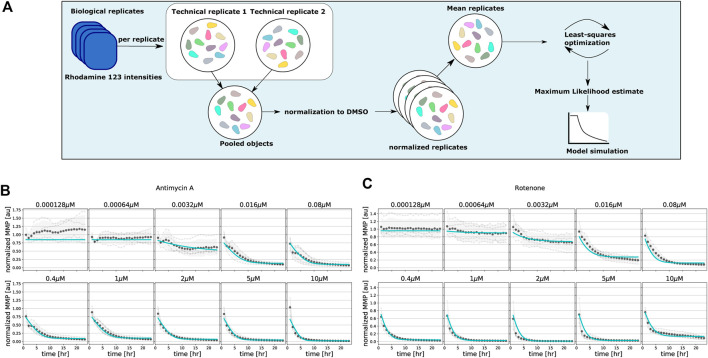
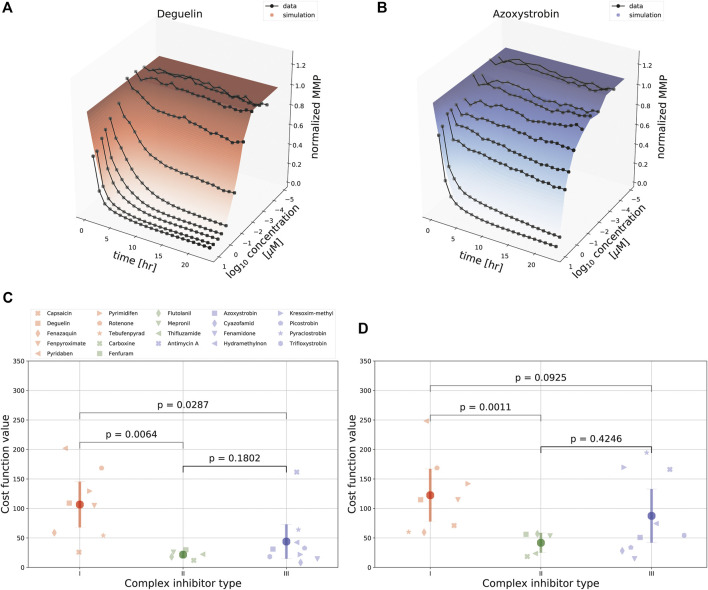
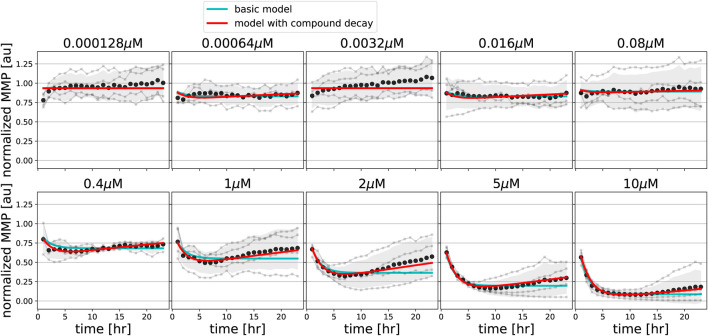
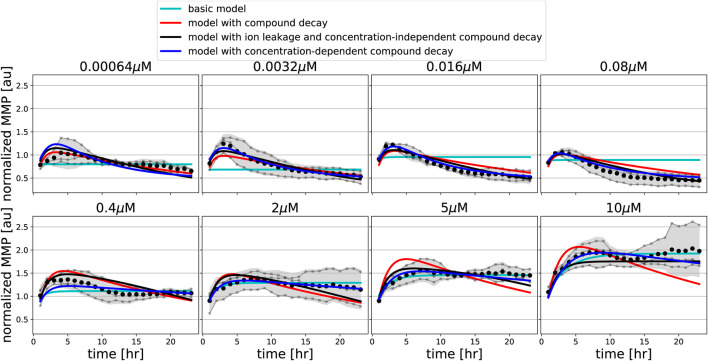
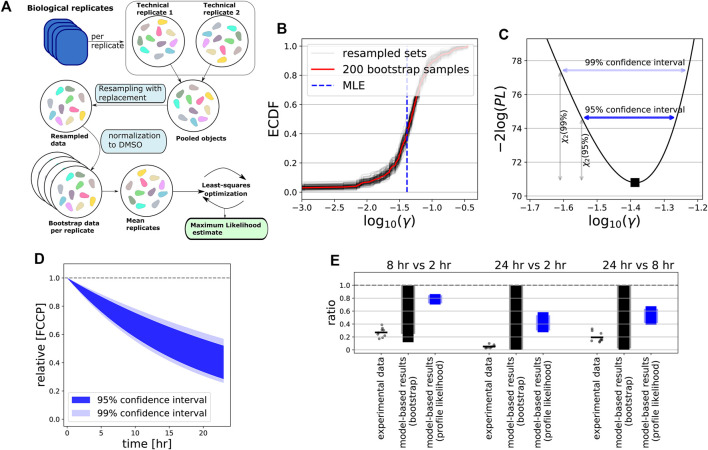
Mitochondria are the main bioenergetic organelles of cells. Exposure to chemicals targeting mitochondria therefore generally results in the development of toxicity. The cellular response to perturbations in cellular energy production is a balance between adaptation, by reorganisation and organelle biogenesis, and sacrifice, in the form of cell death. In homeostatic conditions, aerobic mitochondrial energy production requires the maintenance of a mitochondrial membrane potential (MMP). Chemicals can perturb this MMP, and the extent of this perturbation depends both on the pharmacokinetics of the chemicals and on downstream MMP dynamics. Here we obtain a quantitative understanding of mitochondrial adaptation upon exposure to various mitochondrial respiration inhibitors by applying mathematical modeling to partially published high-content imaging time-lapse confocal imaging data, focusing on MMP dynamics in HepG2 cells over a period of 24 h. The MMP was perturbed using a set of 24 compounds, either acting as uncoupler or as mitochondrial complex inhibitor targeting complex I, II, III or V. To characterize the effect of chemical exposure on MMP dynamics, we adapted an existing differential equation model and fitted this model to the observed MMP dynamics. Complex III inhibitor data were better described by the model than complex I data. Incorporation of pharmacokinetic decay into the model was required to obtain a proper fit for the uncoupler FCCP. Furthermore, oligomycin (complex V inhibitor) model fits were improved by either combining pharmacokinetic (PK) decay and ion leakage or a concentration-dependent decay. Subsequent mass spectrometry measurements showed that FCCP had a significant decay in its PK profile as predicted by the model. Moreover, the measured oligomycin PK profile exhibited only a limited decay at high concentration, whereas at low concentrations the compound remained below the detection limit within cells. This is consistent with the hypothesis that oligomycin exhibits a concentration-dependent decay, yet awaits further experimental verification with more sensitive detection methods. Overall, we show that there is a complex interplay between PK and MMP dynamics within mitochondria and that data-driven modeling is a powerful combination to unravel such complexity.
线粒体是细胞主要的生物能量细胞器。因此,接触靶向线粒体的化学物质通常会导致毒性的产生。细胞对细胞能量产生紊乱的反应是一种平衡,一方面是通过重组和细胞器生物发生进行适应,另一方面是以细胞死亡的形式进行牺牲。在稳态条件下,有氧线粒体能量产生需要维持线粒体膜电位(MMP)。化学物质会扰乱这种MMP,而这种扰乱的程度既取决于化学物质的药代动力学,也取决于下游的MMP动态变化。在此,我们通过对部分已发表的高内涵成像延时共聚焦成像数据应用数学建模,来定量理解暴露于各种线粒体呼吸抑制剂后线粒体的适应性,重点关注HepG2细胞在24小时内的MMP动态变化。使用一组24种化合物来扰乱MMP,这些化合物要么作为解偶联剂,要么作为靶向复合物I、II、III或V的线粒体复合物抑制剂。为了表征化学物质暴露对MMP动态变化的影响,我们调整了一个现有的微分方程模型,并将该模型拟合到观察到的MMP动态变化中。该模型对复合物III抑制剂数据的描述比对复合物I数据的描述更好。为了使解偶联剂FCCP得到合适的拟合,需要将药代动力学衰减纳入模型。此外,通过结合药代动力学(PK)衰减和离子泄漏或浓度依赖性衰减,改善了寡霉素(复合物V抑制剂)模型的拟合。随后的质谱测量表明,FCCP的PK谱如模型预测的那样有显著衰减。此外,测得的寡霉素PK谱在高浓度时仅表现出有限的衰减,而在低浓度时该化合物在细胞内仍低于检测限。这与寡霉素表现出浓度依赖性衰减的假设一致,但仍有待用更灵敏的检测方法进行进一步的实验验证。总体而言,我们表明线粒体内PK和MMP动态变化之间存在复杂的相互作用,并且数据驱动的建模是揭示这种复杂性的有力组合。