Primary Health Care Center, Faculty of Medicine, University of Montenegro, Podgorica, Montenegro.
Clinic for Endocrinology, Faculty of Medicine, University of Nis, Nis, Serbia.
Front Endocrinol (Lausanne). 2021 Aug 19;12:610893. doi: 10.3389/fendo.2021.610893. eCollection 2021.
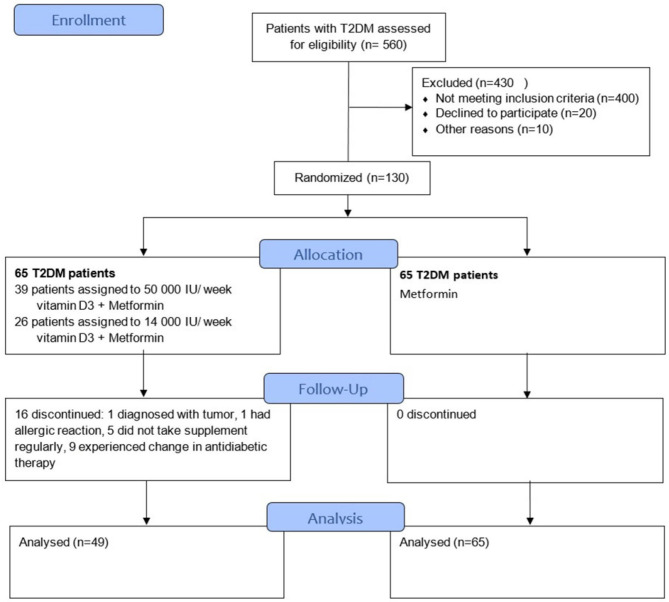
Vitamin D deficiency could play an important role in the pathogenesis of type 2 diabetes mellitus (T2DM) as it may alter several crucial processes in the development of diabetes and its complications, such as pancreatic insulin secretion, peripheral insulin resistance, persistence of systemic "sterile" inflammation and immune activation. Vitamin D may also have an antioxidant effect through the inhibition of free radicals generation. The reported study was designed with eligible consecutively recruited patients with T2DM on standard metformin therapy (n=130), randomized in 1:1 ratio, considered to have undergone Vitamin D supplementation according to the guidelines proposed by the Endocrine Society, or to have continued with metformin only. The potential benefit was monitored through the influence on glycemia level, glycated haemoglobin (HbA1c), insulin resistance index (calculated as homeostatic model assessment; HOMA-IR), Castelli Risk Index I and Tryglicerides/Thiobarbituric acidreactive substances (TG/TBARS) Index in a 6-month follow up period. Our study indicates that oral daily doses of vitamin D improve HbA1c levels over the 3-month and 6-month period, followed by a significant decrease in advanced oxidation protein products levels over the 3-month period when higher vitamin D doses are given. The effect of vitamin D on HOMA-IR index, malondialdehyde levels and TG/TBARS index was not statistically significant. Further investigation should consider defining the doses of vitamin D in patients with T2DM which may attenuate the oxidative stress risk, the risk of metabolic syndrome and the risk of related cardiovascular events.
维生素 D 缺乏可能在 2 型糖尿病(T2DM)的发病机制中发挥重要作用,因为它可能改变糖尿病及其并发症发展过程中的几个关键过程,如胰腺胰岛素分泌、外周胰岛素抵抗、全身“无菌”炎症和免疫激活的持续存在。维生素 D 还可能通过抑制自由基的产生发挥抗氧化作用。这项报告研究设计了纳入了标准二甲双胍治疗的 T2DM 合格连续患者(n=130),随机分为 1:1 比例,根据内分泌学会提出的指南,认为接受了维生素 D 补充治疗,或仅继续使用二甲双胍。通过血糖水平、糖化血红蛋白(HbA1c)、胰岛素抵抗指数(计算为稳态模型评估;HOMA-IR)、Castelli 风险指数 I 和甘油三酯/硫代巴比妥酸反应物质(TG/TBARS)指数在 6 个月随访期间的影响来监测潜在的益处。我们的研究表明,口服每日剂量的维生素 D 可改善 HbA1c 水平在 3 个月和 6 个月期间,随后在给予较高剂量维生素 D 时,丙二醛水平和 TG/TBARS 指数在 3 个月期间显著下降。维生素 D 对 HOMA-IR 指数、丙二醛水平和 TG/TBARS 指数的影响没有统计学意义。进一步的研究应该考虑确定 T2DM 患者的维生素 D 剂量,这可能会降低氧化应激风险、代谢综合征风险和相关心血管事件风险。