Infectious Diseases, Microbiota and Metabolism Unit, Infectious Diseases Department, Center for Biomedical Research of La Rioja (CIBIR), Logroño, Spain.
Infectious Diseases Department, Hospital Universitario San Pedro, Logroño, Spain.
Front Endocrinol (Lausanne). 2021 Aug 19;12:688071. doi: 10.3389/fendo.2021.688071. eCollection 2021.
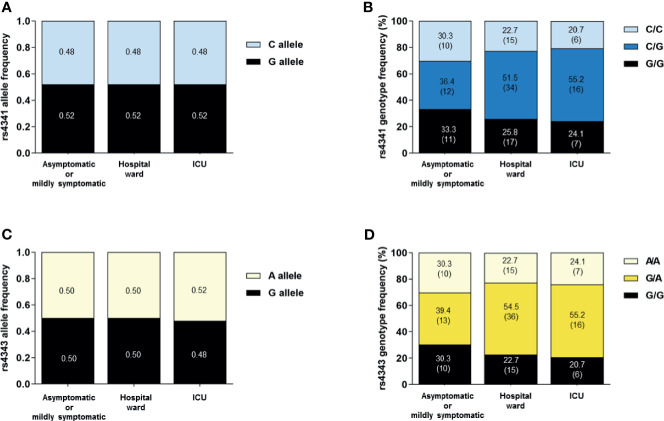
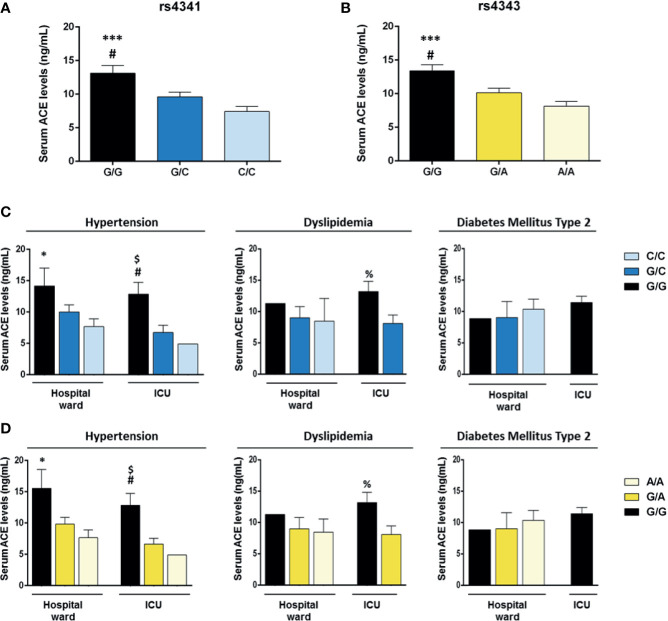
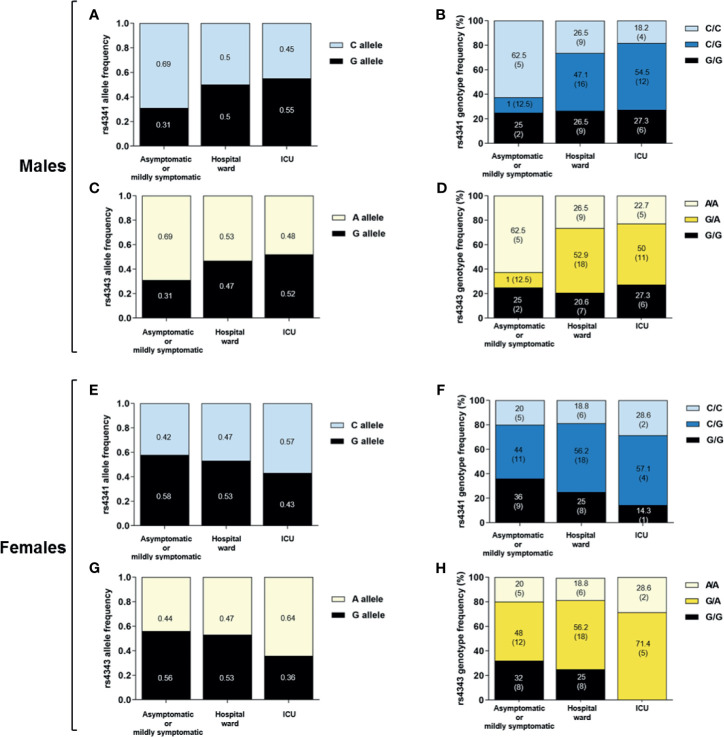
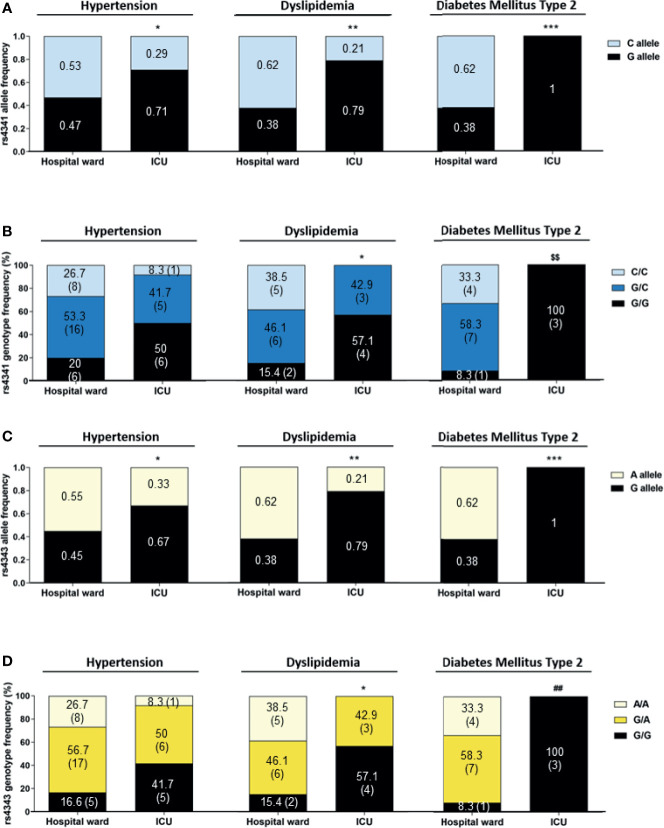
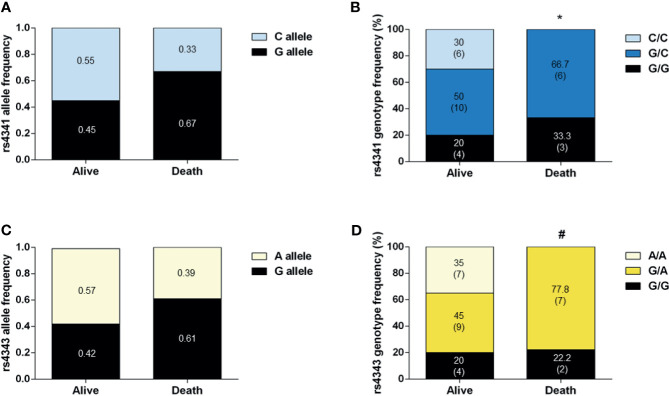
Coronavirus disease 19 (COVID-19) caused by the severe acute respiratory syndrome coronavirus 2 (SARS-CoV-2) infection continues to scale and threaten human health and public safety. It is essential to identify those risk factors that lead to a poor prognosis of the disease. A predisposing host genetic background could be one of these factors that explain the interindividual variability to COVID-19 severity. Thus, we have studied whether the rs4341 and rs4343 polymorphisms of the angiotensin converting enzyme (ACE) gene, key regulator of the renin-aldosterone-angiotensin system (RAAS), could explain the different outcomes of 128 COVID-19 patients with diverse degree of severity (33 asymptomatic or mildly symptomatic, 66 hospitalized in the general ward, and 29 admitted to the ICU). We found that G allele of rs4341 and rs4343 was associated with severe COVID-19 in hypertensive patients, independently of gender (<0.05). G-carrier genotypes of both polymorphisms were also associated with higher mortality (< 0.05) and higher severity of COVID-19 in dyslipidemic (<0.05) and type 2 diabetic patients (< 0.01). The association of G alleles with disease severity was adjusted for age, sex, BMI and number of comorbidities, suggesting that both the metabolic comorbidities and the G allele act synergistically on COVID-19 outcome. Although we did not find a direct association between serum ACE levels and COVID-19 severity, we found higher levels of ACE in the serum of patients with the GG genotype of rs4341 and rs4343 (p<0.05), what could explain the higher susceptibility to develop severe forms of the disease in patients with the GG genotype, in addition to hypertension and dyslipidemia. In conclusion, our preliminary study suggests that the G-containing genotypes of rs4341 and rs4343 confer an additional risk of adverse COVID-19 prognosis. Thus, rs4341 and rs4343 polymorphisms of ACE could be predictive markers of severity of COVID-19 in those patients with hypertension, dyslipidemia or diabetes. The knowledge of these genetic data could contribute to precision management of SARS-CoV-2 infected patients when admitted to hospital.
新型冠状病毒病(COVID-19)是由严重急性呼吸系统综合征冠状病毒 2(SARS-CoV-2)感染引起的,其传播范围不断扩大,严重威胁着人类的健康和公共安全。因此,识别导致疾病预后不良的危险因素至关重要。宿主遗传背景易感性可能是导致 COVID-19 严重程度个体间差异的因素之一。因此,我们研究了血管紧张素转换酶(ACE)基因 rs4341 和 rs4343 多态性是否可以解释 128 例 COVID-19 患者不同严重程度(33 例无症状或轻度症状、66 例普通病房住院、29 例 ICU 住院)的不同结局。我们发现 rs4341 和 rs4343 的 G 等位基因与高血压患者的严重 COVID-19 相关,这与性别无关(<0.05)。两种多态性的 G 携带者基因型也与血脂异常(<0.05)和 2 型糖尿病患者(<0.01)的死亡率更高和 COVID-19 更严重相关。G 等位基因与疾病严重程度的相关性在调整年龄、性别、BMI 和合并症数量后仍然存在,这表明代谢合并症和 G 等位基因协同作用影响 COVID-19 的结局。尽管我们没有发现血清 ACE 水平与 COVID-19 严重程度之间的直接关联,但我们发现 rs4341 和 rs4343 的 GG 基因型患者的血清 ACE 水平更高(p<0.05),这可以解释 GG 基因型患者更容易发展为严重疾病的原因,除了高血压和血脂异常之外。总之,我们的初步研究表明,rs4341 和 rs4343 的 G 等位基因基因型增加了 COVID-19 不良预后的风险。因此,ACE 的 rs4341 和 rs4343 多态性可能是高血压、血脂异常或糖尿病患者 COVID-19 严重程度的预测标志物。这些遗传数据的知识有助于在 SARS-CoV-2 感染患者住院时进行精准管理。