State Key Laboratory of Molecular Vaccinology and Molecular Diagnostics, National Institute of Diagnostics and Vaccine Development in Infectious Diseases, School of Life Sciences, School of Public Health, Xiamen University, Xiamen, People's Republic of China.
Department of Microbiology, Howard University College of Medicine, Washington, DC, USA.
Emerg Microbes Infect. 2021 Dec;10(1):1881-1889. doi: 10.1080/22221751.2021.1976598.
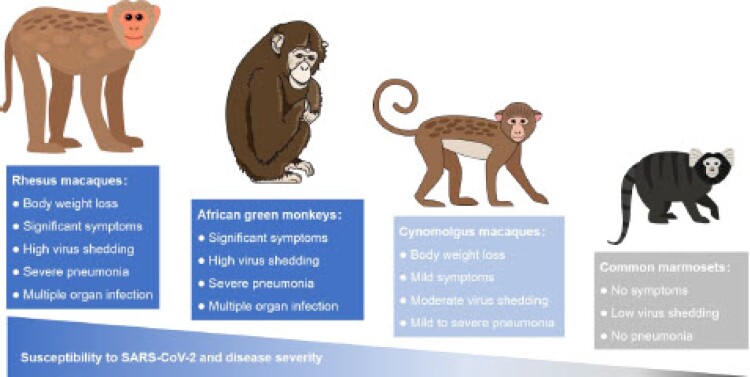
SARS-CoV-2 has been the causative pathogen of the pandemic of COVID-19, resulting in catastrophic health issues globally. It is important to develop human-like animal models for investigating the mechanisms that SARS-CoV-2 uses to infect humans and cause COVID-19. Several studies demonstrated that the non-human primate (NHP) is permissive for SARS-CoV-2 infection to cause typical clinical symptoms including fever, cough, breathing difficulty, and other diagnostic abnormalities such as immunopathogenesis and hyperplastic lesions in the lung. These NHP models have been used for investigating the potential infection route and host immune response to SARS-CoV-2, as well as testing vaccines and drugs. This review aims to summarize the benefits and caveats of NHP models currently available for SARS-CoV-2, and to discuss key topics including model optimization, extended application, and clinical translation.
SARS-CoV-2 是 COVID-19 大流行的病原体,在全球范围内造成了灾难性的健康问题。开发类人动物模型对于研究 SARS-CoV-2 感染人类和导致 COVID-19 的机制非常重要。多项研究表明,非人类灵长类动物(NHP)允许 SARS-CoV-2 感染,导致典型的临床症状,包括发热、咳嗽、呼吸困难和其他诊断异常,如肺部的免疫发病机制和增生性病变。这些 NHP 模型已被用于研究 SARS-CoV-2 的潜在感染途径和宿主免疫反应,以及测试疫苗和药物。本综述旨在总结目前用于 SARS-CoV-2 的 NHP 模型的优点和注意事项,并讨论关键主题,包括模型优化、扩展应用和临床转化。