Sorensen Jackson W, Zinke Laura A, Ter Horst Anneliek M, Santos-Medellín Christian, Schroeder Alena, Emerson Joanne B
Department of Plant Pathology, University of California, Davis, Davis, California, USA.
Genome Center, University of California, Davis, Davis, California, USA.
mSystems. 2021 Oct 26;6(5):e0061421. doi: 10.1128/mSystems.00614-21. Epub 2021 Sep 7.
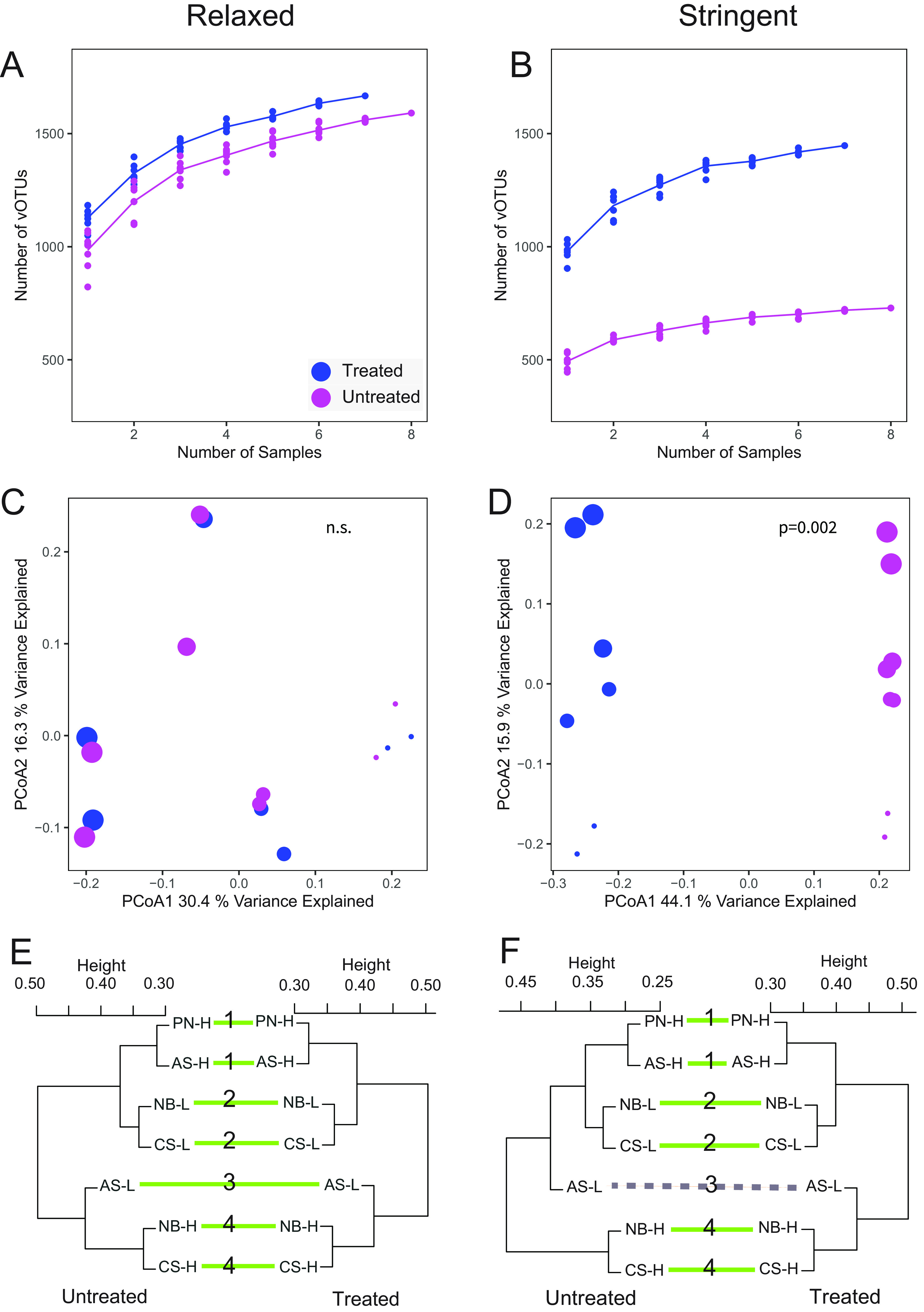
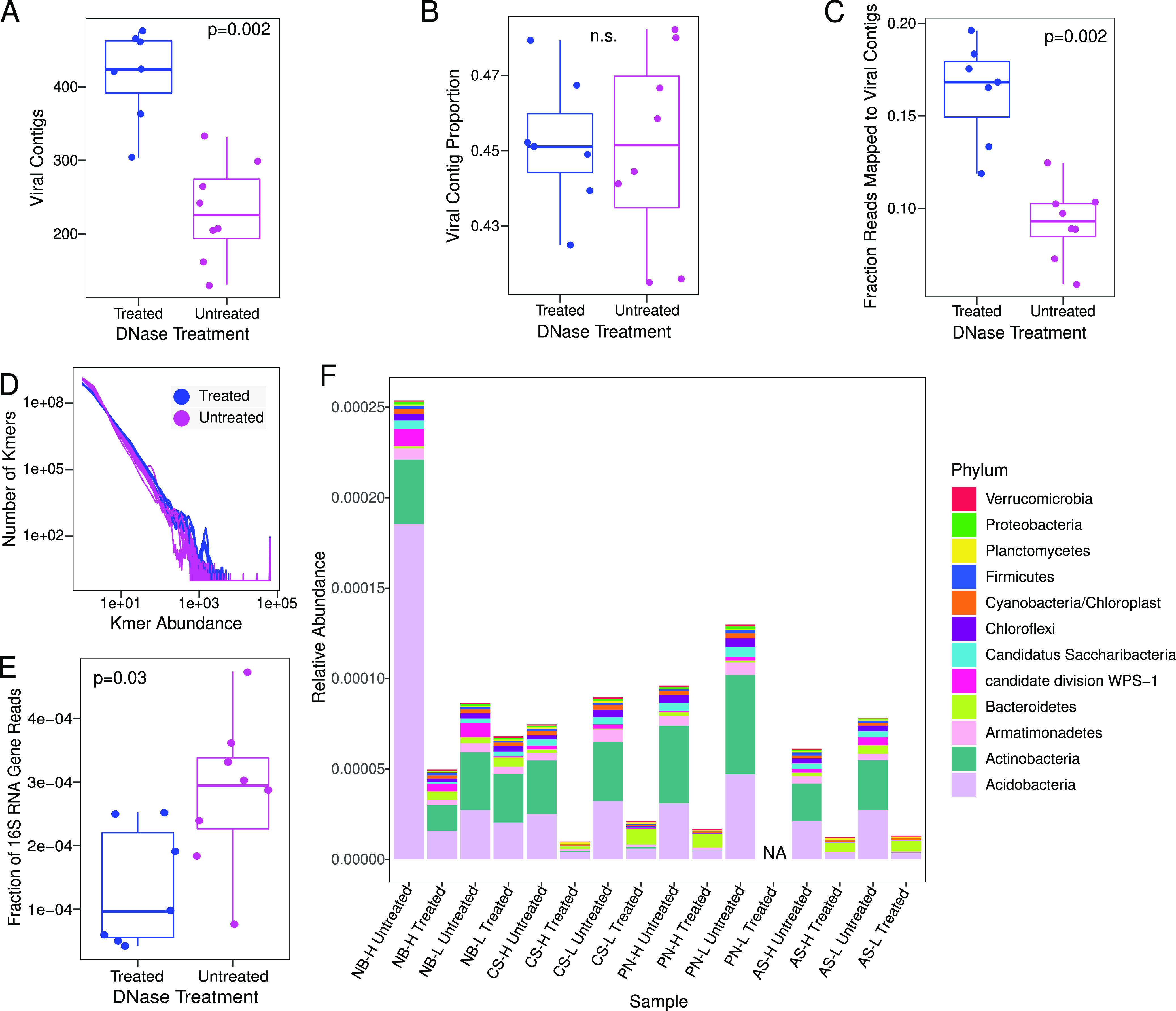
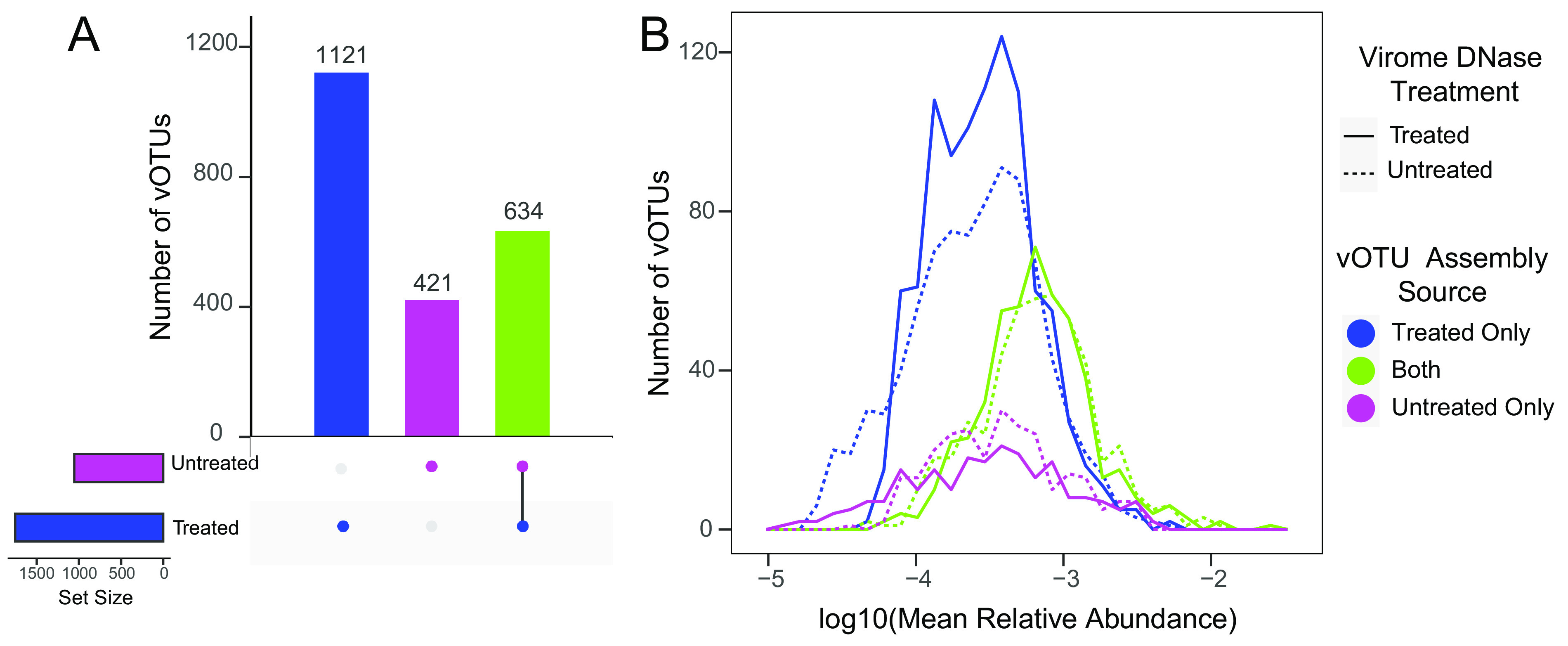
The small genomes of most viruses make it difficult to fully capture viral diversity in metagenomes dominated by DNA from cellular organisms. Viral size fraction metagenomics (viromics) protocols facilitate the enrichment of viral DNA from environmental samples, and these protocols typically include DNase treatment of the post-0.2-μm-filtered viromic fraction to remove contaminating free DNA prior to virion lysis. However, DNase may also remove desirable viral genomic DNA (e.g., contained in virions compromised due to frozen storage or laboratory processing), suggesting that DNase-untreated viromes might be useful in some cases. In order to understand how virome preparation with and without DNase treatment influences the resultant data, here, we compared 15 soil viromes (7 DNase treated and 8 untreated) from 8 samples collected from agricultural fields prior to tomato planting. DNase-treated viromes yielded significantly more assembled viral contigs, contained significantly less nonviral microbial DNA, and recovered more viral populations (viral operational taxonomic units [vOTUs]) through read mapping. However, DNase-treated and untreated viromes were statistically indistinguishable in terms of ecological patterns across viral communities. Although the results suggest that DNase treatment is preferable where possible, in comparison to previously reported total metagenomes from the same samples, both DNase-treated and untreated viromes were significantly enriched in viral signatures by all metrics compared, including a 225-times-higher proportion of viral reads in untreated viromes compared to total metagenomes. Thus, even without DNase treatment, viromics was preferable to total metagenomics for capturing viral diversity in these soils, suggesting that preparation of DNase-untreated viromes can be worthwhile when DNase treatment is not possible. Viromics is becoming an increasingly popular method for characterizing soil viral communities. DNase treatment of the viral size fraction prior to DNA extraction is meant to reduce contaminating free DNA and is a common step within viromics protocols to ensure that sequences are of viral origin. However, some samples may not be amenable to DNase treatment due to viral particles being compromised either in storage (i.e., frozen) or during other sample processing steps. To date, the effect of DNase treatment on the recovery of viruses and downstream ecological interpretations of soil viral communities is not thoroughly understood. This work sheds light on these questions and indicates that while DNase treatment of soil viromes improves the recovery of viral populations, this improvement is modest in comparison to the gains made by viromics over total soil metagenomics. Furthermore, DNase treatment may not be necessary to observe the ecological patterns structuring soil viral communities.

大多数病毒的基因组较小,这使得在以细胞生物的DNA为主导的宏基因组中全面捕捉病毒多样性变得困难。病毒大小分级宏基因组学(病毒组学)方案有助于从环境样本中富集病毒DNA,这些方案通常包括对0.2μm过滤后的病毒组部分进行DNase处理,以在病毒粒子裂解前去除污染的游离DNA。然而,DNase也可能去除理想的病毒基因组DNA(例如,包含在因冷冻保存或实验室处理而受损的病毒粒子中),这表明在某些情况下未经DNase处理的病毒组可能是有用的。为了了解经过和未经DNase处理的病毒组制备如何影响最终数据,在这里,我们比较了从番茄种植前的农田采集的8个样本中的15个土壤病毒组(7个经过DNase处理,8个未处理)。经过DNase处理的病毒组产生了显著更多的组装病毒重叠群,包含的非病毒微生物DNA显著更少,并且通过读段比对回收了更多的病毒群体(病毒操作分类单元[vOTUs])。然而,就病毒群落的生态模式而言,经过DNase处理和未处理的病毒组在统计学上没有区别。尽管结果表明在可能的情况下DNase处理更可取,但与之前报道的来自相同样本的总宏基因组相比,经过DNase处理和未处理的病毒组在所有比较指标上的病毒特征都显著富集,包括未处理病毒组中的病毒读段比例比总宏基因组高225倍。因此,即使不进行DNase处理,病毒组学在捕捉这些土壤中的病毒多样性方面也比总宏基因组学更可取,这表明当无法进行DNase处理时,制备未经DNase处理的病毒组可能是值得的。病毒组学正成为一种越来越流行的表征土壤病毒群落的方法。在DNA提取之前对病毒大小分级部分进行DNase处理旨在减少污染的游离DNA,这是病毒组学方案中的一个常见步骤,以确保序列来自病毒。然而,由于病毒粒子在储存(即冷冻)或其他样本处理步骤中受损,一些样本可能不适合进行DNase处理。迄今为止,DNase处理对土壤病毒群落中病毒回收和下游生态解释的影响尚未完全了解。这项工作阐明了这些问题,并表明虽然对土壤病毒组进行DNase处理可提高病毒群体的回收率,但与病毒组学相对于总土壤宏基因组学所取得的进展相比,这种提高是适度的。此外,观察构建土壤病毒群落的生态模式可能不需要DNase处理。