• 文献检索
  • 文档翻译
  • 深度研究
  • 学术资讯
  • Suppr Zotero 插件Zotero 插件
  • 邀请有礼
  • 套餐&价格
  • 历史记录
应用&插件
Suppr Zotero 插件Zotero 插件浏览器插件Mac 客户端Windows 客户端微信小程序
定价
高级版会员购买积分包购买API积分包
服务
文献检索文档翻译深度研究API 文档MCP 服务
关于我们
关于 Suppr公司介绍联系我们用户协议隐私条款
关注我们

Suppr 超能文献

核心技术专利:CN118964589B侵权必究
粤ICP备2023148730 号-1Suppr @ 2026

文献检索

告别复杂PubMed语法,用中文像聊天一样搜索,搜遍4000万医学文献。AI智能推荐,让科研检索更轻松。

立即免费搜索

文件翻译

保留排版,准确专业,支持PDF/Word/PPT等文件格式,支持 12+语言互译。

免费翻译文档

深度研究

AI帮你快速写综述,25分钟生成高质量综述,智能提取关键信息,辅助科研写作。

立即免费体验

基于机器学习的 CT 放射组学模型可区分 COVID-19 与非 COVID-19 肺炎。

Machine learning-based CT radiomics model distinguishes COVID-19 from non-COVID-19 pneumonia.

机构信息

Department of Radiology, Hainan General Hospital (Hainan Affiliated Hospital of Hainan Medical University), No. 19, Xiuhua St, Xiuying Dic, Haikou, Hainan, 570311, People's Republic of China.

Deepwise AI Lab, Deepwise Inc., No. 8 Haidian avenue, Sinosteel International Plaza, Beijing, 100080, China.

出版信息

BMC Infect Dis. 2021 Sep 8;21(1):931. doi: 10.1186/s12879-021-06614-6.

DOI:10.1186/s12879-021-06614-6
PMID:34496794
原文链接:https://pmc.ncbi.nlm.nih.gov/articles/PMC8424152/
Abstract

BACKGROUND

To develop a machine learning-based CT radiomics model is critical for the accurate diagnosis of the rapid spreading coronavirus disease 2019 (COVID-19).

METHODS

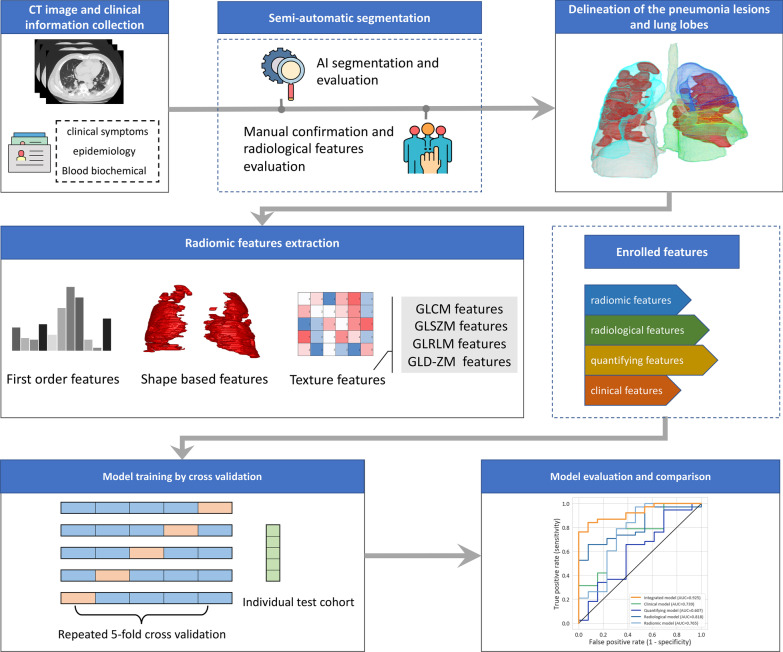
In this retrospective study, a total of 326 chest CT exams from 134 patients (63 confirmed COVID-19 patients and 71 non-COVID-19 patients) were collected from January 20 to February 8, 2020. A semi-automatic segmentation procedure was used to delineate the volume of interest (VOI), and radiomic features were extracted. The Support Vector Machine (SVM) model was built on the combination of 4 groups of features, including radiomic features, traditional radiological features, quantifying features, and clinical features. By repeating cross-validation procedure, the performance on the time-independent testing cohort was evaluated by the area under the receiver operating characteristic curve (AUC), accuracy, sensitivity, and specificity.

RESULTS

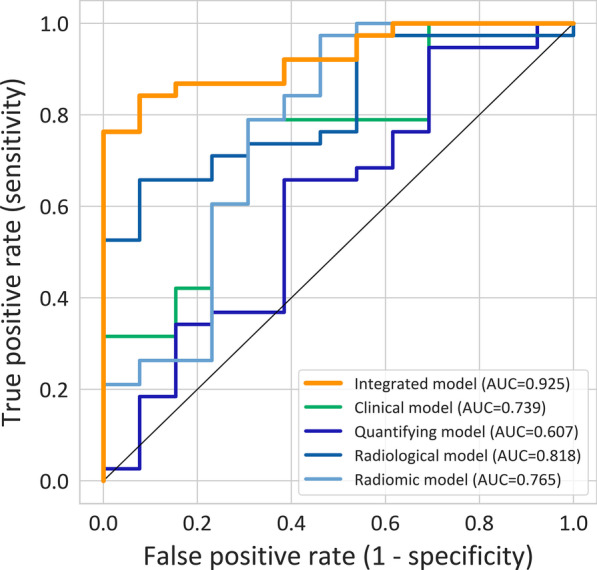
For the SVM model built on the combination of 4 groups of features (integrated model), the per-exam AUC was 0.925 (95% CI 0.856 to 0.994) for differentiating COVID-19 on the testing cohort, and the sensitivity and specificity were 0.816 (95% CI 0.651 to 0.917) and 0.923 (95% CI 0.621 to 0.996), respectively. As for the SVM models built on radiomic features, radiological features, quantifying features, and clinical features, individually, the AUC on the testing cohort reached 0.765, 0.818, 0.607, and 0.739, respectively, significantly lower than the integrated model, except for the radiomic model.

CONCLUSION

The machine learning-based CT radiomics models may accurately classify COVID-19, helping clinicians and radiologists to identify COVID-19 positive cases.

摘要

背景

开发基于机器学习的 CT 放射组学模型对于准确诊断快速传播的 2019 年冠状病毒病(COVID-19)至关重要。

方法

在这项回顾性研究中,共从 2020 年 1 月 20 日至 2 月 8 日收集了 134 名患者(63 名确诊 COVID-19 患者和 71 名非 COVID-19 患者)的 326 次胸部 CT 检查。使用半自动分割程序对感兴趣的容积(VOI)进行描绘,并提取放射组学特征。基于 4 组特征(放射组学特征、传统放射学特征、定量特征和临床特征)的组合构建支持向量机(SVM)模型。通过重复交叉验证程序,使用受试者工作特征曲线下的面积(AUC)、准确性、灵敏度和特异性来评估时间独立测试队列的性能。

结果

对于基于 4 组特征(综合模型)构建的 SVM 模型,在测试队列中区分 COVID-19 的每例检查 AUC 为 0.925(95%CI 0.856 至 0.994),灵敏度和特异性分别为 0.816(95%CI 0.651 至 0.917)和 0.923(95%CI 0.621 至 0.996)。对于基于放射组学特征、放射学特征、定量特征和临床特征分别构建的 SVM 模型,在测试队列中的 AUC 分别达到 0.765、0.818、0.607 和 0.739,明显低于综合模型,除了放射组学模型。

结论

基于机器学习的 CT 放射组学模型可以准确分类 COVID-19,帮助临床医生和放射科医生识别 COVID-19 阳性病例。

https://cdn.ncbi.nlm.nih.gov/pmc/blobs/e474/8425035/b56ad95f5424/12879_2021_6614_Fig7_HTML.jpg
https://cdn.ncbi.nlm.nih.gov/pmc/blobs/e474/8425035/3c0dcd20e63a/12879_2021_6614_Fig1_HTML.jpg
https://cdn.ncbi.nlm.nih.gov/pmc/blobs/e474/8425035/ae703239472f/12879_2021_6614_Fig2_HTML.jpg
https://cdn.ncbi.nlm.nih.gov/pmc/blobs/e474/8425035/6cd367829d4e/12879_2021_6614_Fig3_HTML.jpg
https://cdn.ncbi.nlm.nih.gov/pmc/blobs/e474/8425035/ea74fbeb93d4/12879_2021_6614_Fig4_HTML.jpg
https://cdn.ncbi.nlm.nih.gov/pmc/blobs/e474/8425035/de6e3dc18ce7/12879_2021_6614_Fig5_HTML.jpg
https://cdn.ncbi.nlm.nih.gov/pmc/blobs/e474/8425035/a007cb37808b/12879_2021_6614_Fig6_HTML.jpg
https://cdn.ncbi.nlm.nih.gov/pmc/blobs/e474/8425035/b56ad95f5424/12879_2021_6614_Fig7_HTML.jpg
https://cdn.ncbi.nlm.nih.gov/pmc/blobs/e474/8425035/3c0dcd20e63a/12879_2021_6614_Fig1_HTML.jpg
https://cdn.ncbi.nlm.nih.gov/pmc/blobs/e474/8425035/ae703239472f/12879_2021_6614_Fig2_HTML.jpg
https://cdn.ncbi.nlm.nih.gov/pmc/blobs/e474/8425035/6cd367829d4e/12879_2021_6614_Fig3_HTML.jpg
https://cdn.ncbi.nlm.nih.gov/pmc/blobs/e474/8425035/ea74fbeb93d4/12879_2021_6614_Fig4_HTML.jpg
https://cdn.ncbi.nlm.nih.gov/pmc/blobs/e474/8425035/de6e3dc18ce7/12879_2021_6614_Fig5_HTML.jpg
https://cdn.ncbi.nlm.nih.gov/pmc/blobs/e474/8425035/a007cb37808b/12879_2021_6614_Fig6_HTML.jpg
https://cdn.ncbi.nlm.nih.gov/pmc/blobs/e474/8425035/b56ad95f5424/12879_2021_6614_Fig7_HTML.jpg

相似文献

1
Machine learning-based CT radiomics model distinguishes COVID-19 from non-COVID-19 pneumonia.基于机器学习的 CT 放射组学模型可区分 COVID-19 与非 COVID-19 肺炎。
BMC Infect Dis. 2021 Sep 8;21(1):931. doi: 10.1186/s12879-021-06614-6.
2
CT-based radiomics for predicting the rapid progression of coronavirus disease 2019 (COVID-19) pneumonia lesions.基于 CT 的影像组学预测 2019 冠状病毒病(COVID-19)肺炎病变的快速进展。
Br J Radiol. 2021 Jun 1;94(1122):20201007. doi: 10.1259/bjr.20201007. Epub 2021 Apr 21.
3
Optimizing the radiomics-machine-learning model based on non-contrast enhanced CT for the simplified risk categorization of thymic epithelial tumors: A large cohort retrospective study.基于非增强CT优化放射组学-机器学习模型用于胸腺瘤简化风险分类:一项大型队列回顾性研究
Lung Cancer. 2022 Apr;166:150-160. doi: 10.1016/j.lungcan.2022.03.007. Epub 2022 Mar 8.
4
Machine Learning-Based Prediction of COVID-19 Severity and Progression to Critical Illness Using CT Imaging and Clinical Data.基于机器学习的 CT 影像学与临床数据预测 COVID-19 严重程度及向危重症的进展。
Korean J Radiol. 2021 Jul;22(7):1213-1224. doi: 10.3348/kjr.2020.1104. Epub 2021 Mar 9.
5
Diagnostic classification of coronavirus disease 2019 (COVID-19) and other pneumonias using radiomics features in CT chest images.利用 CT 胸部图像的放射组学特征对 2019 年冠状病毒病(COVID-19)和其他肺炎进行诊断分类。
Sci Rep. 2021 Sep 9;11(1):17885. doi: 10.1038/s41598-021-97497-9.
6
Machine learning-based prognostic modeling using clinical data and quantitative radiomic features from chest CT images in COVID-19 patients.基于机器学习的 COVID-19 患者胸部 CT 图像临床数据和定量放射组学特征的预后建模。
Comput Biol Med. 2021 May;132:104304. doi: 10.1016/j.compbiomed.2021.104304. Epub 2021 Mar 3.
7
A human-computer collaboration for COVID-19 differentiation: combining a radiomics model with deep learning and human auditing.一种用于COVID-19鉴别诊断的人机协作:将放射组学模型与深度学习及人工审核相结合。
Ann Palliat Med. 2021 Jul;10(7):7329-7339. doi: 10.21037/apm-20-2625. Epub 2021 Jul 9.
8
CT radiomics facilitates more accurate diagnosis of COVID-19 pneumonia: compared with CO-RADS.CT 放射组学有助于更准确地诊断 COVID-19 肺炎:与 CO-RADS 相比。
J Transl Med. 2021 Jan 7;19(1):29. doi: 10.1186/s12967-020-02692-3.
9
Screening of COVID-19 based on the extracted radiomics features from chest CT images.基于胸部 CT 图像提取的放射组学特征对 COVID-19 进行筛查。
J Xray Sci Technol. 2021;29(2):229-243. doi: 10.3233/XST-200831.
10
Multi-classifier-based identification of COVID-19 from chest computed tomography using generalizable and interpretable radiomics features.基于多分类器的 COVID-19 胸部 CT 影像识别:利用可推广且可解释的放射组学特征。
Eur J Radiol. 2021 Mar;136:109552. doi: 10.1016/j.ejrad.2021.109552. Epub 2021 Jan 15.

引用本文的文献

1
Development and multicentric external validation of a prognostic COVID-19 severity model based on thoracic CT.基于胸部CT的COVID-19严重程度预后模型的开发与多中心外部验证
BMC Med Inform Decis Mak. 2025 Apr 1;25(1):156. doi: 10.1186/s12911-025-02983-z.
2
Radiomics approach for identifying radiation-induced normal tissue toxicity in the lung.基于放射组学的方法鉴定肺部放射性正常组织损伤。
Sci Rep. 2024 Oct 16;14(1):24256. doi: 10.1038/s41598-024-75993-y.
3
Radiomics analysis for distinctive identification of COVID-19 pulmonary nodules from other benign and malignant counterparts.

本文引用的文献

1
Machine learning-based prognostic modeling using clinical data and quantitative radiomic features from chest CT images in COVID-19 patients.基于机器学习的 COVID-19 患者胸部 CT 图像临床数据和定量放射组学特征的预后建模。
Comput Biol Med. 2021 May;132:104304. doi: 10.1016/j.compbiomed.2021.104304. Epub 2021 Mar 3.
2
A deep learning algorithm using CT images to screen for Corona virus disease (COVID-19).利用 CT 图像进行冠状病毒病(COVID-19)筛查的深度学习算法。
Eur Radiol. 2021 Aug;31(8):6096-6104. doi: 10.1007/s00330-021-07715-1. Epub 2021 Feb 24.
3
A deep learning integrated radiomics model for identification of coronavirus disease 2019 using computed tomography.
放射组学分析用于鉴别 COVID-19 肺结节与其他良恶性结节。
Sci Rep. 2024 Mar 25;14(1):7079. doi: 10.1038/s41598-024-57899-x.
4
Tracheal computed tomography radiomics model for prediction of the Omicron variant of severe acute respiratory syndrome coronavirus 2.用于预测严重急性呼吸综合征冠状病毒 2 的奥密克戎变异株的气管计算机断层扫描放射组学模型。
Radiologie (Heidelb). 2024 Nov;64(Suppl 1):66-75. doi: 10.1007/s00117-024-01275-3. Epub 2024 Mar 6.
5
A Two-Phase Feature Selection Method for Identifying Influential Spreaders of Disease Epidemics in Complex Networks.一种用于识别复杂网络中疾病流行有影响力传播者的两阶段特征选择方法。
Entropy (Basel). 2023 Jul 15;25(7):1068. doi: 10.3390/e25071068.
6
Immunohematologic Biomarkers in COVID-19: Insights into Pathogenesis, Prognosis, and Prevention.COVID-19中的免疫血液生物标志物:对发病机制、预后和预防的见解
Pathog Immun. 2023 Jun 26;8(1):17-50. doi: 10.20411/pai.v8i1.572. eCollection 2023.
7
Monkeypox detection using deep neural networks.使用深度神经网络进行猴痘检测。
BMC Infect Dis. 2023 Jun 27;23(1):438. doi: 10.1186/s12879-023-08408-4.
8
Radiomics analysis in medical imaging research.医学影像研究中的放射组学分析。
J Med Radiat Sci. 2023 Mar;70(1):3-7. doi: 10.1002/jmrs.662. Epub 2023 Feb 10.
9
ACSN: Attention capsule sampling network for diagnosing COVID-19 based on chest CT scans.ACSN:基于胸部 CT 扫描的 COVID-19 诊断用注意胶囊采样网络。
Comput Biol Med. 2023 Feb;153:106338. doi: 10.1016/j.compbiomed.2022.106338. Epub 2022 Nov 22.
10
The Clinical Utility of Molecular Imaging in COVID-19: An Update.分子影像学在 COVID-19 中的临床应用:最新进展。
Semin Nucl Med. 2023 Jan;53(1):98-106. doi: 10.1053/j.semnuclmed.2022.09.002. Epub 2022 Sep 22.
利用计算机断层扫描对 2019 年冠状病毒病进行深度学习集成放射组学模型识别。
Sci Rep. 2021 Feb 16;11(1):3938. doi: 10.1038/s41598-021-83237-6.
4
CT radiomics facilitates more accurate diagnosis of COVID-19 pneumonia: compared with CO-RADS.CT 放射组学有助于更准确地诊断 COVID-19 肺炎:与 CO-RADS 相比。
J Transl Med. 2021 Jan 7;19(1):29. doi: 10.1186/s12967-020-02692-3.
5
Radiomics-based machine learning model to predict risk of death within 5-years in clear cell renal cell carcinoma patients.基于放射组学的机器学习模型预测透明细胞肾细胞癌患者 5 年内死亡风险。
Comput Biol Med. 2021 Feb;129:104135. doi: 10.1016/j.compbiomed.2020.104135. Epub 2020 Nov 23.
6
Deep learning-based model for detecting 2019 novel coronavirus pneumonia on high-resolution computed tomography.基于深度学习的高分辨率计算机断层扫描 2019 年新型冠状病毒肺炎检测模型。
Sci Rep. 2020 Nov 5;10(1):19196. doi: 10.1038/s41598-020-76282-0.
7
The study of automatic machine learning base on radiomics of non-focus area in the first chest CT of different clinical types of COVID-19 pneumonia.基于不同临床类型 COVID-19 肺炎患者首次胸部 CT 中非靶区影像组学的自动机器学习研究。
Sci Rep. 2020 Nov 3;10(1):18926. doi: 10.1038/s41598-020-76141-y.
8
Integrative analysis for COVID-19 patient outcome prediction.COVID-19 患者预后预测的综合分析。
Med Image Anal. 2021 Jan;67:101844. doi: 10.1016/j.media.2020.101844. Epub 2020 Oct 13.
9
Machine learning-based CT radiomics method for predicting hospital stay in patients with pneumonia associated with SARS-CoV-2 infection: a multicenter study.基于机器学习的CT影像组学方法预测新型冠状病毒肺炎患者住院时间:一项多中心研究
Ann Transl Med. 2020 Jul;8(14):859. doi: 10.21037/atm-20-3026.
10
Radiomics Analysis of Computed Tomography helps predict poor prognostic outcome in COVID-19.基于 CT 的影像组学分析有助于预测 COVID-19 的不良预后结果。
Theranostics. 2020 Jun 5;10(16):7231-7244. doi: 10.7150/thno.46428. eCollection 2020.