Dirks Ine, Bossa Matías Nicolás, Berenguer Abel Díaz, Mukherjee Tanmoy, Sahli Hichem, Deligiannis Nikos, Verelst Emma, Ilsen Bart, Eyndhoven Simon Van, Seyler Lucie, Witdouck Arne, Darcis Gilles, Guiot Julien, Giannakis Athanasios, Vandemeulebroucke Jef
Department of Electronics and Informatics (ETRO), Vrije Universiteit Brussel (VUB), Pleinlaan, Brussels, 1050, Belgium.
imec, Kapeldreef, Leuven, 3001, Belgium.
BMC Med Inform Decis Mak. 2025 Apr 1;25(1):156. doi: 10.1186/s12911-025-02983-z.
Risk stratification of COVID-19 patients can support therapeutic decisions, planning and resource allocation in the hospital. In times of high incidence, a prognostic model based on data efficiently retrieved from one source can enable fast decision support.
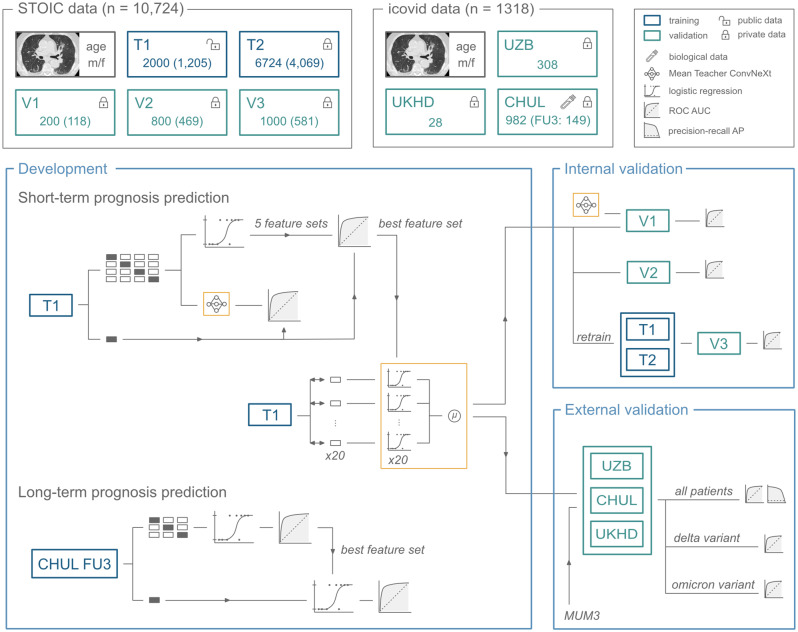
A model was developed to identify patients at risk of developing severe COVID-19 within one month based on their age, sex and imaging features extracted from the thoracic computed tomography (CT). The model was trained on publicly available data from the Study of Thoracic CT in COVID-19 (STOIC) challenge and validated on unseen data from the same study and an external, multicentric dataset. The model, trained on data acquired before any variant of concern dominated, was assessed separately on data collected at later stages of the pandemic when the delta and omicron variants were most prevalent.
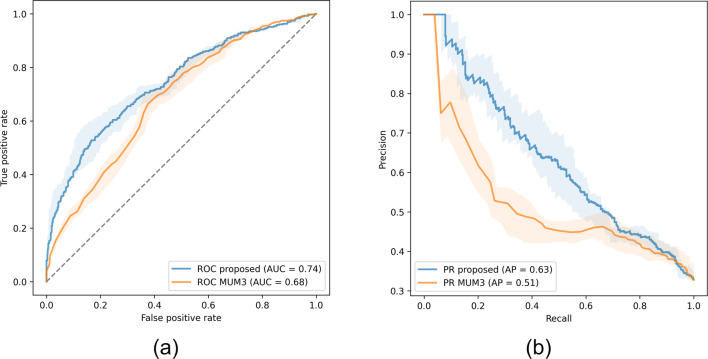
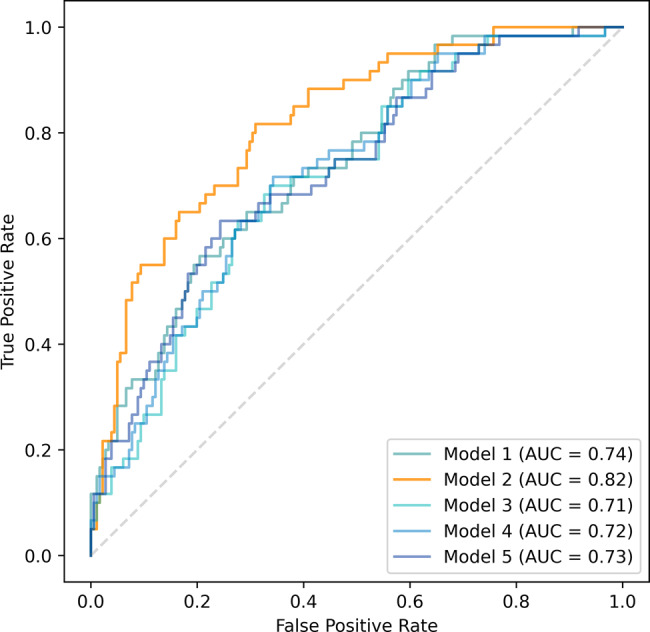
A logistic regression based on handcrafted features was found to perform on par with a direct deep learning approach, and the former was selected for simplicity. Volumetric and intensity-based features of lesions and healthy lung parenchyma proved most predictive, in addition to patient age and sex. The model reached an area under the curve of 0.78 on the challenge test set and 0.74 on the external test set. The performance did not drop for the subset acquired at a later stage of the pandemic.
A logistic regression utilizing features from thoracic CT and its metadata can provide rapid decision support by estimating short-term COVID-19 severity. Its stable performance underscores its potential for real-world clinical integration. By enabling rapid risk stratification using readily available imaging data, this approach can support early clinical decision-making, optimize resource allocation, and improve patient management, particularly during surges in COVID-19 cases. Furthermore, this study provides a foundation for future research on prognostic modelling in respiratory infections.
对新型冠状病毒肺炎(COVID-19)患者进行风险分层有助于指导医院的治疗决策、规划及资源分配。在发病率较高时期,基于从单一来源高效获取的数据建立的预后模型能够实现快速决策支持。
开发了一种模型,该模型基于患者的年龄、性别以及从胸部计算机断层扫描(CT)中提取的影像特征,识别1个月内有发展为重症COVID-19风险的患者。该模型在COVID-19胸部CT研究(STOIC)挑战赛的公开可用数据上进行训练,并在同一研究的未见过的数据以及一个外部多中心数据集上进行验证。该模型在任何关注变异株占主导之前获取的数据上进行训练,并在疫情后期(当时德尔塔和奥密克戎变异株最为流行)收集的数据上分别进行评估。
发现基于手工特征的逻辑回归与直接深度学习方法表现相当,且因简单性而选择了前者。除患者年龄和性别外,病变及健康肺实质的基于体积和强度的特征被证明最具预测性。该模型在挑战赛测试集上的曲线下面积为0.78,在外部测试集上为0.74。对于在疫情后期获取的子集,其性能并未下降。
利用胸部CT及其元数据特征的逻辑回归可通过估计COVID-19短期严重程度提供快速决策支持。其稳定的性能凸显了其在实际临床整合中的潜力。通过使用现成的影像数据实现快速风险分层,这种方法可支持早期临床决策、优化资源分配并改善患者管理,尤其是在COVID-19病例激增期间。此外,本研究为未来呼吸道感染预后建模研究奠定了基础。