Xavier Maria Teresa, Costa Ana Luísa, Caramelo Francisco José, Palma Paulo Jorge, Ramos João Carlos
Institute of Pediatric and Preventive Dentistry, Faculty of Medicine, University of Coimbra, 3000-075 Coimbra, Portugal.
Centre for Innovation and Research in Oral Sciences (CIROS), Faculty of Medicine, University of Coimbra, 3000-075 Coimbra, Portugal.
Materials (Basel). 2021 Sep 3;14(17):5055. doi: 10.3390/ma14175055.
Calcium-silicate-based cements (CSC) have gained an increasing scientific and clinical relevance, enabling more conservative approaches, namely pulp preservation and regeneration therapies. This research aims to study the influence of four clinical variables on the interfaces between CSC and composite adhesive restoration, concerning shear bond strength (SBS) and ultra-morphological patterns.
SBS tests were performed in 320 specimens divided in 16 groups (n = 20) according to: two CSC (NuSmile NeoMTA, Biodentine); two adhesive systems (Clearfil SE Bond 2 (CSEB2), Clearfil Universal Bond Quick (CUBQ)); optional application of an additional hydrophobic bonding layer (HBL); two restoration times (immediate, seven days). Scanning electron microscopy (SEM) was performed to conduct the ultra-morphology interface analysis in 32 deciduous molars prepared and randomly allocated into the 16 groups.
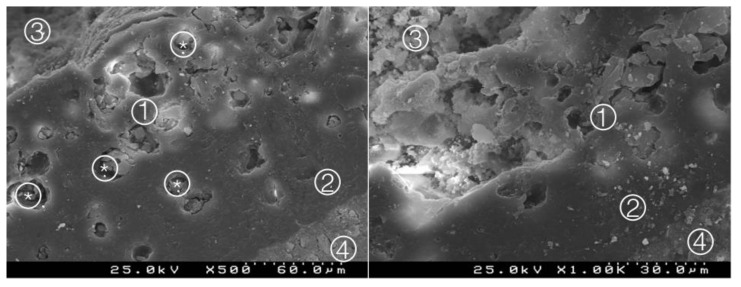
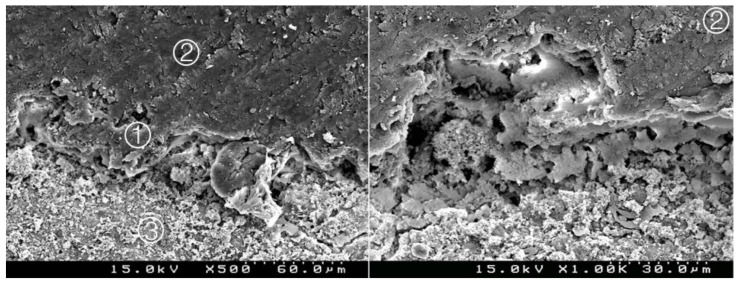
Globally, SBS tests showed higher bond strength of CUBQ compared to CSEB2 ( < 0.001), as with an additional HBL application ( = 0.014) and delayed restoration ( < 0.001). SEM showed the interpenetration between adhesive systems and CSC forming a hybrid layer, whose depth and thickness depended on the restoration time and adhesive strategy.
The independent clinical variables adhesive system, application of an additional HBL and restoration time affected the bond performance and ultra-morphological interface between composite adhesive restoration and CSC.
硅酸钙基水门汀(CSC)在科学和临床方面的相关性日益增加,使得牙髓保存和再生治疗等更为保守的方法成为可能。本研究旨在探讨四个临床变量对CSC与复合树脂粘结修复体之间界面的影响,涉及剪切粘结强度(SBS)和超微形态模式。
根据以下因素将320个样本分为16组(每组n = 20)进行SBS测试:两种CSC(NuSmile NeoMTA、Biodentine);两种粘结系统(Clearfil SE Bond 2(CSEB2)、Clearfil Universal Bond Quick(CUBQ));是否额外应用疏水粘结层(HBL);两种修复时间(即刻、七天)。对32颗制备好的乳牙进行扫描电子显微镜(SEM)检查,随机分为16组,进行超微形态界面分析。
总体而言,SBS测试显示CUBQ的粘结强度高于CSEB2(< 0.001),额外应用HBL时也是如此(= 0.014),延迟修复时同样如此(< 0.001)。SEM显示粘结系统与CSC之间相互渗透形成混合层,其深度和厚度取决于修复时间和粘结策略。
粘结系统、额外应用HBL和修复时间等独立临床变量会影响复合树脂粘结修复体与CSC之间的粘结性能和超微形态界面。