Rogowska Aleksandra Maria, Kuśnierz Cezary, Ochnik Dominika
Institute of Psychology, Faculty of Social Sciences, University of Opole, 45-052 Opole, Poland.
Faculty of Physical Education and Physiotherapy, Opole University of Technology, 45-758 Opole, Poland.
J Clin Med. 2021 Sep 6;10(17):4025. doi: 10.3390/jcm10174025.
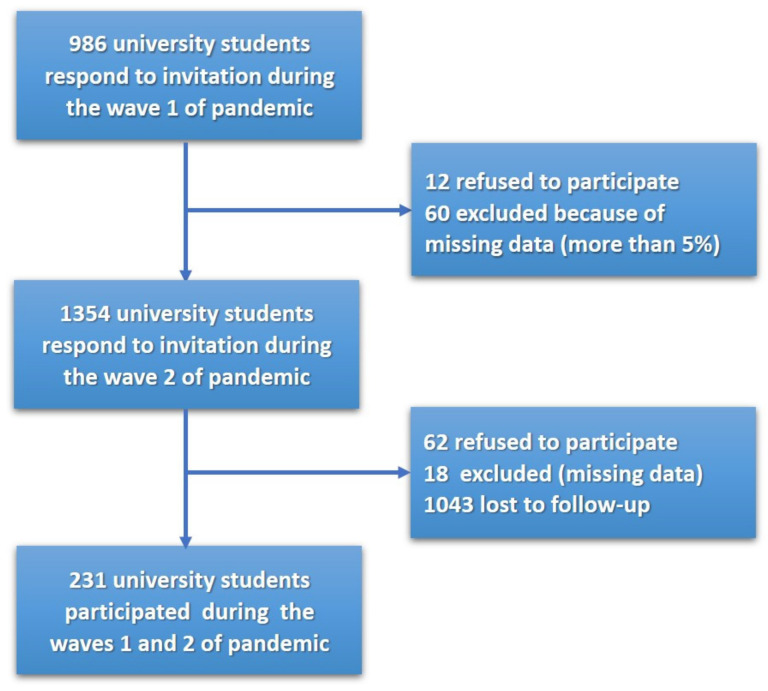
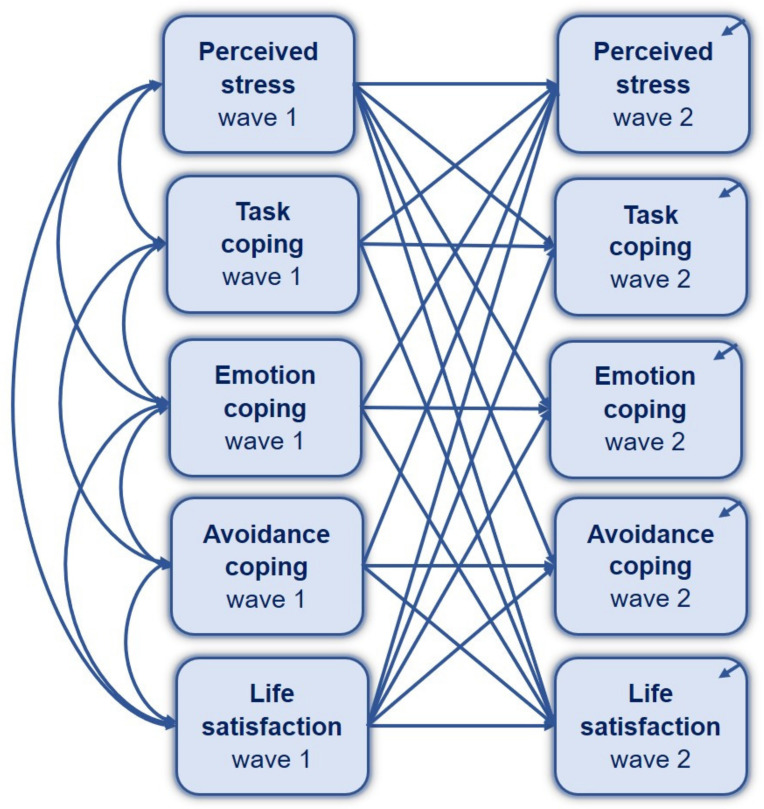
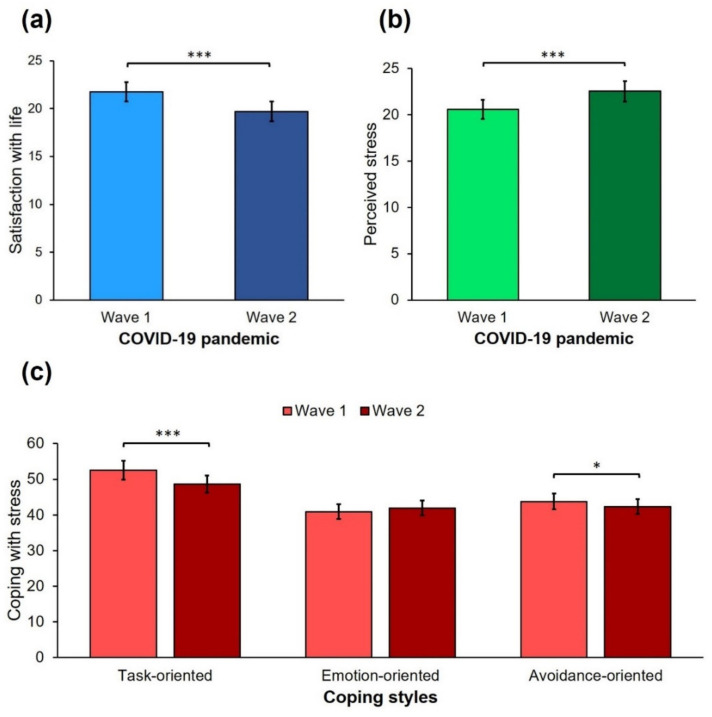
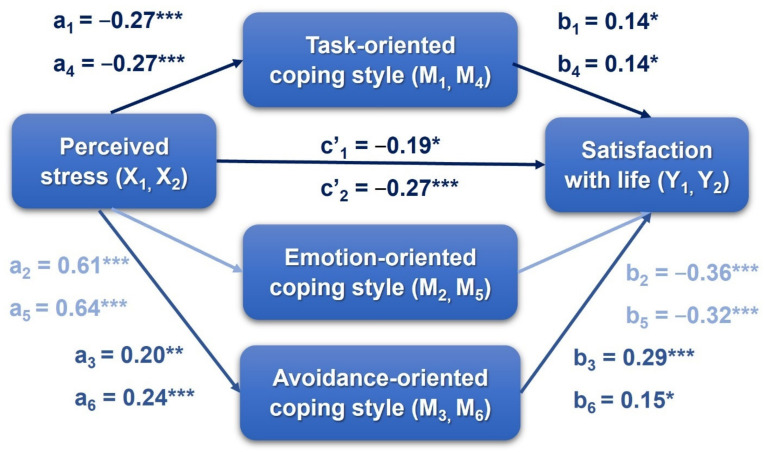
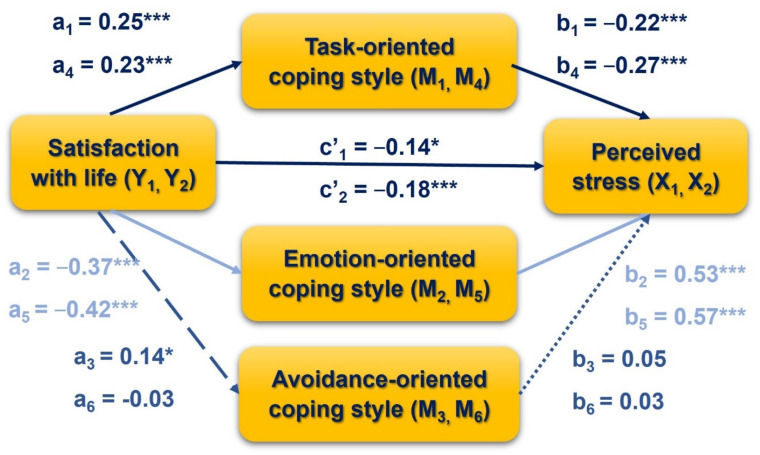
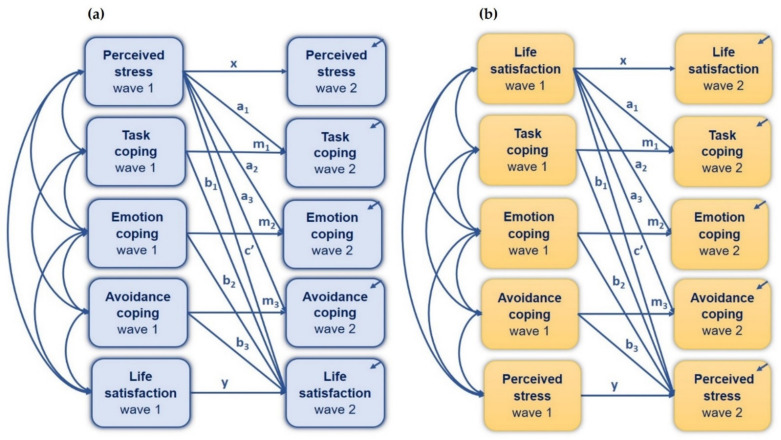
In this study, we aimed to explain the interplay mechanism between stress, life satisfaction, and coping styles among university students. A cohort study was performed during the first (wave 1; W1) and second (wave 2; W2) waves of the Coronavirus disease 2019 (COVID-19) pandemic. The total sample included 231 university students, of which 59.31% were women. The Satisfaction with Life Scale (SWLS), Perceived Stress Scale (PSS), and Coping Inventory for Stressful Situations (CISS) were included in one online survey. Stress, emotion-oriented, and avoidance-oriented coping styles increased from W1 to W2 of the COVID-19 pandemic, while life satisfaction and task-oriented coping decreased. The partial mediation effect of all three coping styles during W1 and W2 (in a cross-sectional approach) on the relationship between perceived stress and life satisfaction was confirmed in this study. The task-oriented and emotion-oriented coping styles can play a mediating role in the reciprocal relationship between life satisfaction and perceived stress during W1 and W2 of the pandemic. There were no mutual interactions between stress and life satisfaction from a longitudinal approach. Coping styles changed subsequently due to stressful environmental changes related to lockdown during the COVID-19 pandemic. Having a wide range of coping strategies from which to choose during an unstable situation should help manage stress and well-being.
在本研究中,我们旨在解释大学生压力、生活满意度和应对方式之间的相互作用机制。在2019年冠状病毒病(COVID-19)大流行的第一波(第1波;W1)和第二波(第2波;W2)期间进行了一项队列研究。总样本包括231名大学生,其中59.31%为女性。一项在线调查纳入了生活满意度量表(SWLS)、感知压力量表(PSS)和应激情境应对量表(CISS)。从COVID-19大流行的W1到W2,压力、情绪导向和回避导向的应对方式增加,而生活满意度和任务导向的应对方式下降。本研究证实了在W1和W2期间(采用横断面方法),所有三种应对方式对感知压力与生活满意度之间关系的部分中介作用。在大流行的W1和W2期间,任务导向和情绪导向的应对方式在生活满意度与感知压力的相互关系中可发挥中介作用。从纵向角度来看,压力与生活满意度之间不存在相互作用。在COVID-19大流行期间,由于与封锁相关的压力环境变化,应对方式随后发生了改变。在不稳定的情况下有多种应对策略可供选择应有助于管理压力和促进幸福感。