Institute of Psychology, Faculty of Social Sciences, University of Opole, pl. Staszica 1, 45-052, Opole, Poland.
Faculty of Medicine, University of Technology, ul. Rolna 43, 40-555, Katowice, Poland.
BMC Psychol. 2022 Nov 7;10(1):255. doi: 10.1186/s40359-022-00950-1.
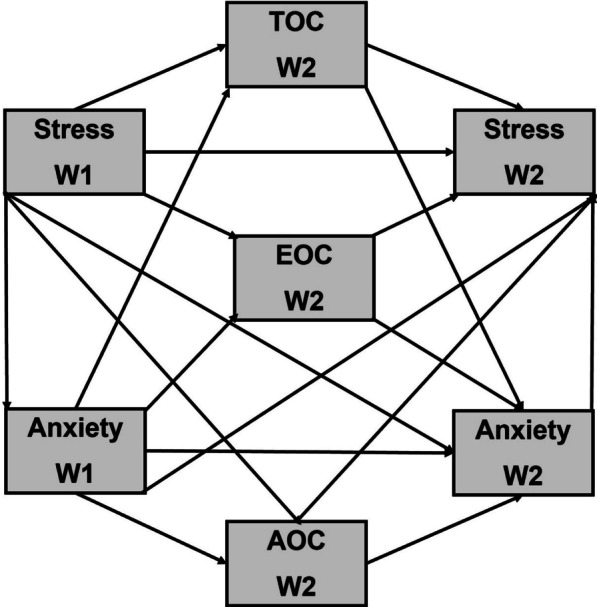
Although the Multidimensional Interaction Model of Stress, Anxiety and Coping (MIMSAC) has been known for years, there is a lack of research examining this theory longitudinally in stressful events. This study aims to revisit the MIMSAC among university students during the COVID-19 pandemic.
A prospective cohort study with the longitudinal design was performed during the first (W1, March 30-April 29, 2020) and second wave (W2, November 3-December 3, 2020) of the COVID-19 pandemic. A total of 216 university students with a mean age of 22 years (ranging from 20 to 36, M = 22.13, SD = 2.04) participated in the study. An online survey included Perceived Stress Scale, Coping Inventory for Stressful Situations, and Generalized Anxiety Disorder.
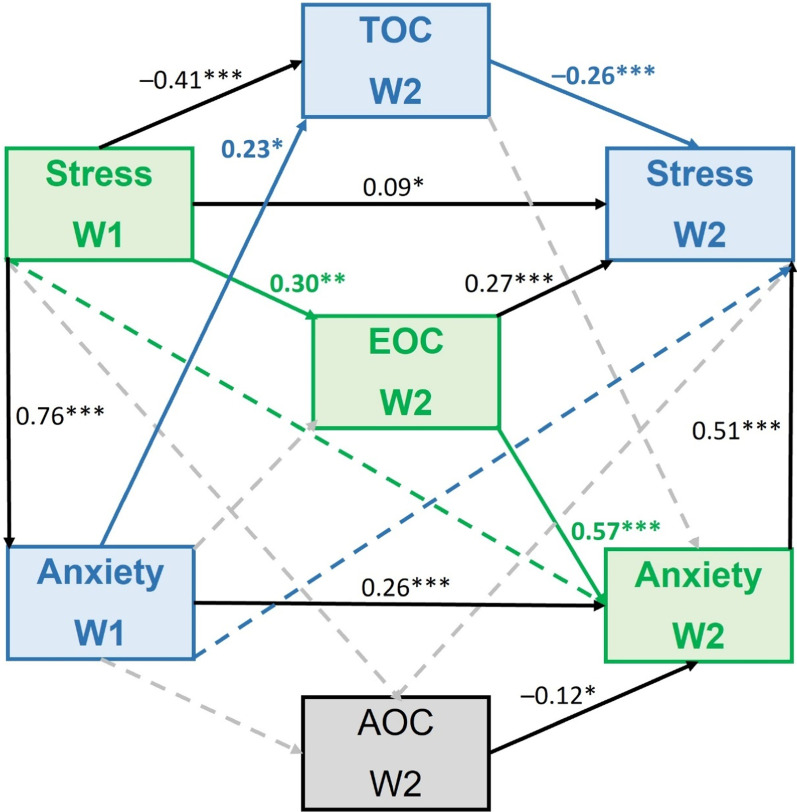
Due to the MIMSAC, all variables changed substantially across W1 and W2, adapting to an unpredictable environment. Women scored higher than men in stress, anxiety, emotion- and avoidance-oriented coping styles. We found the indirect effect of emotion-oriented coping on the stress-anxiety relationship and task-oriented coping on the anxiety-stress interaction. Avoidance was not found as a mediator in the stress-anxiety interaction.
Emotion-oriented coping adversely affected mental health, increasing anxiety in response to stress during the COVID-19 pandemic. Task-oriented coping efficiently decreased stress in reaction to high anxiety, but only in men. Avoidance seems to be an ineffective coping style during the COVID-19 pandemic. Campus intervention programs should focus on reducing negative emotions and increasing the frequency of task-oriented coping strategies among university students.
尽管多维应激、焦虑和应对互动模型(MIMSAC)已经存在多年,但在应激事件中对该理论进行纵向研究的却很少。本研究旨在在 COVID-19 大流行期间重新研究大学生中的 MIMSAC。
在 COVID-19 大流行的第一波(W1,2020 年 3 月 30 日至 4 月 29 日)和第二波(W2,2020 年 11 月 3 日至 12 月 3 日)期间进行了前瞻性队列研究。共有 216 名年龄在 20 至 36 岁之间的平均年龄为 22 岁的大学生(M = 22.13,SD = 2.04)参与了该研究。在线调查包括应激量表、应对压力情况的应对量表和广泛性焦虑症量表。
由于 MIMSAC,所有变量在 W1 和 W2 之间都发生了很大变化,以适应不可预测的环境。女性在应激、焦虑、情绪和回避应对方式方面的得分均高于男性。我们发现情绪应对对应激焦虑关系和任务应对对焦虑应激相互作用有间接影响。回避在应激焦虑相互作用中没有作为中介。
情绪应对方式对心理健康产生负面影响,在 COVID-19 大流行期间,情绪应对方式增加了应激引起的焦虑。任务应对方式有效地降低了高焦虑反应的应激,但仅在男性中如此。回避在 COVID-19 大流行期间似乎是一种无效的应对方式。校园干预计划应重点减少大学生的消极情绪,并增加任务应对策略的频率。