Department Ergonomics: Physical Environmental Factors, Institute for Occupational Safety and Health of the German Social Accident Insurance, D-53757 Sankt Augustin, Germany.
Department of Dermatology, Faculty of Medicine, Technische Universitaet Dresden, D-01307 Dresden, Germany.
Int J Environ Res Public Health. 2021 Aug 27;18(17):9071. doi: 10.3390/ijerph18179071.
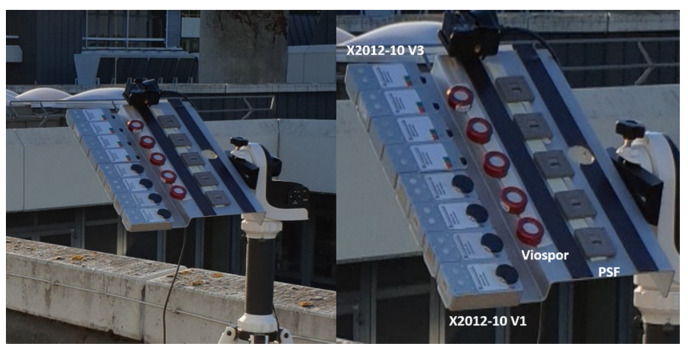
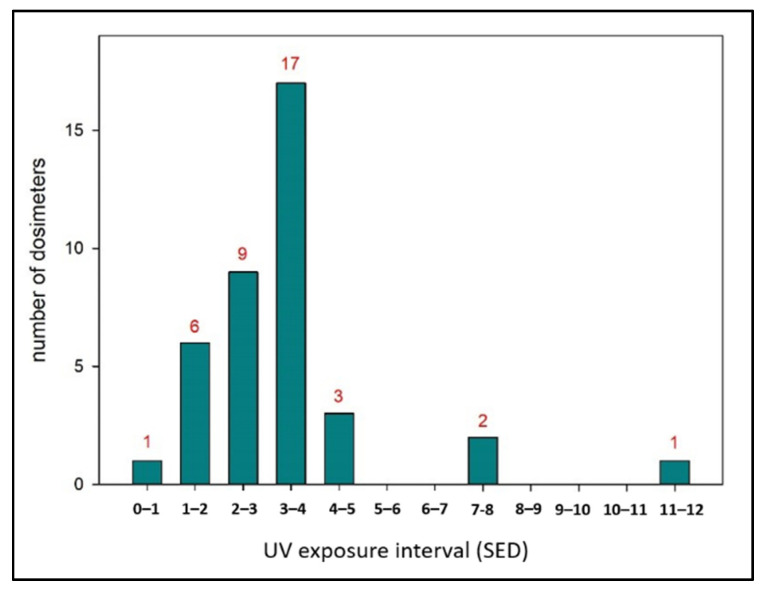
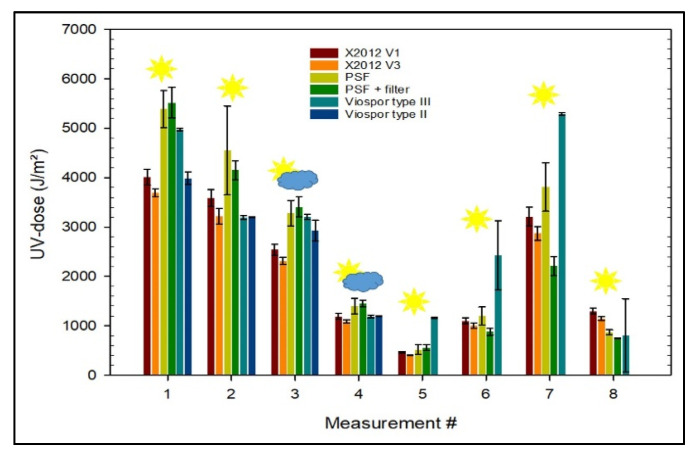
(1) Measuring personal exposure to solar ultraviolet radiation (UVR) poses a major challenges for researchers. Often, the study design determines the measuring devices that can be used, be it the duration of measurements or size restrictions on different body parts. It is therefore of great importance that measuring devices produce comparable results despite technical differences and modes of operation. Particularly when measurement results from different studies dealing with personal UV exposure are to be compared with each other, the need for intercomparability and intercalibration factors between different measurement systems becomes significant. (2) Three commonly used dosimeter types-(polysulphone film (PSF), biological, and electronic dosimeters)-were selected to perform intercalibration measurements. They differ in measurement principle and sensitivity, measurement accuracy, and susceptibility to inaccuracies. The aim was to derive intercalibration factors for these dosimeter types. (3) While a calibration factor between PSF and electronic dosimeters of about 1.3 could be derived for direct irradiation of the dosimeters, this was not the case for larger angles of incidence of solar radiation with increasing fractions of diffuse irradiation. Electronic dosimeters show small standard deviation across all measurements. For biological dosimeters, no intercalibration factor could be found with respect to PSF and electronic dosimeters. In a use case, the relation between steady-state measurements and personal measurements was studied. On average, persons acquired only a small fraction of the ambient radiation.
(1)测量个人暴露于太阳紫外线辐射(UVR)对研究人员来说是一个重大挑战。通常,研究设计决定了可以使用的测量设备,无论是测量的持续时间还是不同身体部位的尺寸限制。因此,尽管测量设备在技术上存在差异和操作模式不同,但产生可比较的结果非常重要。特别是当来自不同研究的个人紫外线暴露测量结果要相互比较时,不同测量系统之间的可比性和校准因素的需求变得非常重要。(2)选择三种常用的剂量计类型(聚砜膜(PSF)、生物和电子剂量计)进行相互校准测量。它们在测量原理和灵敏度、测量精度以及对不准确的敏感性方面存在差异。目的是为这些剂量计类型推导校准因素。(3)虽然可以为 PSF 和电子剂量计之间的直接照射推导约 1.3 的校准因子,但对于太阳辐射入射角较大且漫射辐射比例增加的情况并非如此。电子剂量计在所有测量中显示出较小的标准偏差。对于生物剂量计,无法找到与 PSF 和电子剂量计相关的校准因子。在一个用例中,研究了稳态测量和个人测量之间的关系。平均而言,个人只获得了环境辐射的一小部分。