Centre for Translational Bone, Joint and Soft Tissue Research, University Hospital and Faculty of Medicine, Technische Universität Dresden, D-01307 Dresden, Germany.
Institute of Textile Machinery and High Performance Material Technology, Technische Universität Dresden, D-01062 Dresden, Germany.
Int J Mol Sci. 2021 Aug 28;22(17):9341. doi: 10.3390/ijms22179341.
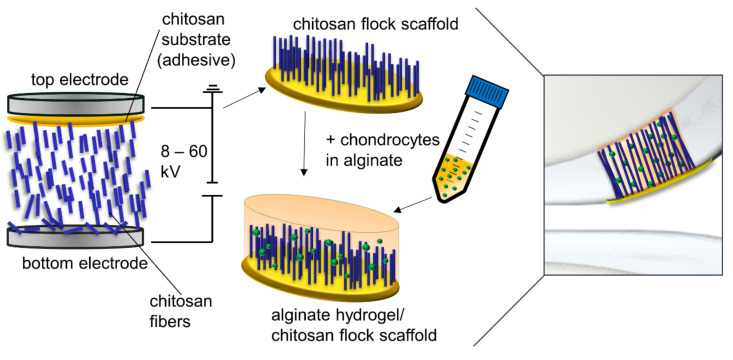
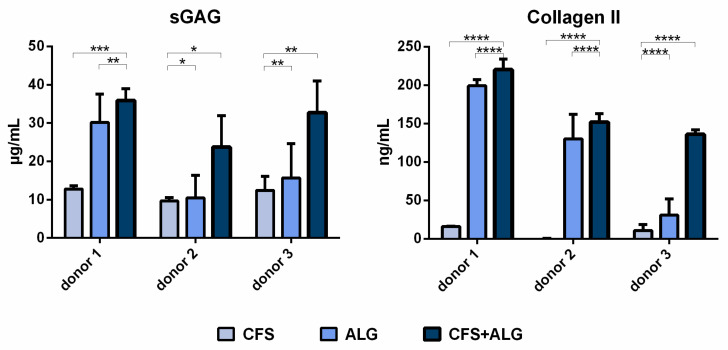
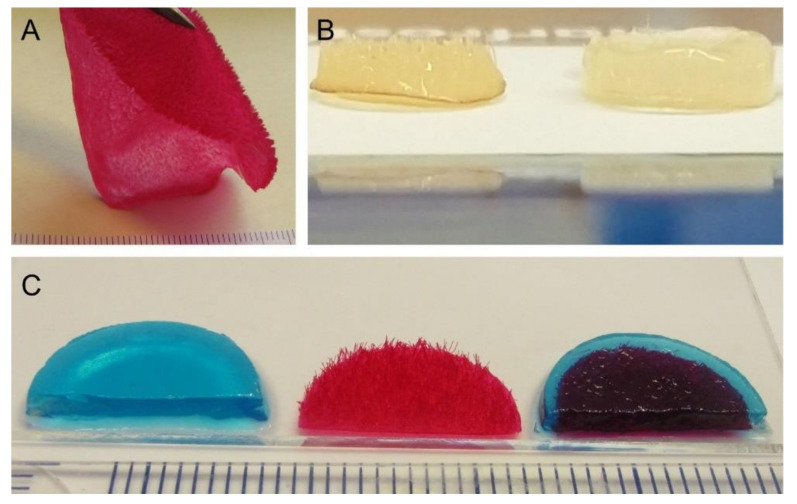
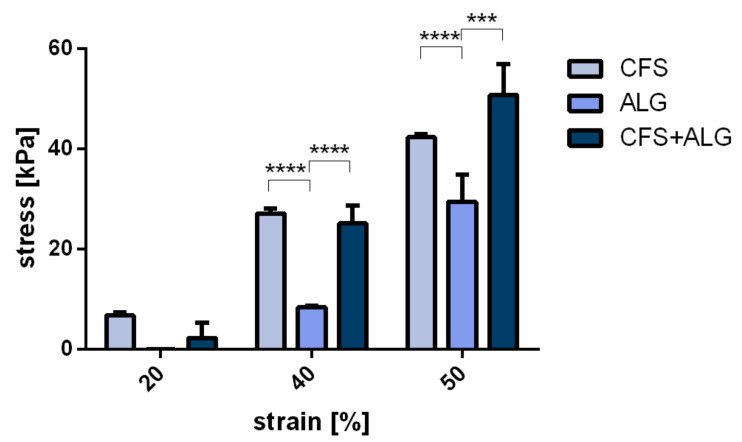
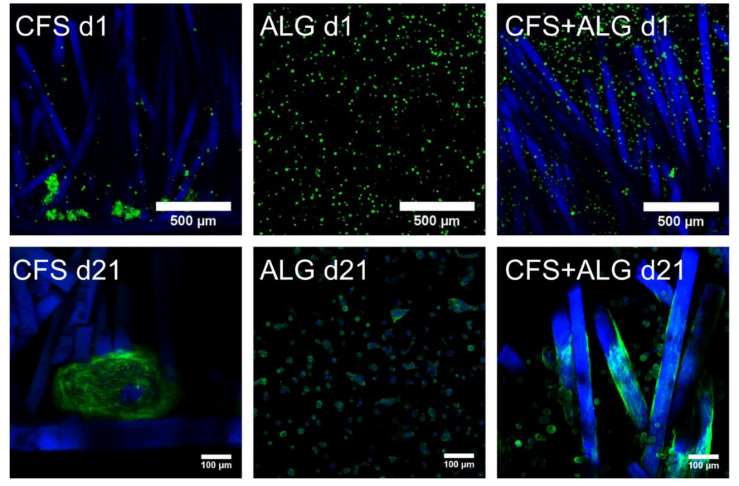
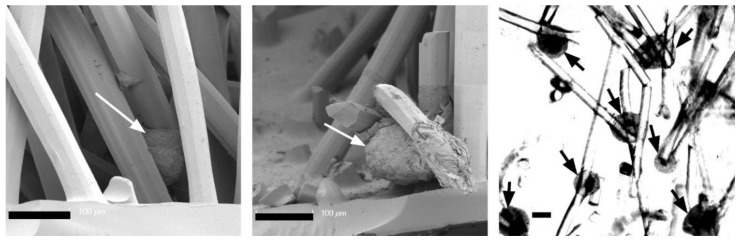
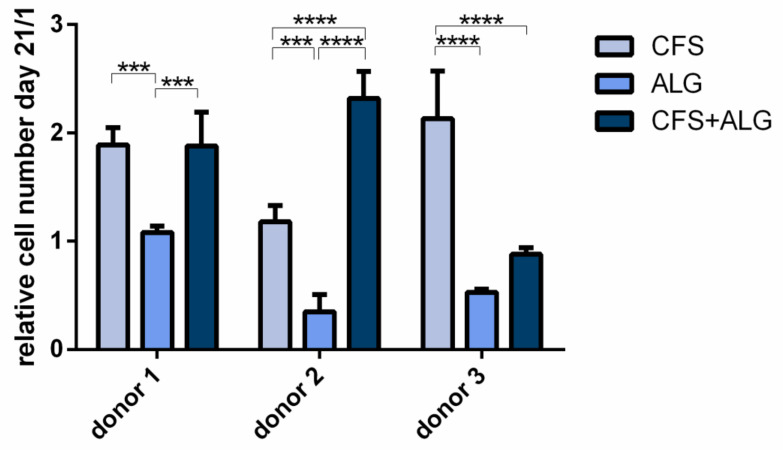
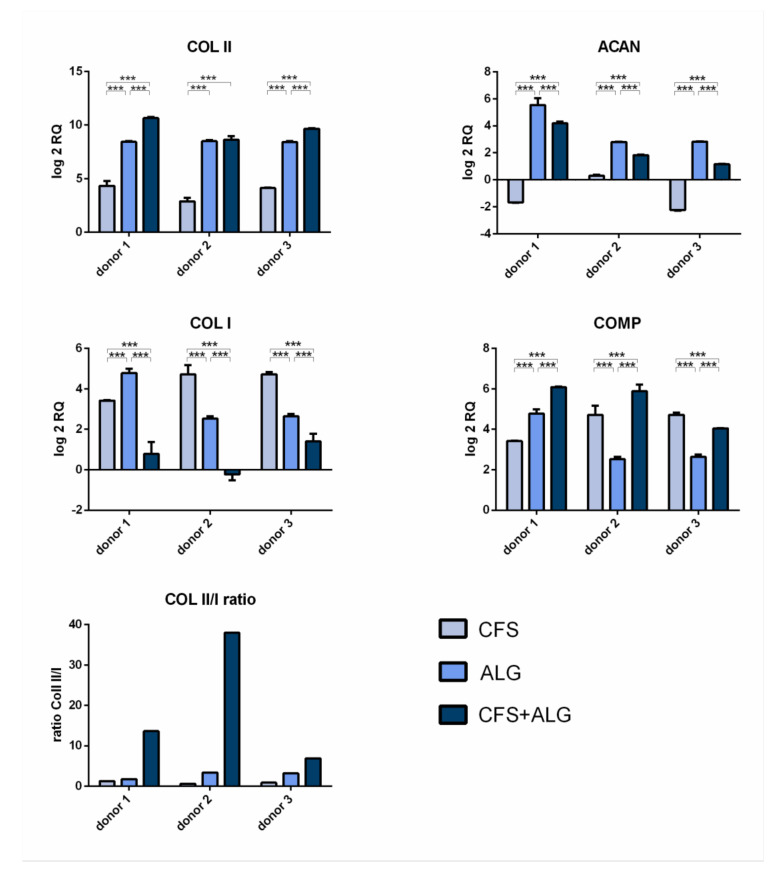
The replacement of damaged or degenerated articular cartilage tissue remains a challenge, as this non-vascularized tissue has a very limited self-healing capacity. Therefore, tissue engineering (TE) of cartilage is a promising treatment option. Although significant progress has been made in recent years, there is still a lack of scaffolds that ensure the formation of functional cartilage tissue while meeting the mechanical requirements for chondrogenic TE. In this article, we report the application of flock technology, a common process in the modern textile industry, to produce flock scaffolds made of chitosan (a biodegradable and biocompatible biopolymer) for chondrogenic TE. By combining an alginate hydrogel with a chitosan flock scaffold (CFS+ALG), a fiber-reinforced hydrogel with anisotropic properties was developed to support chondrogenic differentiation of embedded human chondrocytes. Pure alginate hydrogels (ALG) and pure chitosan flock scaffolds (CFS) were studied as controls. Morphology of primary human chondrocytes analyzed by cLSM and SEM showed a round, chondrogenic phenotype in CFS+ALG and ALG after 21 days of differentiation, whereas chondrocytes on CFS formed spheroids. The compressive strength of CFS+ALG was higher than the compressive strength of ALG and CFS alone. Chondrocytes embedded in CFS+ALG showed gene expression of chondrogenic markers (), the highest collagen II/I ratio, and production of the typical extracellular matrix such as sGAG and collagen II. The combination of alginate hydrogel with chitosan flock scaffolds resulted in a scaffold with anisotropic structure, good mechanical properties, elasticity, and porosity that supported chondrogenic differentiation of inserted human chondrocytes and expression of chondrogenic markers and typical extracellular matrix.
关节软骨组织的损伤或退化仍然是一个挑战,因为这种非血管化组织的自我修复能力非常有限。因此,软骨的组织工程(TE)是一种很有前途的治疗选择。尽管近年来取得了重大进展,但仍缺乏既能确保功能性软骨组织形成,又能满足软骨 TE 的机械要求的支架。在本文中,我们报告了 flock 技术的应用,这是现代纺织工业中的一项常见工艺,用于生产壳聚糖(一种可生物降解和生物相容的生物聚合物)的 flock 支架,用于软骨 TE。通过将藻酸盐水凝胶与壳聚糖 flock 支架(CFS+ALG)结合,开发了一种具有各向异性的纤维增强水凝胶,以支持嵌入的人软骨细胞的软骨分化。纯藻酸盐水凝胶(ALG)和纯壳聚糖 flock 支架(CFS)作为对照进行了研究。通过 cLSM 和 SEM 分析原代人软骨细胞的形态,发现 CFS+ALG 和 ALG 在分化 21 天后呈现出圆形的软骨细胞表型,而 CFS 上的软骨细胞形成了球体。CFS+ALG 的压缩强度高于 ALG 和 CFS 单独的压缩强度。嵌入 CFS+ALG 中的软骨细胞表现出软骨形成标志物的基因表达(),最高的胶原 II/I 比值,以及典型的细胞外基质如 sGAG 和胶原 II 的产生。藻酸盐水凝胶与壳聚糖 flock 支架的结合产生了一种具有各向异性结构、良好的机械性能、弹性和孔隙率的支架,支持插入的人软骨细胞的软骨分化以及软骨形成标志物和典型细胞外基质的表达。