Honrubia-Peris Beatriz, Garde-Noguera Javier, García-Sánchez Jose, Piera-Molons Nuria, Llombart-Cussac Antonio, Fernández-Murga María Leonor
Medical Oncology Department, Hospital Arnau de Vilanova, Fundación para el Fomento de la Investigación Sanitaria i Biomédica de la Comunidad Valenciana (FISABIO), 46020 Valencia, Spain.
Cancers (Basel). 2021 Aug 25;13(17):4280. doi: 10.3390/cancers13174280.
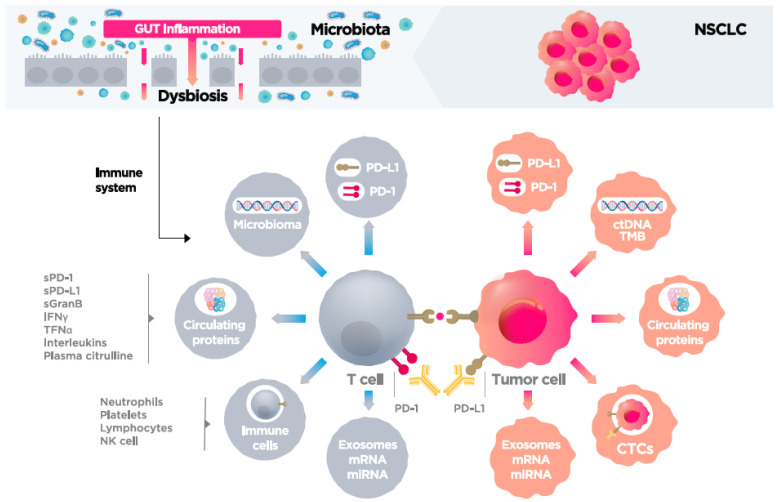
Numerous targeted therapies have been evaluated for the treatment of non-small cell lung cancer (NSCLC). To date, however, only a few agents have shown promising results. Recent advances in cancer immunotherapy, most notably immune checkpoint inhibitors (ICI), have transformed the treatment scenario for these patients. Although some patients respond well to ICIs, many patients do not benefit from ICIs, leading to disease progression and/or immune-related adverse events. New biomarkers capable of reliably predicting response to ICIs are urgently needed to improve patient selection. Currently available biomarkers-including programmed death protein 1 (PD-1) and its ligand (PD-L1), and tumor mutational burden (TMB)-have major limitations. At present, no well-validated, reliable biomarkers are available. Ideally, these biomarkers would be obtained through less invasive methods such as plasma determination or liquid biopsy. In the present review, we describe recent advances in the development of novel soluble biomarkers (e.g., circulating immune cells, TMB, circulating tumor cells, circulating tumor DNA, soluble factor PD-L1, tumor necrosis factor, etc.) for patients with NSCLC treated with ICIs. We also describe the potential use of these biomarkers as prognostic indicators of treatment response and toxicity.
针对非小细胞肺癌(NSCLC)的治疗,已经评估了众多靶向疗法。然而,迄今为止,只有少数药物显示出有前景的结果。癌症免疫疗法的最新进展,最显著的是免疫检查点抑制剂(ICI),已经改变了这些患者的治疗局面。尽管一些患者对ICI反应良好,但许多患者并未从ICI中获益,导致疾病进展和/或免疫相关不良事件。迫切需要能够可靠预测对ICI反应的新生物标志物,以改善患者选择。目前可用的生物标志物,包括程序性死亡蛋白1(PD-1)及其配体(PD-L1)以及肿瘤突变负荷(TMB),都有重大局限性。目前,尚无经过充分验证的可靠生物标志物。理想情况下,这些生物标志物可以通过血浆检测或液体活检等侵入性较小的方法获得。在本综述中,我们描述了用于接受ICI治疗的NSCLC患者的新型可溶性生物标志物(例如循环免疫细胞、TMB、循环肿瘤细胞、循环肿瘤DNA、可溶性因子PD-L1、肿瘤坏死因子等)开发的最新进展。我们还描述了这些生物标志物作为治疗反应和毒性预后指标的潜在用途。