Newcombe Estella A, Due Amanda D, Sottini Andrea, Elkjær Steffie, Theisen Frederik Friis, Fernandes Catarina B, Staby Lasse, Delaforge Elise, Bartling Christian R O, Brakti Inna, Bugge Katrine, Schuler Benjamin, Skriver Karen, Olsen Johan G, Kragelund Birthe B
REPIN, Department of Biology, University of Copenhagen, Copenhagen N, Denmark.
Structural Biology and NMR Laboratory, Department of Biology, University of Copenhagen, Copenhagen N, Denmark.
Nature. 2024 Dec;636(8043):762-768. doi: 10.1038/s41586-024-08271-6. Epub 2024 Nov 27.
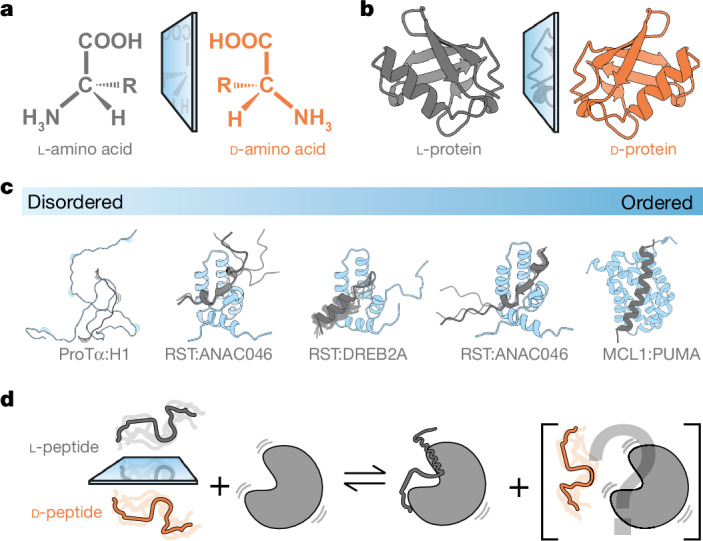
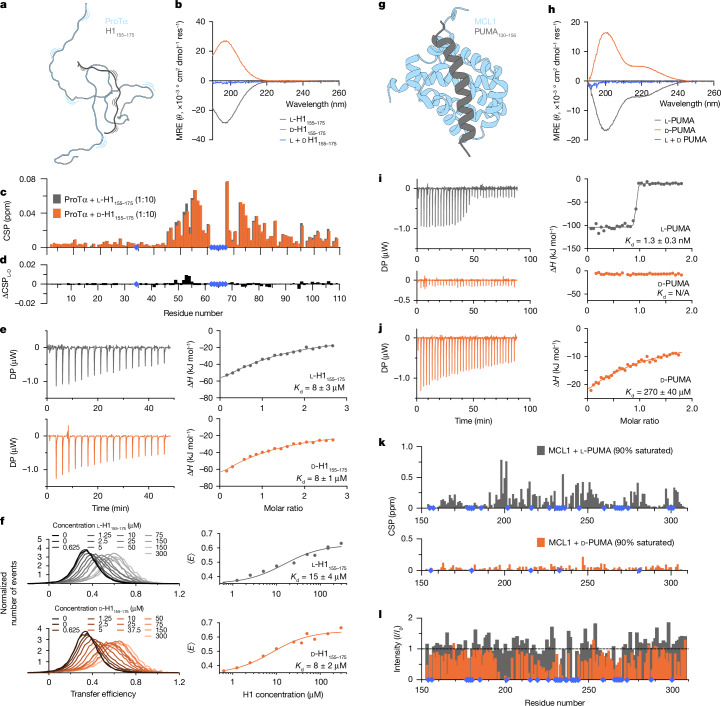
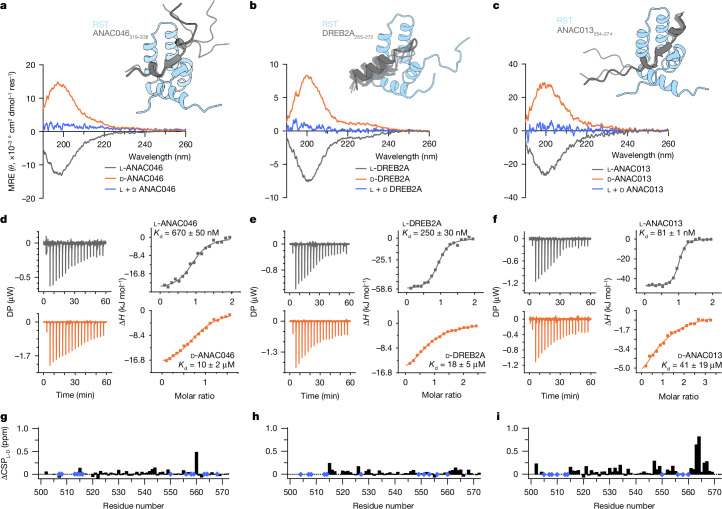
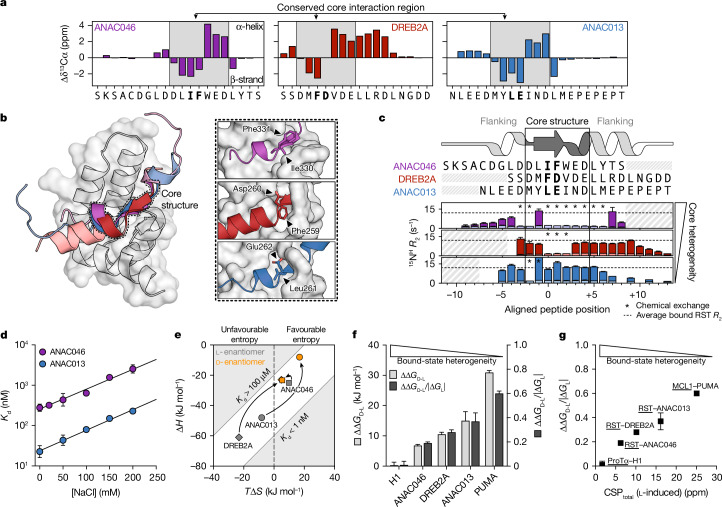
Intrinsically disordered proteins can bind via the formation of highly disordered protein complexes without the formation of three-dimensional structure. Most naturally occurring proteins are levorotatory (L)-that is, made up only of L-amino acids-imprinting molecular structure and communication with stereochemistry. By contrast, their mirror-image dextrorotatory (D)-amino acids are rare in nature. Whether disordered protein complexes are truly independent of chiral constraints is not clear. Here, to investigate the chiral constraints of disordered protein-protein interactions, we chose as representative examples a set of five interacting protein pairs covering the disorder-order continuum. By observing the natural ligands and their stereochemical mirror images in free and bound states, we found that chirality was inconsequential in a fully disordered complex. However, if the interaction relied on the ligand undergoing extensive coupled folding and binding, correct stereochemistry was essential. Between these extremes, binding could be observed for the D-ligand with a strength that correlated with disorder in the final complex. These findings have important implications for our understanding of the molecular processes that lead to complex formation, the use of D-peptides in drug discovery and the chemistry of protein evolution of the first living entities on Earth.
内在无序蛋白质可以通过形成高度无序的蛋白质复合物进行结合,而无需形成三维结构。大多数天然存在的蛋白质是左旋(L)型的,也就是说,仅由L-氨基酸组成,它们印记分子结构并与立体化学进行通信。相比之下,它们的镜像右旋(D)-氨基酸在自然界中很少见。无序蛋白质复合物是否真的不受手性限制尚不清楚。在这里,为了研究无序蛋白质-蛋白质相互作用的手性限制,我们选择了一组涵盖无序-有序连续体的五个相互作用蛋白质对作为代表性例子。通过观察天然配体及其在游离态和结合态的立体化学镜像,我们发现手性在完全无序的复合物中无关紧要。然而,如果相互作用依赖于配体经历广泛的耦合折叠和结合,正确的立体化学则至关重要。在这些极端情况之间,可以观察到D-配体的结合,其强度与最终复合物中的无序程度相关。这些发现对于我们理解导致复合物形成的分子过程、D-肽在药物发现中的应用以及地球上第一个生命实体的蛋白质进化化学具有重要意义。