Gamperl Anthony K, Zrini Zoe A, Sandrelli Rebeccah M
Department of Ocean Sciences, Memorial University, St. John's, NL, Canada.
Front Physiol. 2021 Aug 24;12:719594. doi: 10.3389/fphys.2021.719594. eCollection 2021.
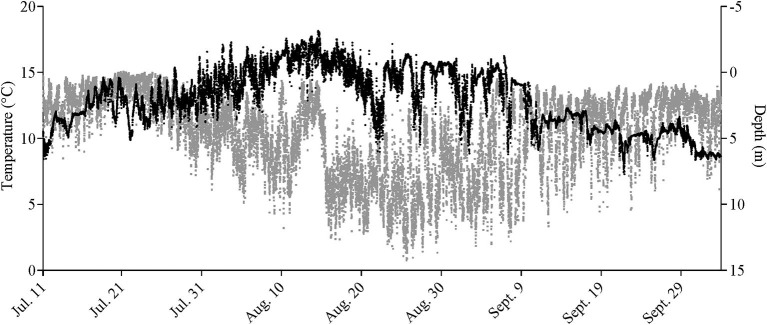
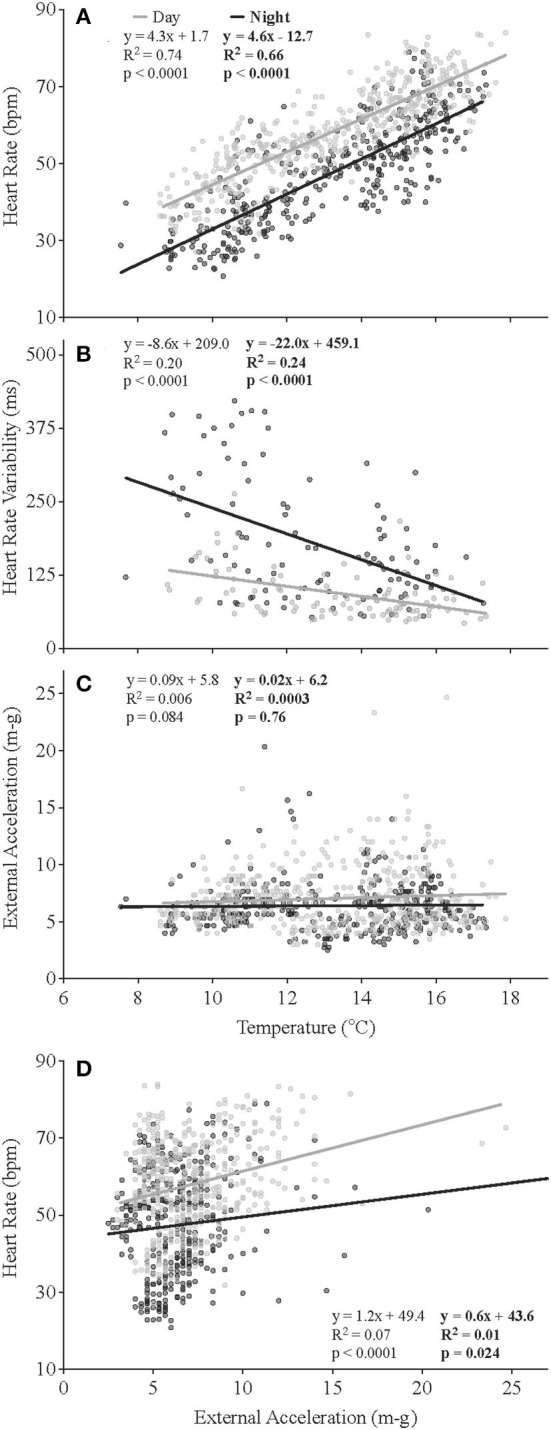
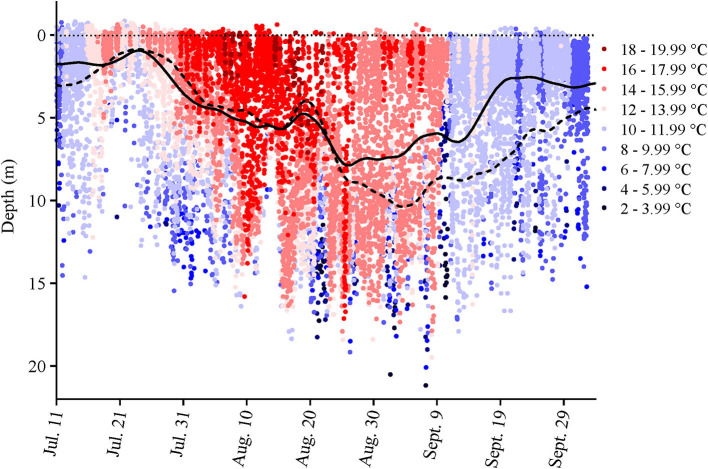
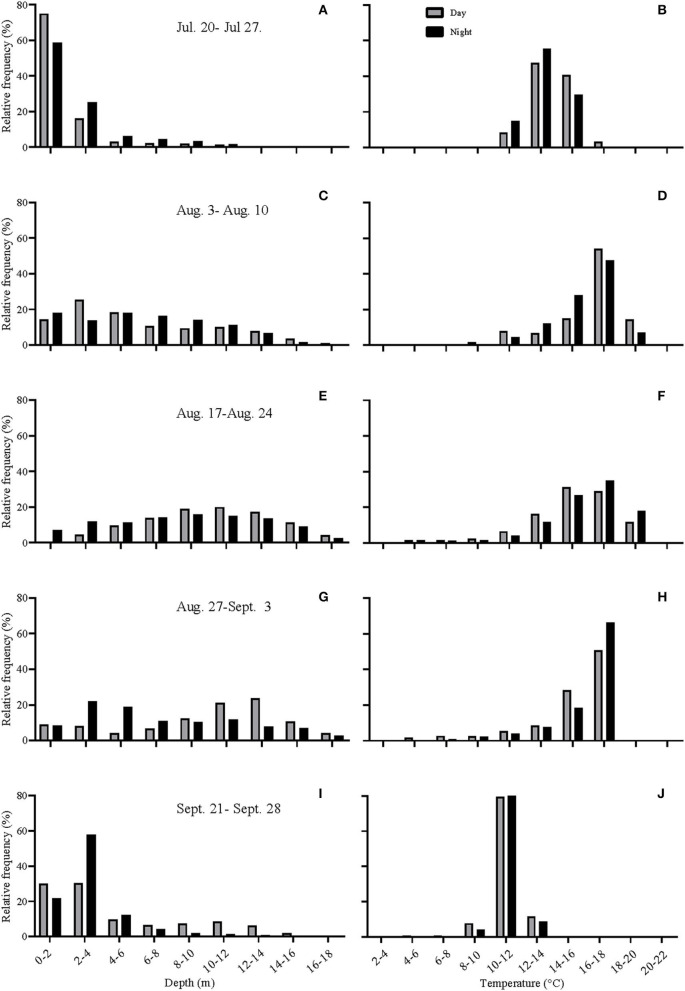
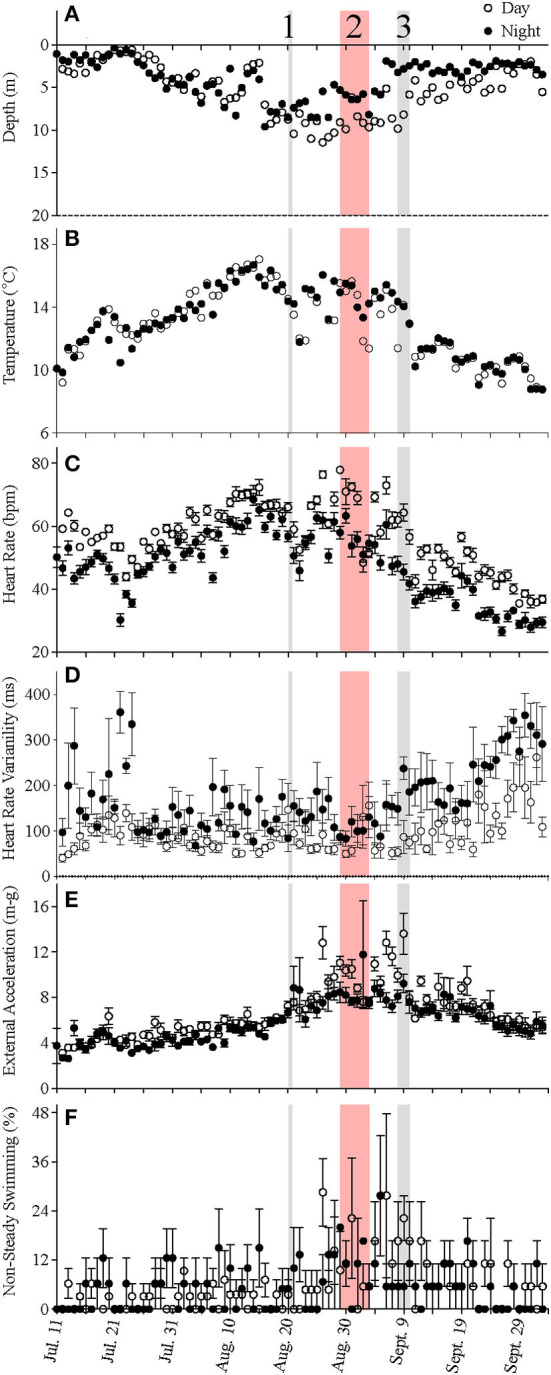
Climate change is leading to increased water temperatures and reduced oxygen levels at sea-cage sites, and this is a challenge that the Atlantic salmon aquaculture industry must adapt to it if it needs to grow sustainably. However, to do this, the industry must better understand how sea-cage conditions influence the physiology and behavior of the fish. We fitted 2.5 kg Atlantic salmon on the south coast of Newfoundland with Star-Oddi milli-HRT ACT and Milli-TD data loggers (data storage tags, DSTs) in the summer of 2019 that allowed us to simultaneously record the fish's 3D acceleration (i.e., activity/behavior), electrocardiograms (and thus, heart rate and heart rate variability), depth, and temperature from early July to mid-October. Over the course of the summer/fall, surface water temperatures went from ~10-12 to 18-19.5°C, and then fell to 8°C. The data provide valuable information on how cage-site conditions affected the salmon and their determining factors. For example, although the fish typically selected a temperature of 14-18°C when available (i.e., this is their preferred temperature in culture), and thus were found deeper in the cage as surface water temperatures peaked, they continued to use the full range of depths available during the warmest part of the summer. The depth occupied by the fish and heart rate were greater during the day, but the latter effect was not temperature-related. Finally, while the fish generally swam at 0.4-1.0 body lengths per second (25-60 cm s), their activity and the proportion of time spent using non-steady swimming (i.e., burst-and-coast swimming) increased when feeding was stopped at high temperatures. Data storage tags that record multiple parameters are an effective tool to understand how cage-site conditions and management influence salmon (fish) behavior, physiology, and welfare in culture, and can even be used to provide fine-scale mapping of environmental conditions. The data collected here, and that in recent publications, strongly suggest that pathogen (biotic) challenges in combination with high temperatures, not high temperatures + moderate hypoxia (70% air saturation) by themselves, are the biggest climate-related challenge facing the salmon aquaculture industry outside of Tasmania.
气候变化正导致海水网箱养殖场地的水温升高和氧含量降低,这是大西洋鲑鱼养殖业若要实现可持续增长就必须适应的一项挑战。然而,要做到这一点,该行业必须更好地了解海水网箱养殖条件如何影响鱼类的生理和行为。2019年夏天,我们在纽芬兰岛南岸为体重约2.5千克的大西洋鲑鱼安装了Star-Oddi milli-HRT ACT和Milli-TD数据记录器(数据存储标签,DST),使我们能够在7月初至10月中旬期间同时记录鱼类的三维加速度(即活动/行为)、心电图(进而记录心率和心率变异性)、深度和温度。在整个夏末秋初期间,表层水温从约10 - 12摄氏度升至18 - 19.5摄氏度,随后又降至8摄氏度。这些数据提供了关于网箱养殖场地条件如何影响鲑鱼及其决定因素的宝贵信息。例如,尽管鱼类通常会选择14 - 18摄氏度的水温(即这是它们养殖环境中的偏好水温),因此在表层水温达到峰值时会在网箱中更深的位置被发现,但在夏季最炎热的时候,它们仍会利用整个可利用的深度范围。鱼类所处深度和心率在白天更高,但后者与温度无关。最后,虽然鱼类通常每秒游动0.4 - 1.0个体长(25 - 60厘米/秒),但当在高温下停止投喂时,它们的活动以及非稳定游动(即爆发 - 滑行游动)所花费时间的比例会增加。记录多个参数的数据存储标签是了解网箱养殖场地条件和管理如何影响养殖鲑鱼(鱼类)行为、生理和健康状况的有效工具,甚至可用于提供环境条件的精细尺度地图。此处收集的数据以及近期出版物中的数据都有力地表明,病原体(生物)挑战与高温相结合,而非高温加上中度缺氧(约70%空气饱和度)本身,是塔斯马尼亚岛以外的鲑鱼养殖业面临的最大气候相关挑战。