• 文献检索
  • 文档翻译
  • 深度研究
  • 学术资讯
  • Suppr Zotero 插件Zotero 插件
  • 邀请有礼
  • 套餐&价格
  • 历史记录
应用&插件
Suppr Zotero 插件Zotero 插件浏览器插件Mac 客户端Windows 客户端微信小程序
定价
高级版会员购买积分包购买API积分包
服务
文献检索文档翻译深度研究API 文档MCP 服务
关于我们
关于 Suppr公司介绍联系我们用户协议隐私条款
关注我们

Suppr 超能文献

核心技术专利:CN118964589B侵权必究
粤ICP备2023148730 号-1Suppr @ 2026

文献检索

告别复杂PubMed语法,用中文像聊天一样搜索,搜遍4000万医学文献。AI智能推荐,让科研检索更轻松。

立即免费搜索

文件翻译

保留排版,准确专业,支持PDF/Word/PPT等文件格式,支持 12+语言互译。

免费翻译文档

深度研究

AI帮你快速写综述,25分钟生成高质量综述,智能提取关键信息,辅助科研写作。

立即免费体验

利用动物携带的环境传感器确定大西洋鲑(Salmo salar)对极端温度和溶解氧的反应。

Response of Atlantic salmon Salmo salar to temperature and dissolved oxygen extremes established using animal-borne environmental sensors.

机构信息

Institute for Marine and Antarctic Studies, University of Tasmania, Private Bag 49, Hobart, TAS, 7001, Australia.

出版信息

Sci Rep. 2017 Jul 3;7(1):4545. doi: 10.1038/s41598-017-04806-2.

DOI:10.1038/s41598-017-04806-2
PMID:28674437
原文链接:https://pmc.ncbi.nlm.nih.gov/articles/PMC5495760/
Abstract

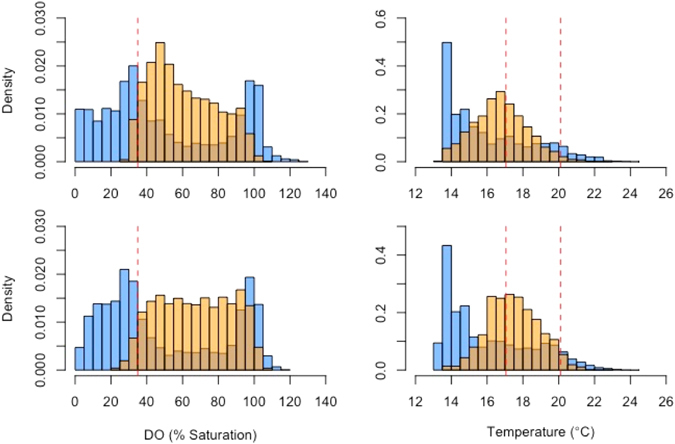
Understanding how aquatic species respond to extremes of DO and temperature is crucial for determining how they will be affected by climate change, which is predicted to increasingly expose them to levels beyond their optima. In this study we used novel animal-borne DO, temperature and depth sensors to determine the effect of extremes of DO and temperature on the vertical habitat use of Atlantic salmon Salmo salar in aquaculture cages. Salmon showed a preference for temperatures around 16.5 to 17.5 °C, however, selection of preferred temperatures was trumped by active avoidance of low DO (<35% saturation) at the bottom of the cage. In addition to low DO, salmon also avoided warm surface waters (>20.1 °C), which led to a considerable contraction in the available vertical habitat. Despite their avoidance behavior, fish spent a large amount of time in waters with suboptimal DO (<60% saturation). These results show that vertical habitat contraction could likely be a significant consequence of climate change if the reduction in DO outpaces the increase in hypoxia tolerance through local adaptation. They furthermore highlight that site-specific environmental conditions and stock-specific tolerance thresholds may need to be considered when determining stocking densities.

摘要

了解水生物种对 DO 和温度极值的反应对于确定它们将如何受到气候变化的影响至关重要,气候变化预计将使它们越来越多地暴露在超出其最适范围的水平。在这项研究中,我们使用了新型的动物携带 DO、温度和深度传感器,以确定 DO 和温度极值对水产养殖笼中大西洋鲑 Salmo salar 垂直栖息地利用的影响。鲑鱼对 16.5 到 17.5°C 左右的温度表现出偏好,但对底部低 DO(<35%饱和度)的主动回避优先于对优选温度的选择。除了低 DO 之外,鲑鱼还避免温暖的表层水(>20.1°C),这导致可利用的垂直栖息地大大收缩。尽管鲑鱼有回避行为,但它们在 DO 低于 60%饱和度的水中花费了大量时间。这些结果表明,如果由于局部适应导致 DO 减少超过缺氧耐受能力的增加,那么垂直栖息地收缩可能是气候变化的一个重大后果。此外,它们还强调,在确定放养密度时,可能需要考虑特定地点的环境条件和特定种群的耐受阈值。
https://cdn.ncbi.nlm.nih.gov/pmc/blobs/9d99/5495760/a8cf39f8e2df/41598_2017_4806_Fig5_HTML.jpg
https://cdn.ncbi.nlm.nih.gov/pmc/blobs/9d99/5495760/ffc471459396/41598_2017_4806_Fig1_HTML.jpg
https://cdn.ncbi.nlm.nih.gov/pmc/blobs/9d99/5495760/73d45276a5ec/41598_2017_4806_Fig2_HTML.jpg
https://cdn.ncbi.nlm.nih.gov/pmc/blobs/9d99/5495760/8690f89e2495/41598_2017_4806_Fig3_HTML.jpg
https://cdn.ncbi.nlm.nih.gov/pmc/blobs/9d99/5495760/c00d93e1e4b3/41598_2017_4806_Fig4_HTML.jpg
https://cdn.ncbi.nlm.nih.gov/pmc/blobs/9d99/5495760/a8cf39f8e2df/41598_2017_4806_Fig5_HTML.jpg
https://cdn.ncbi.nlm.nih.gov/pmc/blobs/9d99/5495760/ffc471459396/41598_2017_4806_Fig1_HTML.jpg
https://cdn.ncbi.nlm.nih.gov/pmc/blobs/9d99/5495760/73d45276a5ec/41598_2017_4806_Fig2_HTML.jpg
https://cdn.ncbi.nlm.nih.gov/pmc/blobs/9d99/5495760/8690f89e2495/41598_2017_4806_Fig3_HTML.jpg
https://cdn.ncbi.nlm.nih.gov/pmc/blobs/9d99/5495760/c00d93e1e4b3/41598_2017_4806_Fig4_HTML.jpg
https://cdn.ncbi.nlm.nih.gov/pmc/blobs/9d99/5495760/a8cf39f8e2df/41598_2017_4806_Fig5_HTML.jpg

相似文献

1
Response of Atlantic salmon Salmo salar to temperature and dissolved oxygen extremes established using animal-borne environmental sensors.利用动物携带的环境传感器确定大西洋鲑(Salmo salar)对极端温度和溶解氧的反应。
Sci Rep. 2017 Jul 3;7(1):4545. doi: 10.1038/s41598-017-04806-2.
2
Climate change and anadromous fish: How does thermal acclimation affect the mechanics of the myotomal muscle of the Atlantic salmon, Salmo salar?气候变化与溯河洄游鱼类:热驯化如何影响大西洋鲑肌肉力学?
J Exp Zool A Ecol Integr Physiol. 2021 Mar;335(3):311-318. doi: 10.1002/jez.2443. Epub 2021 Jan 19.
3
Atlantic Salmon () Cage-Site Distribution, Behavior, and Physiology During a Newfoundland Heat Wave.纽芬兰热浪期间大西洋鲑()的网箱养殖点分布、行为及生理状况
Front Physiol. 2021 Aug 24;12:719594. doi: 10.3389/fphys.2021.719594. eCollection 2021.
4
Atlantic salmon show capability for cardiac acclimation to warm temperatures.大西洋鲑鱼显示出对温暖温度的心脏适应能力。
Nat Commun. 2014 Jun 24;5:4252. doi: 10.1038/ncomms5252.
5
Thermal habitat of adult Atlantic salmon Salmo salar in a warming ocean.成年大西洋三文鱼(Salmo salar)在变暖的海洋中的热栖息地。
J Fish Biol. 2020 Feb;96(2):327-336. doi: 10.1111/jfb.14187. Epub 2019 Nov 19.
6
The Innate Immune Response of Atlantic Salmon () Is Not Negatively Affected by High Temperature and Moderate Hypoxia.大西洋鲑鱼的先天免疫反应不受高温和适度缺氧的负面影响。
Front Immunol. 2020 May 27;11:1009. doi: 10.3389/fimmu.2020.01009. eCollection 2020.
7
Warm acclimation and oxygen depletion induce species-specific responses in salmonids.温暖驯化和缺氧会在鲑科鱼类中引发特定物种的反应。
J Exp Biol. 2015 May 15;218(Pt 10):1471-7. doi: 10.1242/jeb.119115. Epub 2015 Mar 31.
8
Intestinal barrier function of Atlantic salmon (Salmo salar L.) post smolts is reduced by common sea cage environments and suggested as a possible physiological welfare indicator.大西洋鲑(Salmo salar L.)稚鱼后的肠道屏障功能会因常见的海水网箱环境而降低,并被认为是一种可能的生理福利指标。
BMC Physiol. 2010 Nov 9;10:22. doi: 10.1186/1472-6793-10-22.
9
Temperature requirements of Atlantic salmon Salmo salar, brown trout Salmo trutta and Arctic charr Salvelinus alpinus: predicting the effects of climate change.大西洋鲑鱼(Salmo salar)、褐鳟(Salmo trutta)和北极红点鲑(Salvelinus alpinus)的温度要求:预测气候变化的影响。
J Fish Biol. 2010 Nov;77(8):1793-817. doi: 10.1111/j.1095-8649.2010.02762.x. Epub 2010 Oct 6.
10
Inclusion of water temperature in a fuzzy logic Atlantic salmon (Salmo salar) parr habitat model.将水温纳入模糊逻辑大西洋鲑(Salmo salar)幼鱼生境模型。
J Therm Biol. 2020 Jan;87:102471. doi: 10.1016/j.jtherbio.2019.102471. Epub 2019 Nov 26.

引用本文的文献

1
Measured oxygen levels in Norwegian waters and implications for future offshore Atlantic salmon aquaculture.挪威海域的实测氧含量及其对未来近海大西洋鲑鱼养殖的影响。
Sci Rep. 2025 Aug 11;15(1):29416. doi: 10.1038/s41598-025-12697-x.
2
Application of genomic tools to study and potentially improve the upper thermal tolerance of farmed Atlantic salmon (Salmo salar).应用基因组学工具研究并潜在地提高养殖大西洋鲑(Salmo salar)的热耐受上限。
BMC Genomics. 2025 Mar 24;26(1):294. doi: 10.1186/s12864-025-11482-4.
3
Numerical calculation and experimental analysis of thermal environment in industrialized aquaculture facilities.

本文引用的文献

1
Ecophysiology. Climate change tightens a metabolic constraint on marine habitats.生态生理学。气候变化使海洋生境的代谢约束更加紧张。
Science. 2015 Jun 5;348(6239):1132-5. doi: 10.1126/science.aaa1605.
2
Variation in temperature tolerance among families of Atlantic salmon (Salmo salar) is associated with hypoxia tolerance, ventricle size and myoglobin level.大西洋鲑(Salmo salar)家族间的温度耐受性变化与耐低氧能力、心室大小和肌红蛋白水平有关。
J Exp Biol. 2013 Apr 1;216(Pt 7):1183-90. doi: 10.1242/jeb.080556.
3
Modulation of innate immune responses in Atlantic salmon by chronic hypoxia-induced stress.
工业化水产养殖设施热环境的数值计算与实验分析。
PLoS One. 2023 Sep 25;18(9):e0290449. doi: 10.1371/journal.pone.0290449. eCollection 2023.
4
The upper temperature and hypoxia limits of Atlantic salmon (Salmo salar) depend greatly on the method utilized.大西洋鲑(Salmo salar)的上限温度和缺氧极限在很大程度上取决于所采用的方法。
J Exp Biol. 2023 Sep 15;226(18). doi: 10.1242/jeb.246227. Epub 2023 Sep 26.
5
Wearable sensors for monitoring marine environments and their inhabitants.用于监测海洋环境及其生物的可穿戴传感器。
Nat Biotechnol. 2023 Sep;41(9):1208-1220. doi: 10.1038/s41587-023-01827-3. Epub 2023 Jun 26.
6
Influence of Supplemental Dietary Cholesterol on Growth Performance, Indices of Stress, Fillet Pigmentation, and Upper Thermal Tolerance of Female Triploid Atlantic Salmon ().补充膳食胆固醇对雌性三倍体大西洋鲑生长性能、应激指标、鱼片色素沉着及热耐受上限的影响()。
Aquac Nutr. 2022 Oct 28;2022:6336060. doi: 10.1155/2022/6336060. eCollection 2022.
7
Substantial warming of Central European mountain rivers under climate change.气候变化下中欧山区河流的显著变暖
Reg Environ Change. 2023;23(1):43. doi: 10.1007/s10113-023-02037-y. Epub 2023 Feb 18.
8
Temperature affects settlement success of ectoparasitic salmon lice (Lepeophtheirus salmonis) and impacts the immune and stress response of Atlantic salmon (Salmo salar).温度会影响寄生性鲑鱼虱(Lepeophtheirus salmonis)的定殖成功率,并影响大西洋鲑(Salmo salar)的免疫和应激反应。
J Fish Dis. 2022 Jul;45(7):975-990. doi: 10.1111/jfd.13619. Epub 2022 Apr 9.
9
Waves and currents decrease the available space in a salmon cage.海浪和水流会减少鲑鱼养殖网箱内的可用空间。
PLoS One. 2022 Feb 25;17(2):e0263850. doi: 10.1371/journal.pone.0263850. eCollection 2022.
10
Sentinels in Salmon Aquaculture: Heart Rates Across Seasons and During Crowding Events.鲑鱼养殖中的哨兵:不同季节及拥挤事件期间的心率
Front Physiol. 2021 Nov 26;12:755659. doi: 10.3389/fphys.2021.755659. eCollection 2021.
慢性缺氧应激对大西洋鲑固有免疫反应的调节。
Fish Shellfish Immunol. 2013 Jan;34(1):55-65. doi: 10.1016/j.fsi.2012.10.006. Epub 2012 Oct 17.
4
Differences in thermal tolerance among sockeye salmon populations.不同群体间红大麻哈鱼的热耐受差异。
Science. 2011 Apr 1;332(6025):109-12. doi: 10.1126/science.1199158.
5
Temperature requirements of Atlantic salmon Salmo salar, brown trout Salmo trutta and Arctic charr Salvelinus alpinus: predicting the effects of climate change.大西洋鲑鱼(Salmo salar)、褐鳟(Salmo trutta)和北极红点鲑(Salvelinus alpinus)的温度要求:预测气候变化的影响。
J Fish Biol. 2010 Nov;77(8):1793-817. doi: 10.1111/j.1095-8649.2010.02762.x. Epub 2010 Oct 6.
6
A review of the likely effects of climate change on anadromous Atlantic salmon Salmo salar and brown trout Salmo trutta, with particular reference to water temperature and flow.气候变化对洄游性大西洋鲑(Salmo salar)和褐鳟(Salmo trutta)可能影响的综述,特别关注水温与水流。
J Fish Biol. 2009 Dec;75(10):2381-447. doi: 10.1111/j.1095-8649.2009.02380.x.
7
Global fish production and climate change.全球鱼类生产与气候变化。
Proc Natl Acad Sci U S A. 2007 Dec 11;104(50):19709-14. doi: 10.1073/pnas.0702059104. Epub 2007 Dec 6.
8
Climate change affects marine fishes through the oxygen limitation of thermal tolerance.气候变化通过热耐受性的氧气限制影响海洋鱼类。
Science. 2007 Jan 5;315(5808):95-7. doi: 10.1126/science.1135471.
9
Hypoxia: from molecular responses to ecosystem responses.缺氧:从分子反应到生态系统反应
Mar Pollut Bull. 2002;45(1-12):35-45. doi: 10.1016/s0025-326x(02)00061-9.
10
The metabolic demand for oxygen in fish, particularly salmonids, and a comparison with other vertebrates.鱼类,特别是鲑科鱼类对氧气的代谢需求以及与其他脊椎动物的比较。
Respir Physiol. 1972 Mar;14(1):151-70. doi: 10.1016/0034-5687(72)90025-4.