Kaur Anjuli, Singh Sid, Chandan Joht S, Robbins Tim, Patel Vinod
Warwick Medical School, University of Warwick, UK.
George Eliot Hospital NHS Trust, UK.
Digit Health. 2021 Aug 31;7:20552076211038151. doi: 10.1177/20552076211038151. eCollection 2021 Jan-Dec.
During the coronavirus disease 2019 pandemic, face-to-face teaching has been severely disrupted and limited for medical students internationally. This study explores the views of medical students and academic medical staff regarding the suitability and limitations, of a bespoke chatbot tool to support medical education.
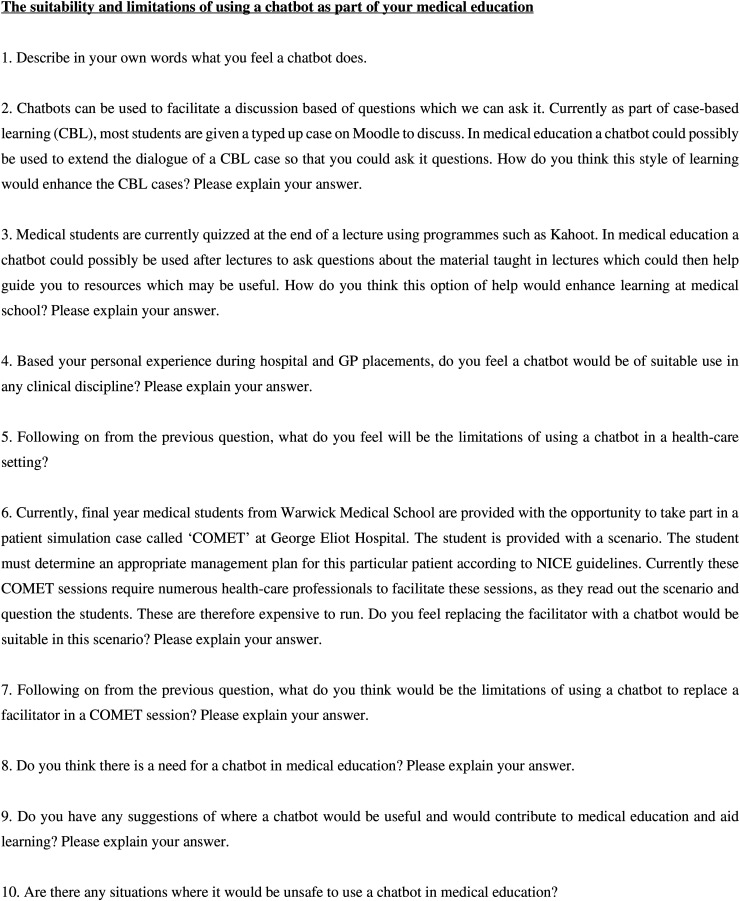
Five focus groups, with a total of 16 participants, were recruited using a convenience sample. The participants included medical students across all year groups and academic staff. The pre-determined focus group topic guide explored how chatbots can augment existing teaching practices. A thematic analysis was conducted using the transcripts to determine key themes.
Thematic analysis identified five main themes: (1) chatbot use as a clinical simulation tool; (2) chatbot use as a revision tool; (3) differential usefulness by medical school year group; (4) standardisation of education and assessment; (5) challenges of use and implementation.
Both staff and students have clear benefits from using chatbots in medical education. However, they documented possible limitations to their use. The creation of chatbots to support the medical curriculum should be further explored and urgently evaluated to assess their impact on medical students training both during and after the global pandemic.
在2019年冠状病毒病大流行期间,国际上医学生的面对面教学受到严重干扰且受限。本研究探讨了医学生和医学学术人员对于一种定制聊天机器人工具在支持医学教育方面的适用性和局限性的看法。
采用便利抽样法招募了5个焦点小组,共16名参与者。参与者包括各年级的医学生和学术人员。预先确定的焦点小组主题指南探讨了聊天机器人如何增强现有的教学实践。使用转录本进行主题分析以确定关键主题。
主题分析确定了五个主要主题:(1)将聊天机器人用作临床模拟工具;(2)将聊天机器人用作复习工具;(3)不同医学院年级组的有用性差异;(4)教育和评估的标准化;(5)使用和实施的挑战。
在医学教育中使用聊天机器人对教职员工和学生都有明显益处。然而,他们记录了使用中可能存在的局限性。应进一步探索并紧急评估创建支持医学课程的聊天机器人,以评估其在全球大流行期间及之后对医学生培训的影响。