Assistant, Department of Neurology and Medical Genetics, Perm State Medical University named after Academician E.A. Wagner, 26 Petropavlovskaya St., Perm, 614990, Russia.
Assistant, Department of Neurological Diseases, Privolzhsky Research Medical University, 10/1 Minin and Pozharsky Square, Nizhny Novgorod, 603005, Russia.
Sovrem Tekhnologii Med. 2021;13(2):68-72. doi: 10.17691/stm2021.13.2.08. Epub 2021 Jan 1.
was to assess the prognostic value of the plasma neuron-specific enolase (NSE) level as a predictor of functional outcome and motor function recovery in the acute period of ischemic stroke (IS).
Fifty patients with IS have been examined. On admission to the hospital and at 12-14 days after stroke onset, a clinical and neurological examination have been carried out with the supplementary quantitative assessment of neurological deficit severity according to the National Institutes of Health Stroke Scale (NIHSS), functional outcome according to the Modified Rankin Scale, and Rivermead Mobility Index. Enzyme immunoassay was used to determine NSE concentration in blood plasma in the acute period of the disease.
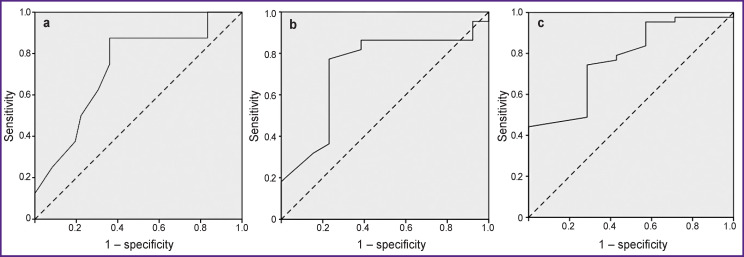
The NSE level in patients' blood plasma in the first 48 h after stroke onset positively correlates with the ischemic focus volume (r=0.49; p=0.003) and the severity of neurological symptoms (according to NIHSS) (r=0.33; p=0.02). NSE less than 2 ng/ml in the acute disease period is a predictor of good functional outcome 12-14 days after stroke onset (OR=12.4; р=0.006). The NSE level >2.6 ng/ml is associated with a high likelihood of lethal outcome.Neurological deficit below 15 according to NIHSS as well as the NSE level <2 ng/ml in the acute IS period are estimated as prognostic factors of significant recovery of motor function at 2 weeks after disease onset (OR=5.8; р=0.02).
Determination of NSE in blood plasma makes it possible to predict functional outcome of the disease development and the recovery of motor function in patients with IS.
评估血浆神经元特异性烯醇化酶(NSE)水平作为缺血性脑卒中(IS)急性期功能结局和运动功能恢复的预测因子的预后价值。
检查了 50 名 IS 患者。在入院时和中风发作后 12-14 天,进行了临床和神经学检查,并根据国立卫生研究院卒中量表(NIHSS)补充定量评估神经功能缺损严重程度、根据改良 Rankin 量表评估功能结局以及 Rivermead 运动指数评估运动功能。在疾病急性期,使用酶联免疫吸附法测定血浆中 NSE 浓度。
中风发作后 48 小时内患者血液 NSE 水平与缺血灶体积呈正相关(r=0.49;p=0.003),与神经症状严重程度(根据 NIHSS)呈正相关(r=0.33;p=0.02)。疾病急性期 NSE<2ng/ml 是中风发作后 12-14 天良好功能结局的预测因子(OR=12.4;p=0.006)。NSE>2.6ng/ml 与高致死率相关。NIHSS 评分<15 和疾病急性期 NSE<2ng/ml 被认为是中风发作后 2 周运动功能显著恢复的预后因素(OR=5.8;p=0.02)。
血液 NSE 测定可预测 IS 患者疾病发展的功能结局和运动功能的恢复。