Department of Otolaryngology-Head and Neck Surgery, University of California-San Francisco, 2233 Post Street, Third Floor, San Francisco, CA, 94115, USA.
Sackler School of Medicine, Tel Aviv University, Tel Aviv, Israel.
Hum Genet. 2022 Apr;141(3-4):495-504. doi: 10.1007/s00439-021-02338-4. Epub 2021 Sep 13.
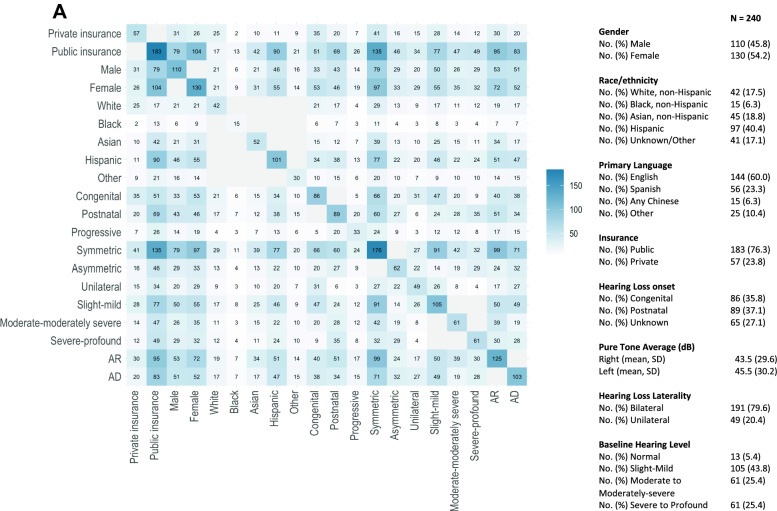
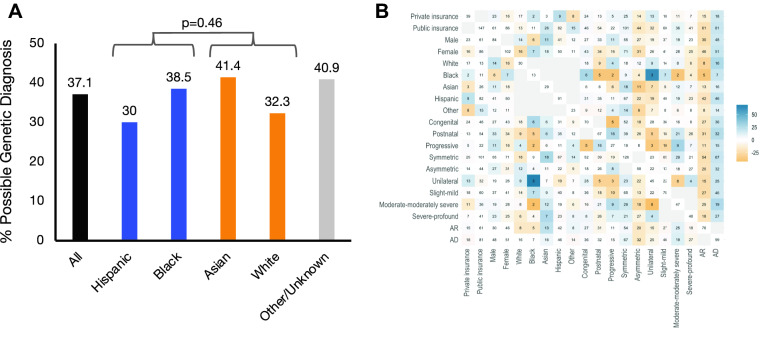
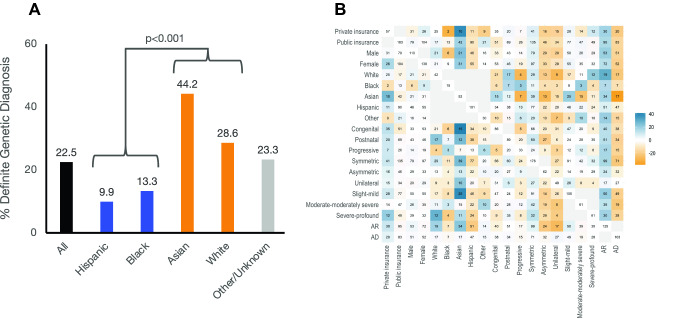
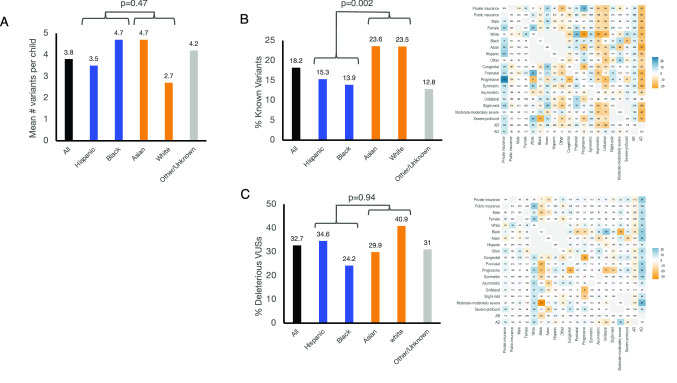
Understanding racial and ethnic disparities in diagnostic rates of genetic testing is critical for health equity. We sought to understand the extent and cause of racial and ethnic disparities in diagnostic efficacy of comprehensive genetic testing (CGT) for sensorineural hearing loss (SNHL). We performed a retrospective cohort study at two tertiary children's hospitals on a diverse cohort of 240 consecutive pediatric patients (76% publicly insured, 82% non-White) with SNHL of unknown etiology who underwent CGT. Definite and possible genetic diagnoses were assigned for each patient, representing the likelihood of a genetic cause of hearing loss. Associations between diagnostic rates were examined. 3.8 ± 2.1 variants were detected per patient; this frequency did not vary between White/Asian and Hispanic/Black cohorts. Overall, 82% of variants were variants of uncertain significance (VUS). Compared with White and Asian subjects, variants identified among Hispanic and Black children were less likely to be classified as pathogenic/likely pathogenic (15% vs. 24%, p < 0.001), and Hispanic and Black children were less likely to have a definite genetic diagnosis (10% vs. 37%, p < 0.001). The adjusted odds ratio for definite genetic diagnosis in Black and Hispanic children compared with White and Asian children was 0.19. Expanding genetic diagnostic criteria to include predicted deleterious VUSs reduced these disparities between White/Asian and Hispanic/Black children, with comparable molecular diagnostic rates (41% vs. 38%, p = 0.72). However, in silico predictions are insufficiently valid for clinical use. Increased inclusion of underrepresented groups in genetic hearing-loss studies to clinically validate these variants is necessary to reduce racial and ethnic disparities in diagnostic efficacy of comprehensive genetic testing.
了解基因检测诊断率的种族和民族差异对于实现健康公平至关重要。我们旨在了解全面基因检测(CGT)在诊断感音神经性听力损失(SNHL)方面的种族和民族差异的程度和原因。我们在两家三级儿童医院对一个多样化的 240 名连续 SNHL 病因不明的儿科患者队列(76%有公共保险,82%是非白人)进行了回顾性队列研究,这些患者接受了 CGT。为每位患者分配了明确和可能的遗传诊断,代表听力损失的遗传原因的可能性。检查了诊断率之间的关联。每位患者检测到 3.8±2.1 个变异;白人和亚洲人与西班牙裔/黑人群体之间的频率没有差异。总体而言,82%的变异为意义不明的变异(VUS)。与白人和亚洲人相比,在西班牙裔和黑人儿童中发现的变异不太可能被归类为致病性/可能致病性(15%比 24%,p<0.001),而且西班牙裔和黑人儿童不太可能有明确的遗传诊断(10%比 37%,p<0.001)。与白人和亚洲儿童相比,黑人和西班牙裔儿童有明确遗传诊断的调整后优势比为 0.19。将遗传诊断标准扩大到包括预测有害的 VUS 可减少白人和亚洲人与西班牙裔/黑人群体之间的这些差异,分子诊断率相当(41%比 38%,p=0.72)。但是,基于计算机的预测对于临床应用还不够有效。为了减少全面基因检测诊断效果的种族和民族差异,有必要增加代表性不足的群体在遗传性听力损失研究中的参与,以临床验证这些变体。