Domhardt Matthias, Messner Eva-Maria, Eder Anna-Sophia, Engler Sophie, Sander Lasse B, Baumeister Harald, Terhorst Yannik
Department of Clinical Psychology and Psychotherapy, Institute of Psychology and Education, Ulm University, Lise-Meitner-Str. 16, 89081, Ulm, Germany.
Department of Rehabilitation Psychology and Psychotherapy, Institute of Psychology, Albert-Ludwigs-University Freiburg, Engelberger Str. 41, 79106, Freiburg im Breisgau, Germany.
Child Adolesc Psychiatry Ment Health. 2021 Sep 13;15(1):49. doi: 10.1186/s13034-021-00401-6.
The access to empirically-supported treatments for common mental disorders in children and adolescents is often limited. Mental health apps might extend service supplies, as they are deemed to be cost-efficient, scalable and appealing for youth. However, little is known about the quality of available apps. Therefore, we aimed to systematically evaluate current mobile-based interventions for pediatric anxiety, depression and posttraumatic stress disorder (PTSD).
Systematic searches were conducted in Google Play Store and Apple App Store to identify relevant apps. To be eligible for inclusion, apps needed to be: (1) designed to target either anxiety, depression or PTSD in youth (0-18 years); (2) developed for children, adolescents or caregivers; (3) provided in English or German; (4) operative after download. The quality of eligible apps was assessed with two standardized rating systems (i.e., Mobile App Rating Scale (MARS) and ENLIGHT) independently by two reviewers.
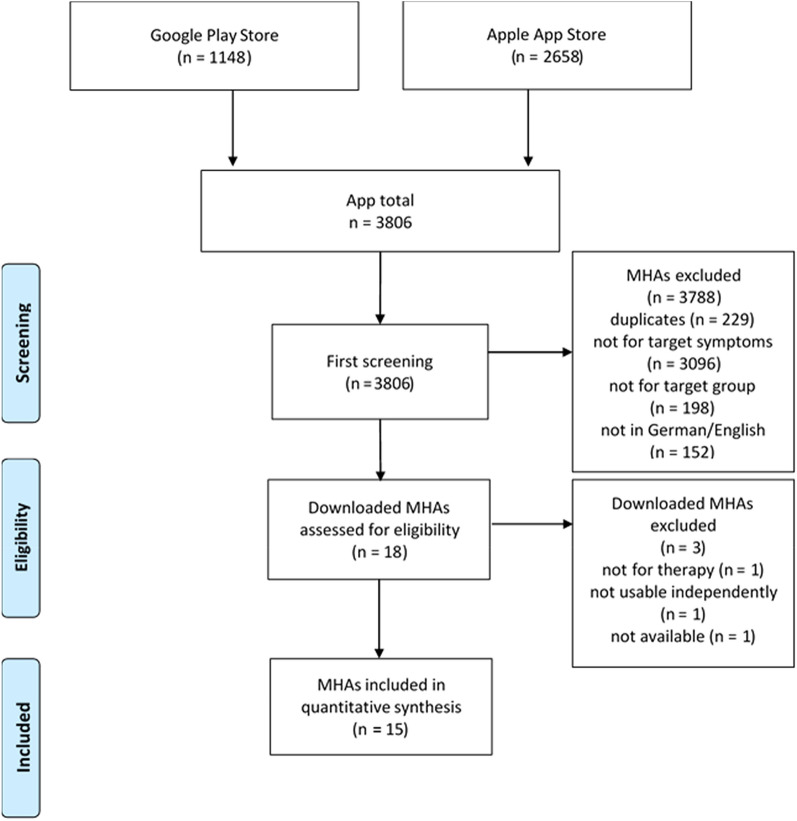
Overall, the searches revealed 3806 apps, with 15 mental health apps (0.39%) fulfilling our inclusion criteria. The mean overall scores suggested a moderate app quality (MARS: M = 3.59, SD = 0.50; ENLIGHT: M = 3.22, SD = 0.73). Moreover, only one app was evaluated in an RCT. The correlation of both rating scales was high (r = .936; p < .001), whereas no significant correlations were found between rating scales and user ratings (p > .05).
Our results point to a rather poor overall app quality, and indicate an absence of scientific-driven development and lack of methodologically sound evaluation of apps. Thus, future high-quality research is required, both in terms of theoretically informed intervention development and assessment of mental health apps in RCTs. Furthermore, institutionalized best-practices that provide central information on different aspects of apps (e.g., effectiveness, safety, and data security) for patients, caregivers, stakeholders and mental health professionals are urgently needed.
儿童和青少年常见精神障碍的经验证有效治疗方法的可及性往往有限。心理健康应用程序可能会扩大服务供应,因为它们被认为具有成本效益、可扩展性且对年轻人有吸引力。然而,对于现有应用程序的质量知之甚少。因此,我们旨在系统地评估当前针对儿童焦虑症、抑郁症和创伤后应激障碍(PTSD)的基于移动设备的干预措施。
在谷歌Play商店和苹果应用商店进行系统搜索,以识别相关应用程序。要符合纳入标准,应用程序需要:(1)旨在针对青少年(0至18岁)的焦虑症、抑郁症或创伤后应激障碍;(2)为儿童、青少年或照顾者开发;(3)以英语或德语提供;(4)下载后可运行。两名评审员独立使用两个标准化评分系统(即移动应用评分量表(MARS)和ENLIGHT)对符合条件的应用程序的质量进行评估。
总体而言,搜索共发现3806个应用程序,其中15个心理健康应用程序(0.39%)符合我们的纳入标准。平均总体得分表明应用程序质量中等(MARS:M = 3.59,SD = 0.50;ENLIGHT:M = 3.22,SD = 0.73)。此外,只有一个应用程序在随机对照试验中进行了评估。两个评分量表的相关性很高(r = 0.936;p < 0.001),而评分量表与用户评分之间未发现显著相关性(p > 0.05)。
我们的结果表明应用程序的总体质量相当差,并表明缺乏科学驱动的开发以及对应用程序缺乏方法学上合理的评估。因此,未来需要高质量的研究,包括理论上合理的干预开发和在随机对照试验中对心理健康应用程序的评估。此外,迫切需要制度化的最佳实践,为患者、照顾者、利益相关者和心理健康专业人员提供有关应用程序不同方面(如有效性、安全性和数据安全性)的核心信息。