von Thiele Schwarz Ulrica, Nielsen Karina, Edwards Kasper, Hasson Henna, Ipsen Christine, Savage Carl, Simonsen Abildgaard Johan, Richter Anne, Lornudd Caroline, Mazzocato Pamela, Reed Julie E
School of Health, Care and Social Welfare, Mälardalen University, Västerås, Sweden.
Medical Management Centre, LIME, Karolinska Institutet, Stockholm, Sweden.
Eur J Work Organ Psychol. 2020 Aug 26;30(3):415-427. doi: 10.1080/1359432X.2020.1803960. eCollection 2021.
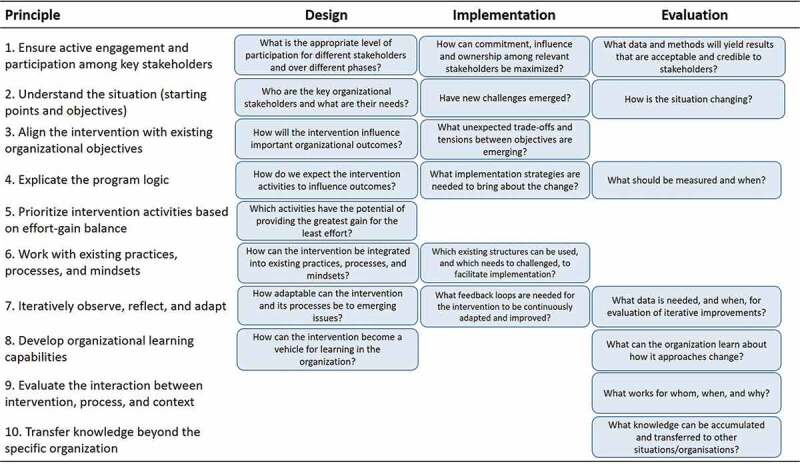
Research on organizational interventions needs to meet the objectives of both researchers and participating organizations. This duality means that real-world impact has to be considered throughout the research process, simultaneously addressing both scientific rigour and practical relevance. This discussion paper aims to offer a set of principles, grounded in knowledge from various disciplines that can guide researchers in designing, implementing, and evaluating organizational interventions. Inspired by Mode 2 knowledge production, the principles were developed through a transdisciplinary, participatory and iterative process where practitioners and academics were invited to develop, refine and validate the principles. The process resulted in 10 principles: 1) Ensure active engagement and participation among key stakeholders; 2) Understand the situation (starting points and objectives); 3) Align the intervention with existing organizational objectives; 4) Explicate the program logic; 5) Prioritize intervention activities based on effort-gain balance; 6) Work with existing practices, processes, and mindsets; 7) Iteratively observe, reflect, and adapt; 8) Develop organizational learning capabilities; 9) Evaluate the interaction between intervention, process, and context; and 10) Transfer knowledge beyond the specific organization. The principles suggest how the design, implementation, and evaluation of organizational interventions can be researched in a way that maximizes both practical and scientific impact.
对组织干预措施的研究需要兼顾研究人员和参与组织的目标。这种双重性意味着在整个研究过程中都必须考虑实际影响,同时兼顾科学严谨性和实际相关性。本讨论文件旨在提供一套基于多学科知识的原则,以指导研究人员设计、实施和评估组织干预措施。受模式2知识生产的启发,这些原则是通过一个跨学科、参与性和迭代性的过程制定的,在此过程中邀请了从业者和学者来制定、完善和验证这些原则。该过程产生了10条原则:1)确保关键利益相关者积极参与;2)了解情况(起点和目标);3)使干预措施与组织现有目标保持一致;4)阐明项目逻辑;5)根据努力-收益平衡确定干预活动的优先级;6)结合现有实践、流程和思维模式开展工作;7)反复观察、反思和调整;8)培养组织学习能力;9)评估干预措施、过程和背景之间的相互作用;10)将知识传播到特定组织之外。这些原则表明了如何以一种能使实际影响和科学影响最大化的方式来研究组织干预措施的设计、实施和评估。