Eli Lilly and Company, Indianapolis, Indiana, USA.
Dexcom, Inc., San Diego, California, USA.
Diabetes Technol Ther. 2022 Jan;24(1):61-66. doi: 10.1089/dia.2021.0239. Epub 2021 Nov 1.
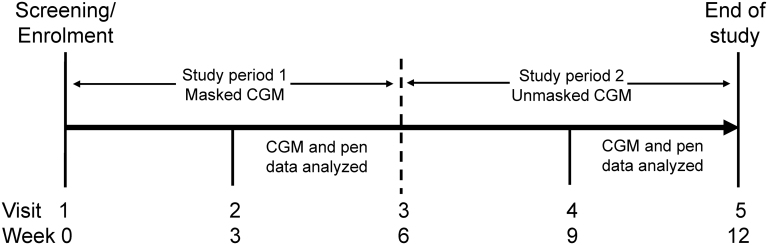
This study used connected pen to determine missed bolus dose (MBD) frequency during masked and unmasked continuous glucose monitoring (CGM) periods and examined its link with time-in-range (TIR), time-above-range (TAR), time-below-range (TBR), and key participant characteristics in people with diabetes. This was a 12-week, single-arm, exploratory, two-period study for people with type 1 diabetes (T1D) or type 2 diabetes (T2D). The primary objective was to estimate the average number of MBD during masked and real-time CGM use. The secondary objective was to estimate the average percent TIR and its relationship to MBD. An exploratory objective was to investigate the participant characteristics that were associated with MBD. Data were analyzed for differences in MBD by diabetes type and other participant characteristics, by CGM period, and by hypoglycemic fear scores. Participants ( = 64; T1D, = 38; T2D, = 26) were 48 ± 11.9 years old and 44% were female. From the masked to the unmasked period, MBD, %TAR, %TBR, and glycated hemoglobin decreased significantly (0.74 MBD/day to 0.62 MBD/day, = 0.008; 53.6%-48.1%, = 0.004; 4.49%-2.93%, < 0.001; mean 8.8%-8.4%, < 0.001, respectively), while %TIR increased significantly (41.9%-49.0%, < 0.001). MBD/day was negatively associated with TIR ( = 0.016) and positively associated with TAR ( = 0.015) for T1D and positively associated with TBR ( = 0.024) for T2D in the masked period only. MBD was significantly associated with fear of hypoglycemia for T2D, but not T1D. MBD is associated with reduced TIR when CGM is masked and tailored therapeutic approaches are needed for T1D and T2D populations.
本研究使用连续笔来确定戴口罩和不戴口罩时连续血糖监测(CGM)期间的漏注剂量(MBD)频率,并检查其与糖尿病患者的达标时间(TIR)、血糖高于目标范围时间(TAR)、血糖低于目标范围时间(TBR)以及关键患者特征之间的关系。这是一项为期 12 周、单臂、探索性、两期研究,纳入了 1 型糖尿病(T1D)或 2 型糖尿病(T2D)患者。主要目的是估计戴口罩和实时 CGM 使用期间的平均 MBD 数量。次要目的是估计平均 TIR 及其与 MBD 的关系。一个探索性目标是调查与 MBD 相关的患者特征。通过糖尿病类型和其他患者特征、CGM 期间以及低血糖恐惧评分,对 MBD 进行差异分析。参与者( = 64;T1D, = 38;T2D, = 26)年龄为 48 ± 11.9 岁,44%为女性。从戴口罩到不戴口罩期间,MBD、%TAR、%TBR 和糖化血红蛋白显著降低(0.74 MBD/天至 0.62 MBD/天, = 0.008;53.6%-48.1%, = 0.004;4.49%-2.93%, < 0.001;平均 8.8%-8.4%, < 0.001),而%TIR 显著增加(41.9%-49.0%, < 0.001)。在戴口罩期间,MBD/天与 TIR 呈负相关( = 0.016),与 TAR 呈正相关( = 0.015),仅与 T2D 呈正相关( = 0.024)。MBD 与 T2D 的低血糖恐惧显著相关,但与 T1D 无关。当 CGM 被掩盖时,MBD 与 TIR 降低有关,需要为 T1D 和 T2D 人群制定有针对性的治疗方法。