• 文献检索
  • 文档翻译
  • 深度研究
  • 学术资讯
  • Suppr Zotero 插件Zotero 插件
  • 邀请有礼
  • 套餐&价格
  • 历史记录
应用&插件
Suppr Zotero 插件Zotero 插件浏览器插件Mac 客户端Windows 客户端微信小程序
定价
高级版会员购买积分包购买API积分包
服务
文献检索文档翻译深度研究API 文档MCP 服务
关于我们
关于 Suppr公司介绍联系我们用户协议隐私条款
关注我们

Suppr 超能文献

核心技术专利:CN118964589B侵权必究
粤ICP备2023148730 号-1Suppr @ 2026

文献检索

告别复杂PubMed语法,用中文像聊天一样搜索,搜遍4000万医学文献。AI智能推荐,让科研检索更轻松。

立即免费搜索

文件翻译

保留排版,准确专业,支持PDF/Word/PPT等文件格式,支持 12+语言互译。

免费翻译文档

深度研究

AI帮你快速写综述,25分钟生成高质量综述,智能提取关键信息,辅助科研写作。

立即免费体验

与纽约市新冠疫情后有年幼子女的女性怀孕意愿变化相关的因素。

Factors Associated With Changes in Pregnancy Intention Among Women Who Were Mothers of Young Children in New York City Following the COVID-19 Outbreak.

机构信息

Division of Environmental Pediatrics, Department of Pediatrics, NYU Langone Medical Center, New York, New York.

Department of Population Health, NYU Langone Medical Center, New York, New York.

出版信息

JAMA Netw Open. 2021 Sep 1;4(9):e2124273. doi: 10.1001/jamanetworkopen.2021.24273.

DOI:10.1001/jamanetworkopen.2021.24273
PMID:34524437
原文链接:https://pmc.ncbi.nlm.nih.gov/articles/PMC8444024/
Abstract

IMPORTANCE

Early evidence shows a decrease in the number of US births during the COVID-19 pandemic, yet few studies have examined individual-level factors associated with pregnancy intention changes, especially among diverse study populations or in areas highly affected by COVID-19 in the US.

OBJECTIVE

To study changes in pregnancy intention following the outbreak of the COVID-19 pandemic and identify factors possibly associated with these changes.

DESIGN, SETTING, AND PARTICIPANTS: A cross-sectional, population-based study was conducted among women who were currently pregnant or had delivered a live infant and responded to a survey emailed to 2603 women (n = 1560). Women who were mothers of young children enrolled in the prospective New York University Children's Health and Environment Study birth cohort were included; women who were not currently pregnant or recently postpartum were excluded.

EXPOSURES

Demographic, COVID-19-related, stress-related, and financial/occupational factors were assessed via a survey administered from April 20 to August 31, 2020.

MAIN OUTCOMES AND MEASURES

Pregnancy intentions before the COVID-19 pandemic and change in pregnancy intentions following the outbreak.

RESULTS

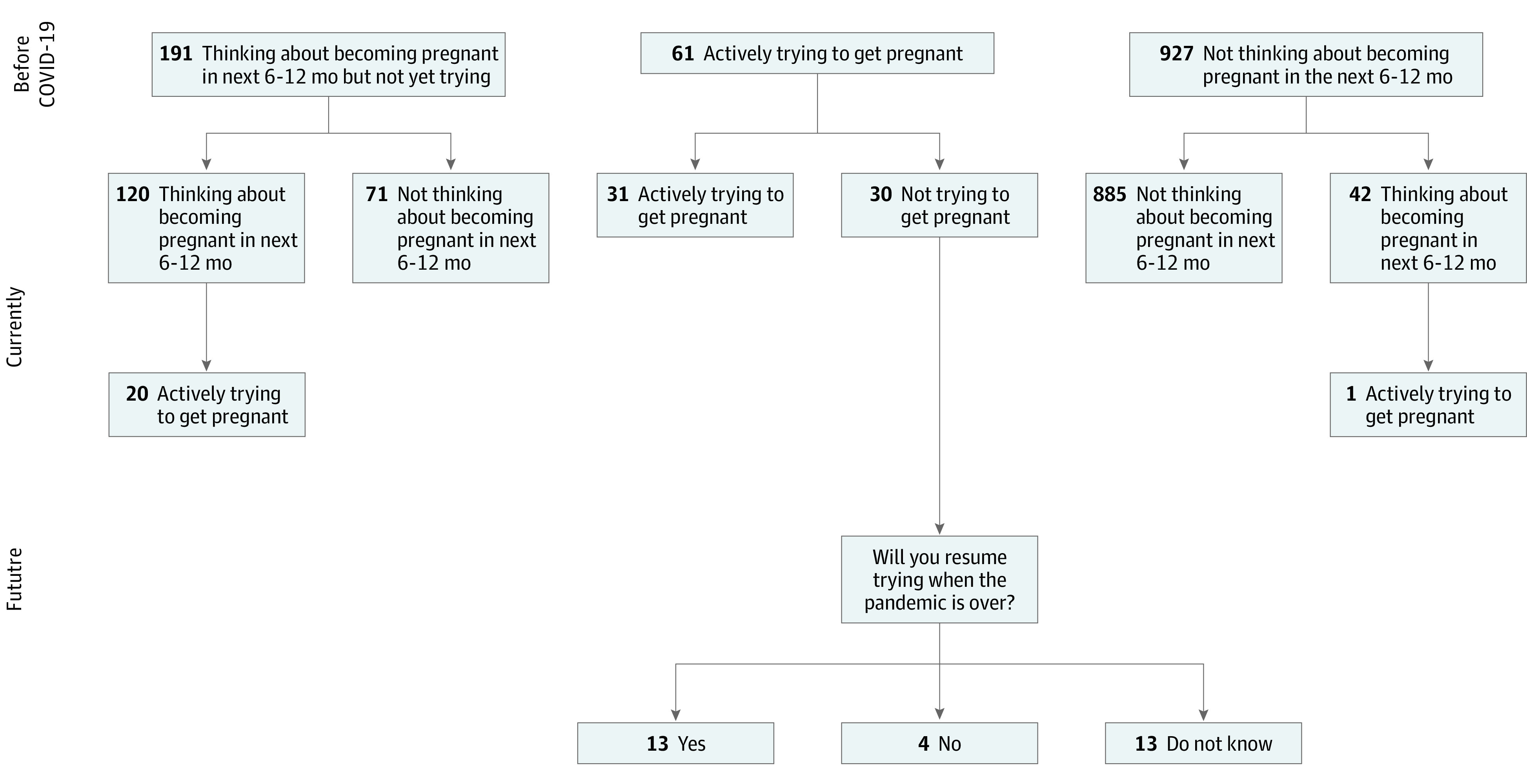
Of the 2603 women who were sent the survey, 1560 (59.9%) who were currently pregnant or had delivered a live infant responded, and 1179 women (75.6%) answered the pregnancy intention questions. Mean (SD) age was 32.2 (5.6) years. Following the outbreak, 30 of 61 (49.2%) women who had been actively trying to become pregnant had ceased trying, 71 of 191 (37.2%) women who had been planning to become pregnant were no longer planning, and 42 of 927 (4.5%) women who were neither planning nor trying were newly considering pregnancy. Among those who ceased trying, fewer than half (13 [43.3%]) thought they would resume after the pandemic. Of those pre-COVID-19 planners/triers who stopped considering or attempting pregnancy, a greater proportion had lower educational levels, although the difference was not statistically significant on multivariable analysis (odds ratio [OR], 2.14; 95% CI, 0.92-4.96). The same was true for those with higher stress levels (OR, 1.09; 95% CI, 0.99-1.20) and those with greater financial insecurity (OR, 1.37; 95% CI, 0.97-1.92. Those who stopped considering or attempting pregnancy were more likely to respond to the questionnaire during the peak of the outbreak (OR, 2.04; 95% CI, 1.01-4.11). Of those pre-COVID-19 nonplanners/nontriers who reported newly thinking about becoming pregnant, a smaller proportion responded during the peak, although the finding was not statistically significant on multivariable analysis (OR, 0.52; 95% CI, 0.26-1.03). Likewise, fewer respondents who were financially insecure reported newly considering pregnancy, although the finding was not statistically significant (OR, 0.69; 95% CI, 0.46-1.03). They were significantly less likely to be of Hispanic ethnicity (OR, 0.27; 955 CI, 0.10-0.71) and more likely to have fewer children in the home (OR, 0.62; 95% CI, 0.40-0.98) or self-report a COVID-19 diagnosis (OR, 2.70; 95% CI, 1.31-5.55).

CONCLUSIONS AND RELEVANCE

In this cross-sectional study of 1179 women who were mothers of young children in New York City, increased stress and financial insecurity owing to the COVID-19 pandemic paralleled a reduction in pregnancy intention in the early months of the pandemic, potentially exacerbating long-term decreases in the fertility rate.
https://cdn.ncbi.nlm.nih.gov/pmc/blobs/81ce/8444024/b6b5245112de/jamanetwopen-e2124273-g001.jpg
摘要

重要提示

早期证据表明,在美国 COVID-19 大流行期间,美国的出生人数有所减少,但很少有研究调查与怀孕意愿变化相关的个体因素,尤其是在多样化的研究人群或美国 COVID-19 高度流行的地区。

目的

研究 COVID-19 大流行爆发后怀孕意愿的变化,并确定可能与这些变化相关的因素。

设计、地点和参与者:这是一项横断面、基于人群的研究,纳入了目前怀孕或分娩活产婴儿并对 2603 名女性(n=1560)发送的调查做出回应的女性。研究对象为参加纽约大学儿童健康与环境研究前瞻性出生队列的幼儿母亲;不包括目前未怀孕或刚分娩的女性。

暴露因素

通过 2020 年 4 月 20 日至 8 月 31 日进行的一项调查评估了人口统计学、与 COVID-19 相关的、与压力相关的以及财务/职业因素。

主要结局和测量指标

COVID-19 大流行前的怀孕意愿和大流行爆发后的怀孕意愿变化。

结果

在收到调查的 2603 名女性中,1560 名(59.9%)目前怀孕或分娩活产婴儿的女性做出了回应,1179 名女性(75.6%)回答了怀孕意愿问题。平均(SD)年龄为 32.2(5.6)岁。疫情爆发后,61 名(49.2%)正在积极备孕的女性中有 30 名停止备孕,191 名(37.2%)计划怀孕的女性中有 71 名不再计划怀孕,927 名(4.5%)既不计划也不尝试怀孕的女性中有 42 名新考虑怀孕。在停止备孕的女性中,不到一半(13 名[43.3%])认为她们会在大流行后恢复备孕。在 COVID-19 前计划备孕/尝试怀孕的女性中,更多的人受教育程度较低,尽管多变量分析的差异无统计学意义(比值比[OR],2.14;95%置信区间[CI],0.92-4.96)。对于那些压力水平较高的女性(OR,1.09;95%CI,0.99-1.20)和经济不安全感较大的女性(OR,1.37;95%CI,0.97-1.92)也是如此。那些停止考虑或尝试怀孕的女性更有可能在疫情高峰期回答问卷(OR,2.04;95%CI,1.01-4.11)。在 COVID-19 前非计划/非尝试怀孕的女性中,报告新考虑怀孕的女性比例较小,但多变量分析的结果无统计学意义(OR,0.52;95%CI,0.26-1.03)。同样,经济不安全的报告者新考虑怀孕的比例较低,尽管这一发现无统计学意义(OR,0.69;95%CI,0.46-1.03)。她们不太可能是西班牙裔(OR,0.27;95%CI,0.10-0.71),更有可能家中孩子较少(OR,0.62;95%CI,0.40-0.98)或自我报告 COVID-19 诊断(OR,2.70;95%CI,1.31-5.55)。

结论和相关性

在这项针对纽约市幼儿母亲的 1179 名女性的横断面研究中,COVID-19 大流行期间的压力和经济不安全感增加与疫情早期怀孕意愿下降平行,可能会加剧生育率的长期下降。

相似文献

1
Factors Associated With Changes in Pregnancy Intention Among Women Who Were Mothers of Young Children in New York City Following the COVID-19 Outbreak.与纽约市新冠疫情后有年幼子女的女性怀孕意愿变化相关的因素。
JAMA Netw Open. 2021 Sep 1;4(9):e2124273. doi: 10.1001/jamanetworkopen.2021.24273.
2
Folic acid supplementation and malaria susceptibility and severity among people taking antifolate antimalarial drugs in endemic areas.在流行地区,服用抗叶酸抗疟药物的人群中,叶酸补充剂与疟疾易感性和严重程度的关系。
Cochrane Database Syst Rev. 2022 Feb 1;2(2022):CD014217. doi: 10.1002/14651858.CD014217.
3
Social, Cognitive, and eHealth Mechanisms of COVID-19-Related Lockdown and Mandatory Quarantine That Potentially Affect the Mental Health of Pregnant Women in China: Cross-Sectional Survey Study.社会、认知和电子健康因素在新冠疫情封锁和强制隔离期间对中国孕妇心理健康的潜在影响:一项横断面调查研究。
J Med Internet Res. 2021 Jan 22;23(1):e24495. doi: 10.2196/24495.
4
Intention to Seek Mental Health Services During the 2022 Shanghai COVID-19 City-Wide Lockdown: Web-Based Cross-Sectional Study.2022年上海新冠疫情全市封控期间寻求心理健康服务的意向:基于网络的横断面研究
JMIR Form Res. 2024 Dec 2;8:e51470. doi: 10.2196/51470.
5
Assessment of Neurodevelopment in Infants With and Without Exposure to Asymptomatic or Mild Maternal SARS-CoV-2 Infection During Pregnancy.评估在妊娠期间有无无症状或轻度 SARS-CoV-2 感染的母体暴露的婴儿的神经发育情况。
JAMA Netw Open. 2023 Apr 3;6(4):e237396. doi: 10.1001/jamanetworkopen.2023.7396.
6
COVID-19 related psychological distress and fears among mothers and pregnant women in Saudi Arabia.沙特阿拉伯母亲和孕妇对 COVID-19 相关心理困扰和恐惧。
PLoS One. 2021 Aug 24;16(8):e0256597. doi: 10.1371/journal.pone.0256597. eCollection 2021.
7
Perceived paternal emotional fertility intention and its correlates in Ethiopia among a cohort of pregnant women: Community based longitudinal survey; A secondary data analysis of the 2019/20 baseline survey.埃塞俄比亚一组孕妇中感知到的父亲生育意愿及其相关因素:基于社区的纵向调查;2019/20年基线调查的二次数据分析
PLoS One. 2025 Feb 27;20(2):e0318654. doi: 10.1371/journal.pone.0318654. eCollection 2025.
8
Racial/Ethnic Disparities in Very Preterm Birth and Preterm Birth Before and During the COVID-19 Pandemic.种族/民族差异与极早产儿和 COVID-19 大流行前后的早产。
JAMA Netw Open. 2021 Mar 1;4(3):e211816. doi: 10.1001/jamanetworkopen.2021.1816.
9
Postpartum sleep health in a multiethnic cohort of women during the COVID-19 pandemic in New York City.纽约市 COVID-19 大流行期间多族裔女性产后睡眠健康。
Sleep Health. 2022 Apr;8(2):175-182. doi: 10.1016/j.sleh.2021.10.009. Epub 2022 Jan 4.
10
Depression and anxiety among pregnant mothers in the initial stage of the Coronavirus Disease (COVID-19) pandemic in the southwest of Iran.伊朗西南部冠状病毒病(COVID-19)大流行初期孕妇的抑郁和焦虑。
Reprod Health. 2021 Jun 4;18(1):111. doi: 10.1186/s12978-021-01167-y.

引用本文的文献

1
Impact of COVID-19 on live birth and perinatal outcomes following subsequent frozen-thawed embryo transfer.新型冠状病毒肺炎对后续冻融胚胎移植后的活产及围产期结局的影响
J Assist Reprod Genet. 2025 Aug 15. doi: 10.1007/s10815-025-03573-8.
2
Prevalence and patterns of pre-existing multimorbidity in pregnancy in Northern Ireland: a population-based, retrospective study using linked routinely collected healthcare data.北爱尔兰孕期既往多种疾病的患病率及模式:一项基于人群的回顾性研究,使用关联的常规收集医疗保健数据
BMC Pregnancy Childbirth. 2025 Jun 7;25(1):666. doi: 10.1186/s12884-025-07771-1.
3
Changes in Hormonal Contraceptive Dispensing Trends Among Commercially Insured Kentucky Females During the COVID-19 Pandemic.

本文引用的文献

1
The impact of the COVID-19 pandemic on maternal and perinatal health: a scoping review.COVID-19 大流行对孕产妇和围产期健康的影响:范围综述。
Reprod Health. 2021 Jan 18;18(1):10. doi: 10.1186/s12978-021-01070-6.
2
Fertility intentions among couples in Shanghai under COVID-19: A cross-sectional study.上海 COVID-19 疫情下夫妇的生育意愿:一项横断面研究。
Int J Gynaecol Obstet. 2020 Dec;151(3):399-406. doi: 10.1002/ijgo.13366. Epub 2020 Sep 25.
3
Desire for parenthood at the time of COVID-19 pandemic: an insight into the Italian situation.
新冠疫情期间肯塔基州商业保险女性激素避孕药物发放趋势的变化
Pharmacoepidemiol Drug Saf. 2025 May;34(5):e70159. doi: 10.1002/pds.70159.
4
The impact of COVID-19 pandemic on fertility behaviour in Indian states: Evidence from the National Family Health Survey (2019/21).新冠疫情对印度各邦生育行为的影响:来自全国家庭健康调查(2019/21)的证据
PLoS One. 2024 Dec 6;19(12):e0314800. doi: 10.1371/journal.pone.0314800. eCollection 2024.
5
Financial strain measures and associations with adult health: A systematic literature review.经济压力测量及其与成人健康的关联:一项系统的文献综述。
Soc Sci Med. 2025 Jan;364:117531. doi: 10.1016/j.socscimed.2024.117531. Epub 2024 Nov 20.
6
Trends in Short Interpregnancy Interval Births in the United States, 2016-2022.2016 - 2022年美国短孕间期分娩趋势
Obstet Gynecol. 2025 Jan 1;145(1):82-90. doi: 10.1097/AOG.0000000000005784. Epub 2024 Nov 7.
7
Fertility Intentions During the Covid-19 Pandemic: An Analysis of Individual- and Municipality-Level Determinants.新冠疫情期间的生育意愿:个体和市政层面决定因素分析
Popul Dev Rev. 2024 Jul;50(Suppl 1):213-242. doi: 10.1111/padr.12561. Epub 2023 May 17.
8
Baby Bump or Baby Slump? COVID-19, Lockdowns, and their Effects on Births in Australia.孕期顺利还是孕期不佳?新冠疫情、封锁措施及其对澳大利亚出生率的影响。
SSM Popul Health. 2024 Jan 5;25:101604. doi: 10.1016/j.ssmph.2024.101604. eCollection 2024 Mar.
9
Delays in Obtaining Abortion and Miscarriage Care Among Pregnant Persons in New York State During the COVID-19 Pandemic: The CAP Study.新冠疫情期间纽约州孕妇获得堕胎和流产护理的延迟情况:CAP研究
Womens Health Rep (New Rochelle). 2024 Jan 17;5(1):30-39. doi: 10.1089/whr.2023.0128. eCollection 2024.
10
Childcare burden and changes in fertility desires of mothers during the COVID-19 pandemic.新冠疫情期间母亲的育儿负担及生育意愿变化
Front Psychol. 2023 Nov 30;14:1243907. doi: 10.3389/fpsyg.2023.1243907. eCollection 2023.
新冠疫情时期的生育意愿:对意大利情况的洞察。
J Psychosom Obstet Gynaecol. 2020 Sep;41(3):183-190. doi: 10.1080/0167482X.2020.1759545. Epub 2020 May 7.
4
The NYU Children's Health and Environment Study.纽约大学儿童健康与环境研究。
Eur J Epidemiol. 2020 Mar;35(3):305-320. doi: 10.1007/s10654-020-00623-6. Epub 2020 Mar 25.
5
QuickStats: Expected Number of Births over a Woman's Lifetime* - National Vital Statistics System, United States, 1940-2018.快速统计:女性一生中的预期生育数* - 美国国家生命统计系统,1940 - 2018年
MMWR Morb Mortal Wkly Rep. 2020 Jan 10;69(1):20. doi: 10.15585/mmwr.mm6901a5.
6
A parsimonious characterization of change in global age-specific and total fertility rates.全球年龄别生育率和总生育率变化的简约特征描述。
PLoS One. 2018 Jan 29;13(1):e0190574. doi: 10.1371/journal.pone.0190574. eCollection 2018.
7
Disparities in Assisted Reproductive Technology Utilization by Race and Ethnicity, United States, 2014: A Commentary.2014年美国不同种族和族裔在辅助生殖技术使用上的差异:一篇评论
J Womens Health (Larchmt). 2017 Jun;26(6):605-608. doi: 10.1089/jwh.2017.6467. Epub 2017 Jun 6.
8
Assisted reproductive technology and the risk of pregnancy-related complications and adverse pregnancy outcomes in singleton pregnancies: a meta-analysis of cohort studies.辅助生殖技术与单胎妊娠相关并发症和不良妊娠结局风险的关系:队列研究的荟萃分析。
Fertil Steril. 2016 Jan;105(1):73-85.e1-6. doi: 10.1016/j.fertnstert.2015.09.007. Epub 2015 Oct 9.
9
Disparities in access to effective treatment for infertility in the United States: an Ethics Committee opinion.美国不孕症有效治疗可及性的差异:伦理委员会意见
Fertil Steril. 2015 Nov;104(5):1104-10. doi: 10.1016/j.fertnstert.2015.07.1139. Epub 2015 Sep 10.
10
Reproduction at an advanced maternal age and maternal health.高龄产妇与母婴健康。
Fertil Steril. 2015 May;103(5):1136-43. doi: 10.1016/j.fertnstert.2015.03.004.