Hua Ying, Fang Jinqiong, Yao Xiaocong, Zhu Zhongxin
Department of Administrative Office, The First People's Hospital of Xiaoshan District, Xiaoshan Affiliated Hospital of Wenzhou Medical University, Hangzhou, Zhejiang, China.
Department of Osteoporosis Care and Control, The First People's Hospital of Xiaoshan District, Xiaoshan Affiliated Hospital of Wenzhou Medical University, Hangzhou, Zhejiang, China.
Endocr Connect. 2021 Oct 13;10(10):1307-1314. doi: 10.1530/EC-21-0352.
Obesity and osteoporosis are major public health issues globally. The prevalence of these two diseases prompts the need to better understand the relationship between them. Previous studies, however, have yielded controversial findings on this issue. Therefore, our aim in this study was to evaluate the independent association between waist circumference (WC), as a marker of obesity, and the bone mineral density (BMD) of the lumbar spine among middle-aged adults using data from the National Health and Nutrition Examination Survey (NHANES).
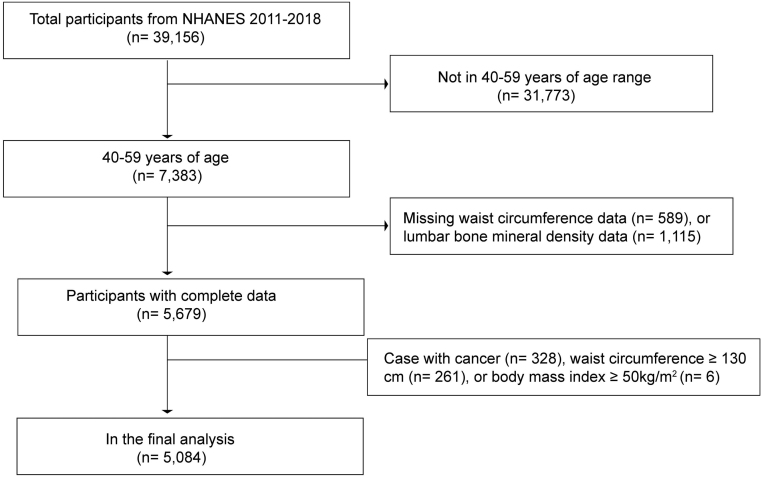
Our analysis was based on NHANES data from 2011 to 2018, including 5084 adults, 40-59 years of age. A weighted multiple linear regression analysis was used to evaluate the association between WC and lumbar BMD, with smooth curve fitting performed for non-linearities.
After adjusting for BMI and other potential confounders, WC was negatively associated with lumbar BMD in men (β = -2.8, 95% CI: -4.0 to -1.6) and premenopausal women (β = -2.6, 95% CI: -4.1 to -1.1). On subgroup analysis stratified by BMI, this negative association was more significant in men with a BMI ≥30 kg/m2 (β = -4.1, 95% CI: -6.3 to -2.0) and in pre- and postmenopausal women with a BMI <25 kg/m2 (premenopausal women: β= -5.7, 95% CI: -9.4 to-2.0; postmenopausal women: β=-5.6, 95% CI: -9.7 to -1.6). We further identified an inverted U-shaped relationship among premenopausal women, with a point of inflection at WC of 80 cm.
Our study found an inverse relationship between WC and lumbar BMD in middle-aged men with BMI ≥30 kg/m2, and women with BMI <25 kg/m2.
肥胖和骨质疏松是全球主要的公共卫生问题。这两种疾病的流行促使人们需要更好地了解它们之间的关系。然而,先前的研究在这个问题上得出了有争议的结果。因此,我们在本研究中的目的是利用美国国家健康与营养检查调查(NHANES)的数据,评估腰围(WC)作为肥胖指标与中年成年人腰椎骨密度(BMD)之间的独立关联。
我们的分析基于2011年至2018年的NHANES数据,包括5084名40 - 59岁的成年人。采用加权多元线性回归分析来评估WC与腰椎BMD之间的关联,并对非线性关系进行平滑曲线拟合。
在调整体重指数(BMI)和其他潜在混杂因素后,WC与男性(β = -2.8,95%置信区间:-4.0至-1.6)和绝经前女性(β = -2.6,95%置信区间:-4.1至-1.1)的腰椎BMD呈负相关。在按BMI分层的亚组分析中,这种负相关在BMI≥30 kg/m²的男性(β = -4.1,95%置信区间:-6.3至-2.0)以及BMI <25 kg/m²的绝经前和绝经后女性中更为显著(绝经前女性:β = -5.7,95%置信区间:-9.4至-2.0;绝经后女性:β = -5.6,95%置信区间:-9.7至-1.6)。我们进一步发现绝经前女性中存在倒U形关系,拐点处的WC为80 cm。
我们的研究发现,在BMI≥30 kg/m²的中年男性和BMI <25 kg/m²的女性中,WC与腰椎BMD呈负相关。