Center for Reproductive Medicine, Huizhou Central People's Hospital, Huizhou, Guangdong, China.
Department of Medical Oncology, Huizhou First Hospital, Huizhou, Guangdong, China.
PLoS One. 2023 Dec 20;18(12):e0295360. doi: 10.1371/journal.pone.0295360. eCollection 2023.
Obesity has significant implications for fertility and reproductive health. However, evidences linking abdominal obesity to female infertility were limited and inconclusive. Our objective was to figure out the potential relationship between waist circumference (WC) and infertility among women of childbearing age in the United States using data from the National Health and Nutrition Examination Survey (NHANES).
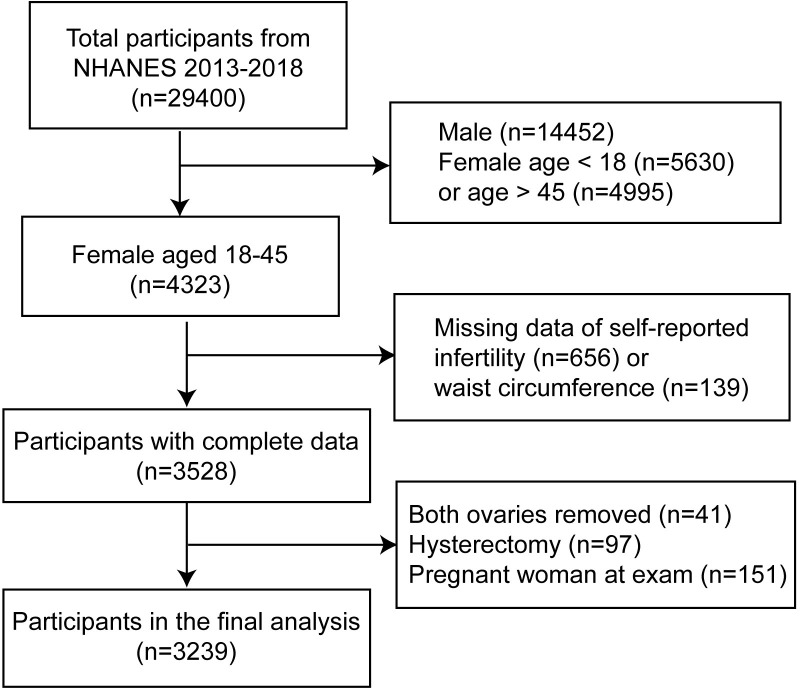
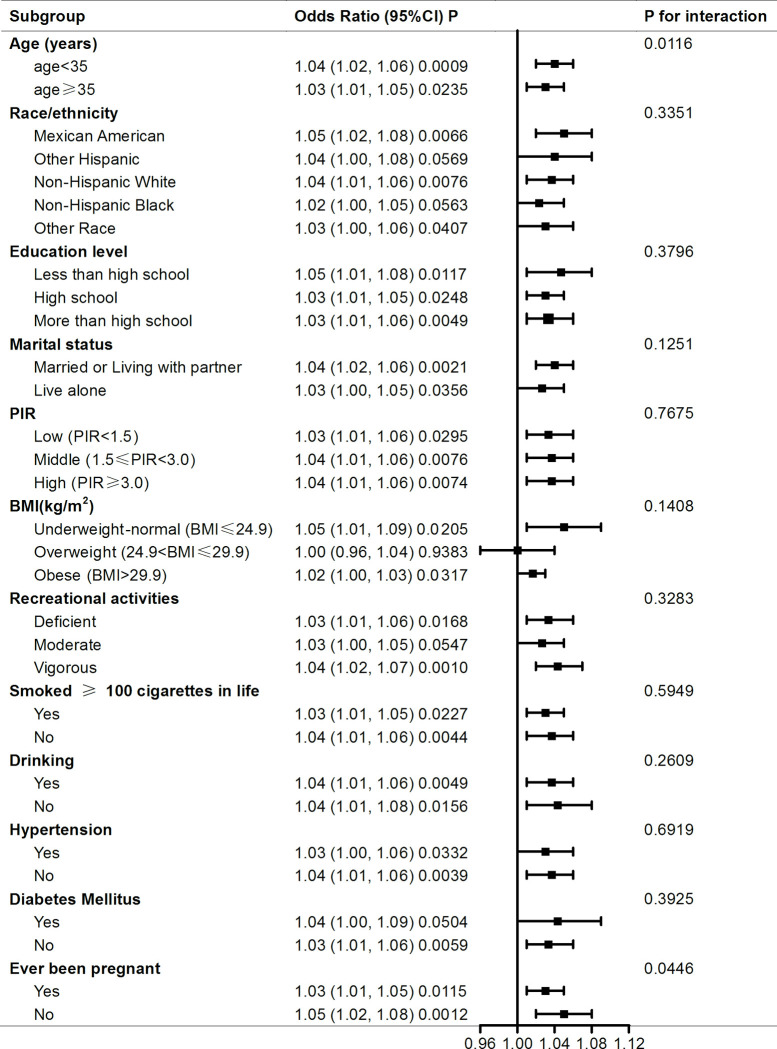
Our cross-sectional study included 3239 female participants aged 18-45 years. To explore the independent relationship between WC and female infertility, the weighted multivariable logistic regression and smoothed curve fitting were performed. Interaction and subgroup analyzes were then conducted for secondary analysis.
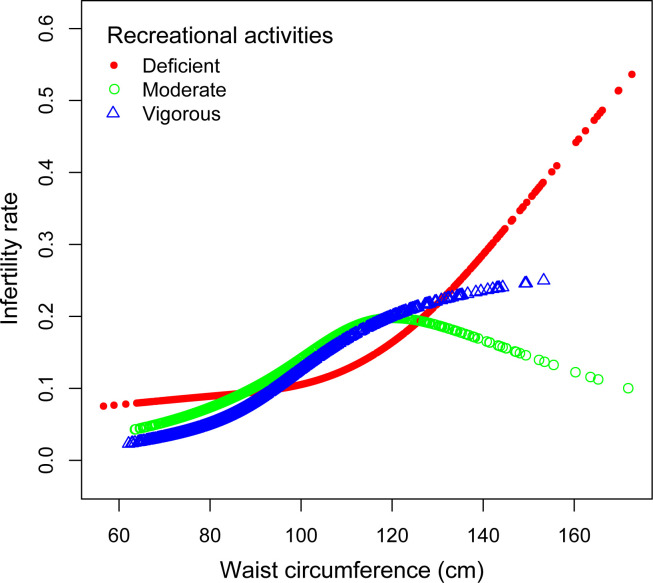
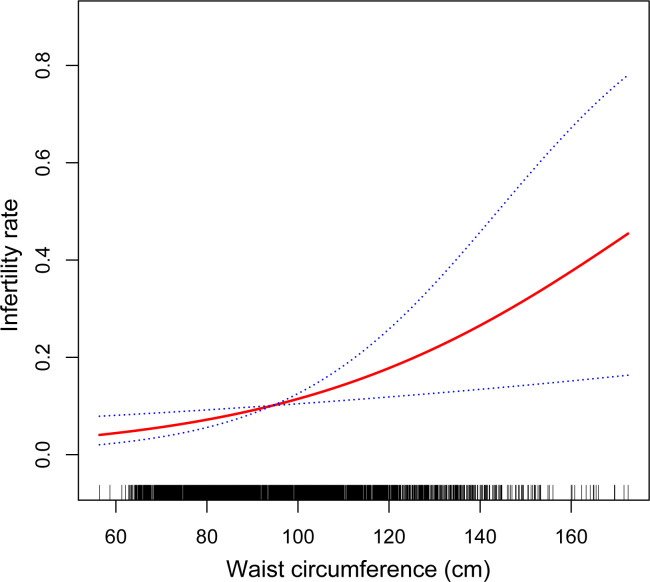
WC was positively associated with female infertility independent of BMI after adjusting for BMI and other potential confounders. In fully adjusted model, for every 1cm increase in waist circumference, the risk of infertility increased by 3% (OR = 1.03, 95% CI: 1.01-1.06). When WC was divided into five equal groups, women in the highest quintile had 2.64 times risk of infertility than that in the lowest quintile (OR = 2.64, 95% CI: 1.31-5.30). Smooth curve fitting revealed a non-linear but positively dose-dependent relationship between WC and female infertility. Furthermore, we found an inverted U-shaped relationship (turning point: 113.5 cm) between WC and female infertility in participants who had moderate recreational activities and a J-shaped relationship (turning point: 103 cm) between WC and female infertility in participants who had deficient recreational activities.
Waist circumference is a positive predictor of female infertility, independent of BMI. Moderate recreational activities can lower the risk of female infertility associated with abdominal obesity.
肥胖对生育力和生殖健康有重大影响。然而,将腹部肥胖与女性不孕联系起来的证据有限且不确定。我们的目的是使用来自国家健康和营养检查调查(NHANES)的数据,在美国生育年龄的女性中确定腰围(WC)与不孕之间的潜在关系。
我们的横断面研究包括 3239 名年龄在 18-45 岁的女性参与者。为了探讨 WC 与女性不孕之间的独立关系,我们进行了加权多变量逻辑回归和平滑曲线拟合。然后进行了交互和亚组分析进行二次分析。
在调整 BMI 和其他潜在混杂因素后,WC 与 BMI 独立相关,与女性不孕呈正相关。在完全调整的模型中,腰围每增加 1cm,不孕的风险增加 3%(OR=1.03,95%CI:1.01-1.06)。当 WC 分为五个相等的组时,最高五分位的女性不孕风险是最低五分位的 2.64 倍(OR=2.64,95%CI:1.31-5.30)。平滑曲线拟合显示 WC 与女性不孕之间存在非线性但呈正相关的关系。此外,我们发现中等娱乐活动参与者的 WC 和女性不孕之间存在倒 U 形关系(转折点:113.5cm),而缺乏娱乐活动参与者的 WC 和女性不孕之间存在 J 形关系(转折点:103cm)。
WC 是女性不孕的一个积极预测因素,独立于 BMI。中等娱乐活动可以降低与腹部肥胖相关的女性不孕的风险。