Consejo Nacional de Ciencia y Tecnología (CONACYT), Mexico City, Mexico.
Unidad de Genómica de Poblaciones Aplicada a la Salud, Facultad de Química, UNAM/Instituto Nacional de Medicina Genómica (INMEGEN), Periférico Sur No. 4809, Tlalpan, 14610, Mexico City, Mexico.
Mol Med. 2021 Sep 15;27(1):108. doi: 10.1186/s10020-021-00371-7.
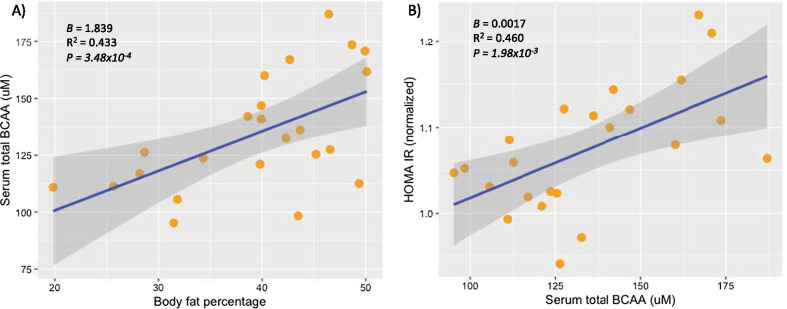
Elevations of circulating branched-chain amino acids (BCAA) are observed in humans with obesity and metabolic comorbidities, such as insulin resistance. Although it has been described that microbial metabolism contributes to the circulating pool of these amino acids, studies are still scarce, particularly in pediatric populations. Thus, we aimed to explore whether in early adolescents, gut microbiome was associated to circulating BCAA and in this way to insulin resistance.
Shotgun sequencing was performed in DNA from fecal samples of 23 early adolescents (10-12 years old) and amino acid targeted metabolomics analysis was performed by LC-MS/MS in serum samples. By using the HUMAnN2 algorithm we explored microbiome functional profiles to identify whether bacterial metabolism contributed to serum BCAA levels and insulin resistance markers.
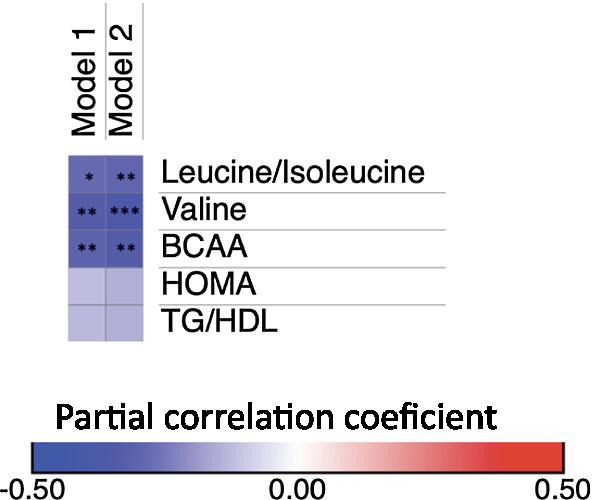
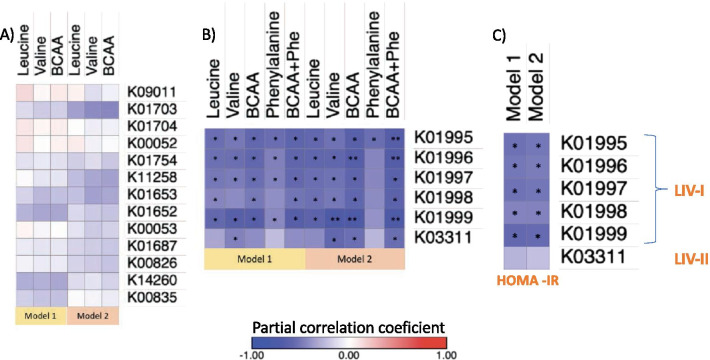
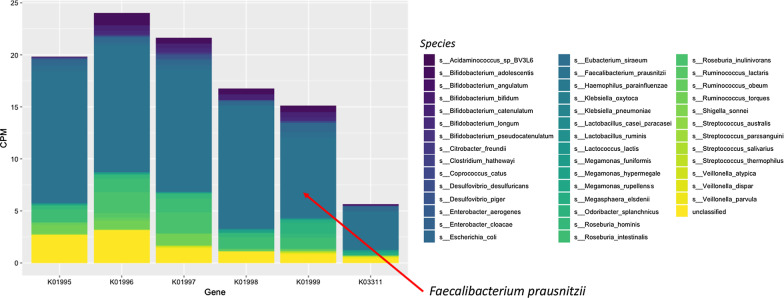
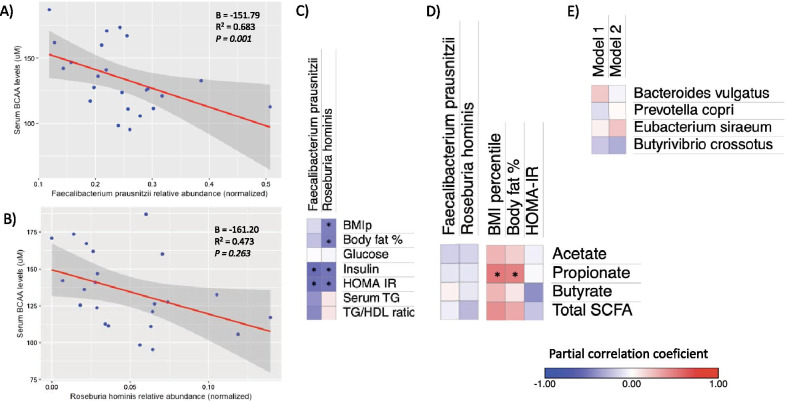
We identified that abundance of genes encoding bacterial BCAA inward transporters were negatively correlated with circulating BCAA and HOMA-IR (P < 0.01). Interestingly, Faecalibacterium prausnitzii contributed to approximately ~ 70% of bacterial BCAA transporters gene count. Moreover, Faecalibacterium prausnitzii abundance was also negatively correlated with circulating BCAA (P = 0.001) and with HOMA-IR (P = 0.018), after adjusting for age, sex and body adiposity. Finally, the association between Faecalibacterium genus and BCAA levels was replicated over an extended data set (N = 124).
We provide evidence that gut bacterial BCAA transport genes, mainly encoded by Faecalibacterium prausnitzii, are associated with lower circulating BCAA and lower insulin resistance. Based on the later, we propose that the relationship between Faecalibacterium prausnitzii and insulin resistance, could be through modulation of BCAA.
肥胖和代谢合并症(如胰岛素抵抗)患者的循环支链氨基酸(BCAA)水平升高。虽然已经描述了微生物代谢有助于这些氨基酸的循环池,但研究仍然很少,特别是在儿科人群中。因此,我们旨在探索在早期青少年中,肠道微生物组是否与循环 BCAA 相关,以及是否通过这种方式与胰岛素抵抗相关。
对 23 名早期青少年(10-12 岁)粪便样本中的 DNA 进行了鸟枪法测序,并通过 LC-MS/MS 对血清样本进行了氨基酸靶向代谢组学分析。通过使用 HUMAnN2 算法,我们探索了微生物组功能谱,以确定细菌代谢是否有助于血清 BCAA 水平和胰岛素抵抗标志物。
我们发现编码细菌 BCAA 内向转运体的基因丰度与循环 BCAA 和 HOMA-IR 呈负相关(P < 0.01)。有趣的是,普拉梭菌(Faecalibacterium prausnitzii)大约贡献了细菌 BCAA 转运体基因数的 70%。此外,在调整年龄、性别和身体肥胖后,普拉梭菌(Faecalibacterium prausnitzii)的丰度与循环 BCAA(P = 0.001)和 HOMA-IR(P = 0.018)呈负相关。最后,在扩展数据集(N = 124)中复制了粪杆菌属与 BCAA 水平之间的关联。
我们提供的证据表明,肠道细菌 BCAA 转运基因,主要由普拉梭菌(Faecalibacterium prausnitzii)编码,与较低的循环 BCAA 和较低的胰岛素抵抗相关。基于后者,我们提出普拉梭菌(Faecalibacterium prausnitzii)与胰岛素抵抗之间的关系可能是通过调节 BCAA 实现的。