Pyri Fatemeh, Abedi Parvin, Maraghi Elham, Jefreh Maryam Gholamzadeh
Department of Midwifery, Menopause Andropause Research Centre, Ahvaz Jundishapur University of Medical Sciences, Ahvaz, Iran.
Department of Biostatistics and Epidemiology, Faculty of Public Health, Ahvaz Jundishapur University of Medical Sciences, Ahvaz, Iran.
J Midlife Health. 2021 Apr-Jun;12(2):116-121. doi: 10.4103/jmh.JMH_66_20. Epub 2021 Jul 27.
Premature ovarian insufficiency may impair the quality of life and expose women to disorders such as cardiovascular disease, osteoporosis, and depression. This study aimed to evaluate the effect of mindfulness on the quality of life in women with premature ovarian insufficiency.
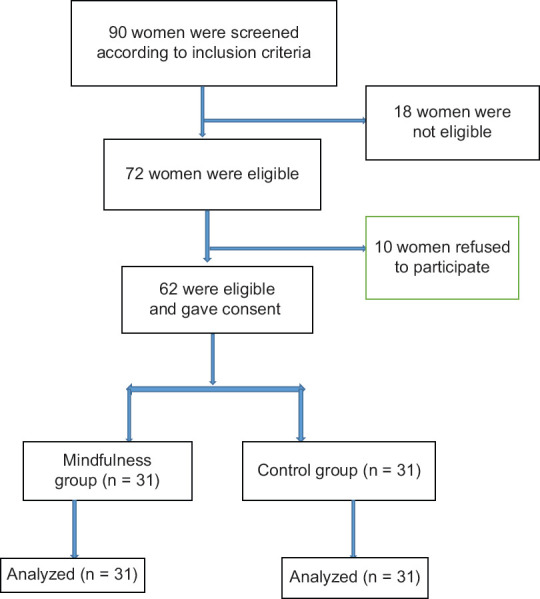
This study involved 62 women who were randomly allocated into two groups of mindfulness and control. The mindfulness group received eight sessions of training. A demographic questionnaire, menopause-specific quality of life and a checklist (for assessing hot flashes) were used to collect the data. The quality of life, frequency, and intensity of hot flashes were measured before the intervention, immediately, and 3 months after it. Independent -test, the Chi-square test, and the repeated measure test were used for data analysis.
The scores of quality of life dropped from 95.6 ± 9.77 at baseline to 77.32 ± 7.93 after intervention and 48.32 ± 4.96 at 3-months follow-up in the mindfulness group but rose from 99.5 ± 16.1 at baseline to 100.2 ± 15.33 after intervention, and 102.6 ± 14.9 3-months after it in the control group, < 0.001. The scores of vasomotor, psychological, physical, and sexual domains also improved significantly in the mindfulness group compared to the control group. The mean of hot flashes in the mindfulness group was 1.30 ± 0.69 and decreased to 1.1 ± 0.56 and 0.66 ± 0.58 immediately and in 3 months after intervention, respectively. The frequency of hot flashes was 14.74 ± 10.4 per week before intervention in the mindfulness group which reduced to 12.38 ± 8.66 and 6.74 ± 6.34 per week, immediately and 3 months after the intervention, while in the control group, there was an increase in the frequency of hot flashes ( < 0.0001).
According to the results of this study, mindfulness could improve quality of life and reduce hot flashes, so mindfulness training for women with premature ovarian insufficiency is strongly recommended.
卵巢早衰可能会损害生活质量,并使女性易患心血管疾病、骨质疏松症和抑郁症等疾病。本研究旨在评估正念对卵巢早衰女性生活质量的影响。
本研究纳入62名女性,她们被随机分为正念组和对照组。正念组接受八次训练课程。使用人口统计学问卷、更年期特异性生活质量量表和一份清单(用于评估潮热)来收集数据。在干预前、干预后立即以及干预后3个月测量生活质量、潮热的频率和强度。采用独立样本t检验、卡方检验和重复测量检验进行数据分析。
正念组的生活质量得分从基线时的95.6±9.77降至干预后的77.32±7.93以及3个月随访时的48.32±4.96,而对照组的生活质量得分从基线时的99.5±16.1升至干预后的100.2±15.33以及干预后3个月的102.6±14.9,P<0.001。与对照组相比,正念组的血管舒缩、心理状态、身体状况和性功能等方面的得分也有显著改善。正念组潮热的平均值为1.30±0.69,干预后立即降至1.1±0.56,3个月后降至0.66±0.58。正念组干预前潮热频率为每周14.74±10.4次,干预后立即降至每周12.38±8.66次,3个月后降至每周6.74±6.34次,而对照组潮热频率有所增加(P<0.0001)。
根据本研究结果,正念可以改善生活质量并减少潮热,因此强烈建议对卵巢早衰女性进行正念训练。