Department of Clinical Therapeutics, School of Medicine, and.
Department of Cell Biology and Biophysics, Faculty of Biology, National and Kapodistrian University of Athens, Athens, Greece.
Blood Adv. 2021 Nov 9;5(21):4398-4405. doi: 10.1182/bloodadvances.2021005444.
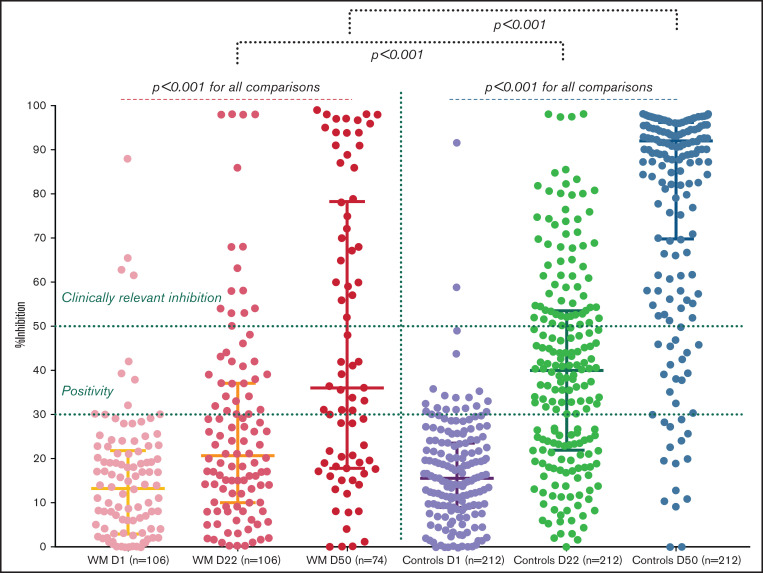
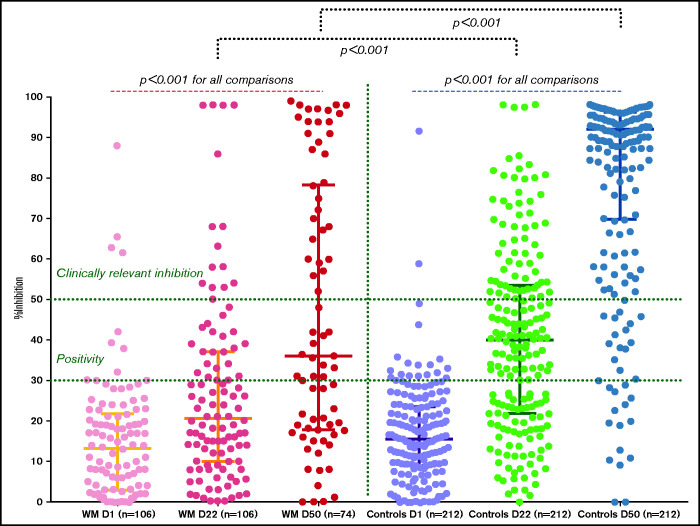
Immunocompromised patients with hematologic malignancies are more susceptible to COVID-19 and at higher risk of severe complications and worse outcomes compared with the general population. In this context, we evaluated the humoral response by determining the titers of neutralizing antibodies (NAbs) against SARS-CoV-2 in patients with Waldenström macroglobulinemia (WM) after vaccination with the BNT162b2 or AZD1222 vaccine. A US Food and Drug Administration-approved enzyme-linked immunosorbent assay-based methodology was implemented to evaluate NAbs on the day of the first vaccine shot, as well as on days 22 and 50 afterward. A total of 106 patients with WM (43% men; median age, 73 years) and 212 healthy controls (46% men; median age, 66 years) who were vaccinated during the same period at the same center were enrolled in the study (which is registered at www.clinicaltrials.gov as #NCT04743388). Our data indicate that vaccination with either 2 doses of the BNT162b2 or 1 dose of the AZD1222 vaccine leads to lower production of NAbs against SARS-CoV-2 in patients with WM compared with controls on days 22 and 50 (P < .001 for all comparisons). Disease-related immune dysregulation and therapy-related immunosuppression are involved in the low humoral response. Importantly, active treatment with either rituximab or Bruton's tyrosine kinase inhibitors was proven as an independent prognostic factor for suboptimal antibody response after vaccination. In conclusion, patients with WM have low humoral response after COVID-19 vaccination, which underlines the need for timely vaccination ideally during a treatment-free period and for continuous vigilance on infection control measures.
免疫功能低下的血液系统恶性肿瘤患者比普通人群更容易感染 COVID-19,并且发生严重并发症和不良结局的风险更高。在此背景下,我们评估了瓦尔登斯特伦巨球蛋白血症(WM)患者接种 BNT162b2 或 AZD1222 疫苗后的体液免疫反应,通过测定针对 SARS-CoV-2 的中和抗体(NAb)滴度来评估。我们采用了美国食品药品监督管理局(FDA)批准的基于酶联免疫吸附试验的方法,在第一针疫苗接种当天以及之后的第 22 天和第 50 天评估 NAb。共纳入了 106 例 WM 患者(43%为男性;中位年龄 73 岁)和同期在同一中心接种疫苗的 212 例健康对照者(46%为男性;中位年龄 66 岁)。这项研究已在 www.clinicaltrials.gov 上注册,编号为 #NCT04743388。我们的数据表明,与对照组相比,接种 2 剂 BNT162b2 或 1 剂 AZD1222 疫苗后,WM 患者在第 22 天和第 50 天产生针对 SARS-CoV-2 的 NAb 数量较低(所有比较 P<0.001)。疾病相关的免疫失调和治疗相关的免疫抑制参与了低体液免疫反应。重要的是,无论是利妥昔单抗还是布鲁顿酪氨酸激酶抑制剂的积极治疗,均被证明是疫苗接种后抗体反应不佳的独立预后因素。总之,WM 患者在 COVID-19 疫苗接种后产生的体液免疫反应较低,这强调了及时接种疫苗的必要性,理想情况下是在无治疗期内进行,并且需要持续警惕感染控制措施。