Cold Spring Harbor Laboratory, Cold Spring Harbor, NY 11724, USA; Division of Hematology/Oncology, Boston Children's Hospital and Department of Pediatric Oncology, Dana-Farber Cancer Institute, Howard Hughes Medical Institute, Harvard Stem Cell Institute, Harvard Medical School, Boston, MA 02115, USA; The David H. Koch Institute for Integrative Cancer Research at MIT, Department of Biology, MIT, Cambridge, MA 02139, USA.
Cold Spring Harbor Laboratory, Cold Spring Harbor, NY 11724, USA.
Cell Stem Cell. 2021 Nov 4;28(11):1922-1935.e5. doi: 10.1016/j.stem.2021.08.007. Epub 2021 Sep 15.
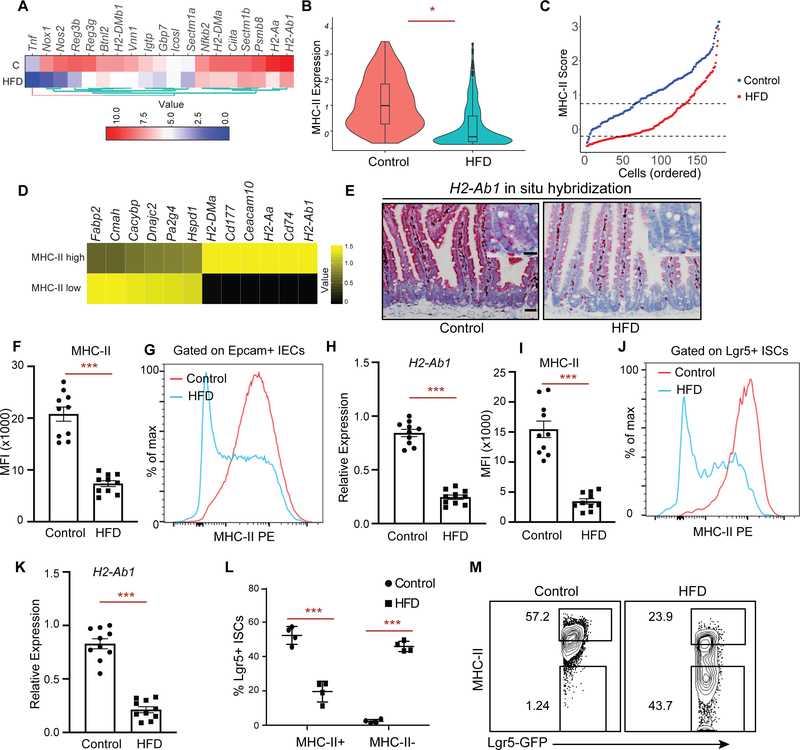
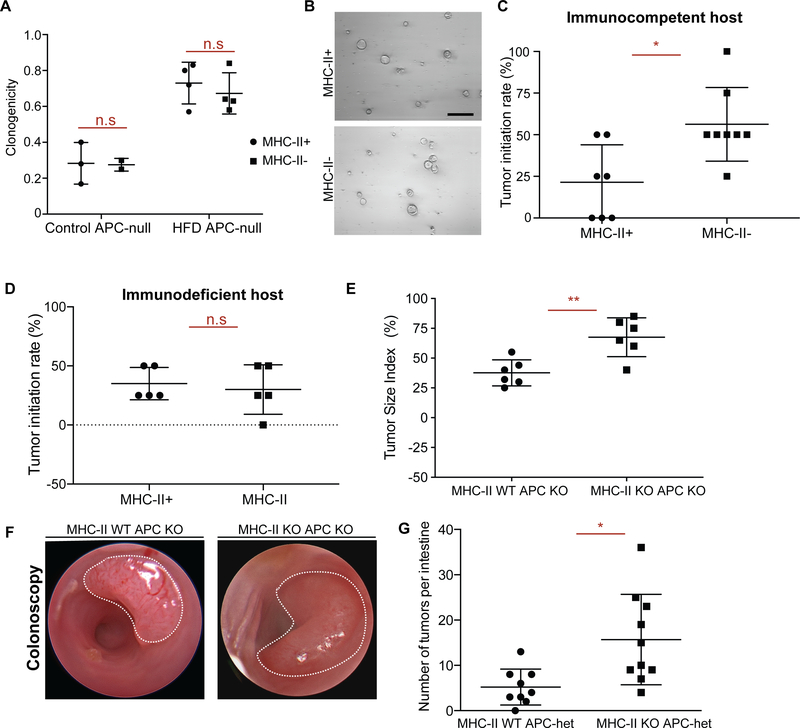
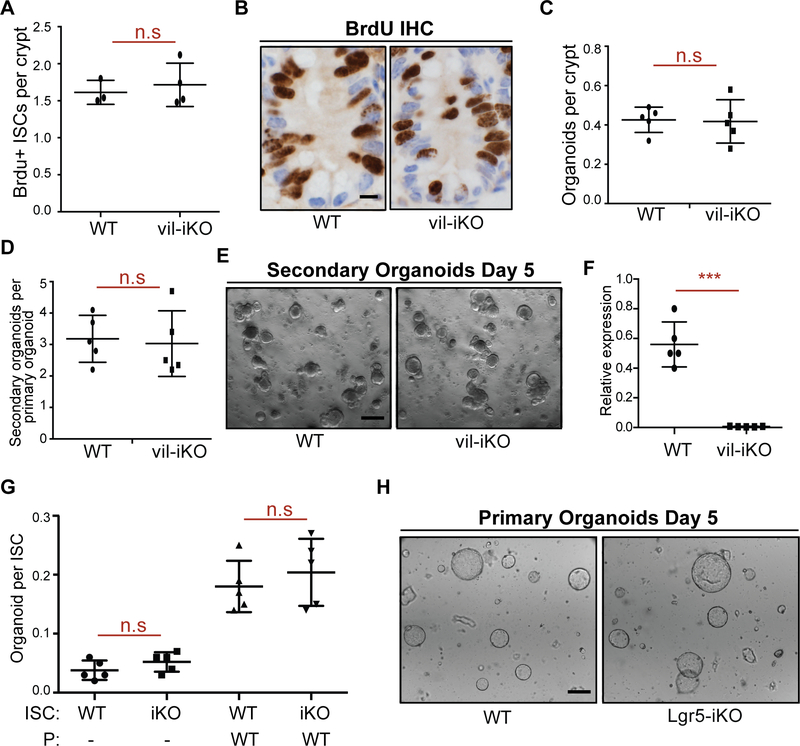
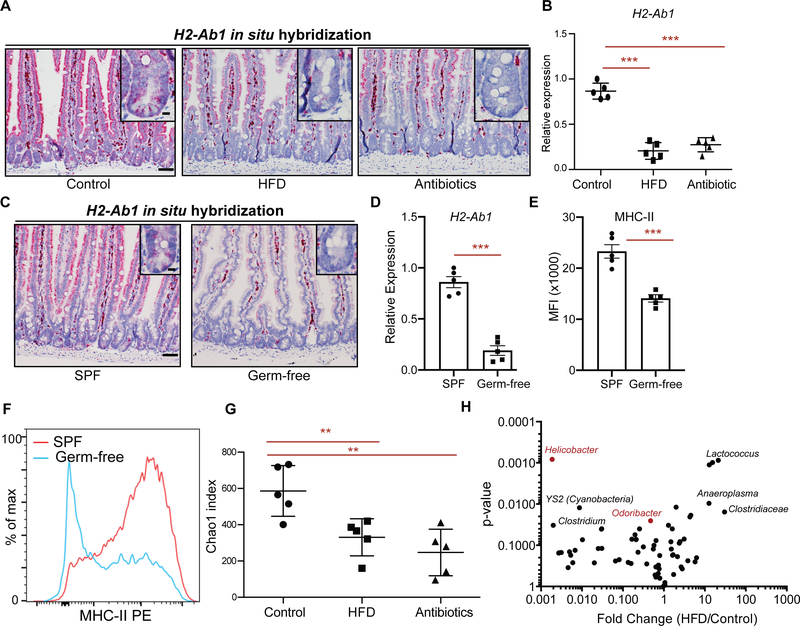
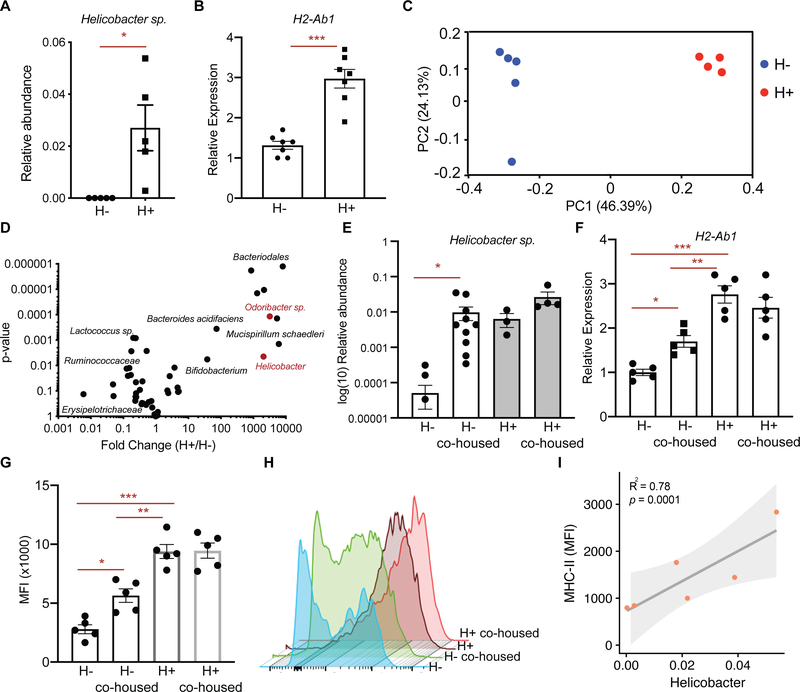
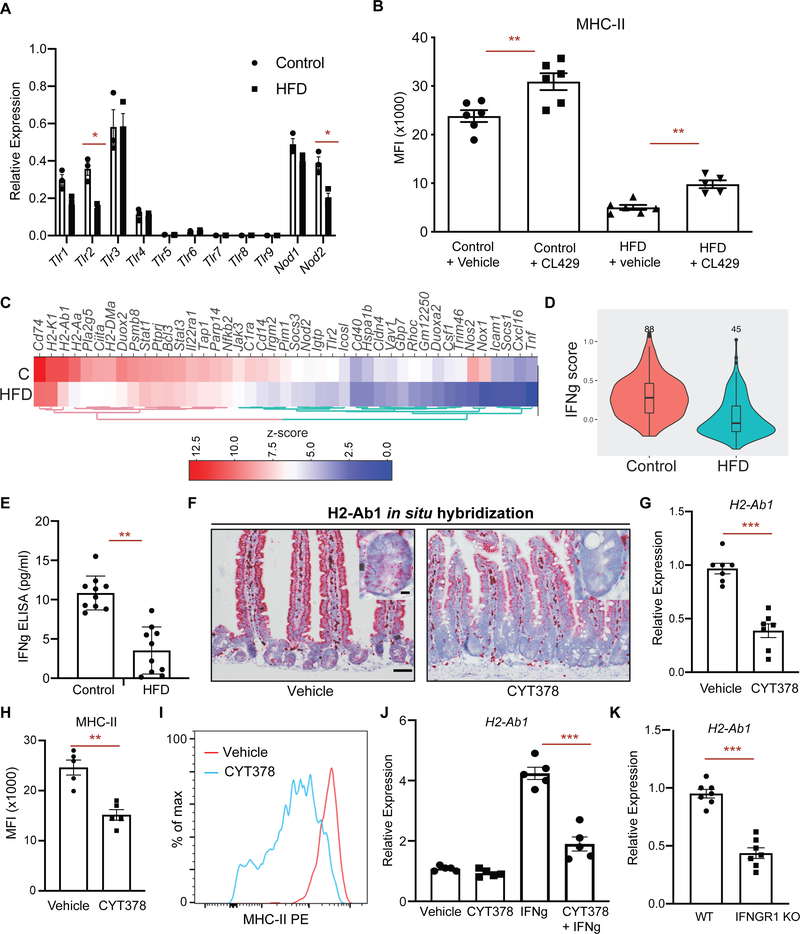
Little is known about how interactions of diet, intestinal stem cells (ISCs), and immune cells affect early-stage intestinal tumorigenesis. We show that a high-fat diet (HFD) reduces the expression of the major histocompatibility complex class II (MHC class II) genes in intestinal epithelial cells, including ISCs. This decline in epithelial MHC class II expression in a HFD correlates with reduced intestinal microbiome diversity. Microbial community transfer experiments suggest that epithelial MHC class II expression is regulated by intestinal flora. Mechanistically, pattern recognition receptor (PRR) and interferon-gamma (IFNγ) signaling regulates epithelial MHC class II expression. MHC class II-negative (MHC-II-) ISCs exhibit greater tumor-initiating capacity than their MHC class II-positive (MHC-II+) counterparts upon loss of the tumor suppressor Apc coupled with a HFD, suggesting a role for epithelial MHC class II-mediated immune surveillance in suppressing tumorigenesis. ISC-specific genetic ablation of MHC class II increases tumor burden cell autonomously. Thus, HFD perturbs a microbiome-stem cell-immune cell interaction that contributes to tumor initiation in the intestine.
目前对于饮食、肠干细胞(ISCs)和免疫细胞的相互作用如何影响早期肠道肿瘤发生知之甚少。我们发现高脂肪饮食(HFD)会降低肠道上皮细胞中主要组织相容性复合体 II 类(MHC II 类)基因的表达,包括 ISCs。HFD 导致上皮细胞 MHC II 类表达下降与肠道微生物组多样性减少相关。微生物群落转移实验表明上皮细胞 MHC II 类表达受肠道菌群调节。在机制上,模式识别受体(PRR)和干扰素-γ(IFNγ)信号调节上皮细胞 MHC II 类的表达。在与高脂肪饮食相结合的肿瘤抑制因子 Apc 缺失的情况下,MHC II 类阴性(MHC-II-)ISCs 比 MHC II 类阳性(MHC-II+)ISCs 具有更大的起始肿瘤能力,这表明上皮细胞 MHC II 类介导的免疫监视在抑制肿瘤发生中起作用。ISC 特异性 MHC II 类基因缺失会增加肿瘤负担,这是细胞自主性的。因此,HFD 扰乱了微生物群-干细胞-免疫细胞相互作用,从而促进了肠道的肿瘤起始。