Demerlé Clemence, Gorvel Laurent, Olive Daniel
Cancer Research Center in Marseille (CRCM), INSERM U1068, CNRS U7258, Aix Marseille University (AMU), Paoli Calmette Institute (IPC), Marseille, France.
Front Oncol. 2021 Aug 31;11:682007. doi: 10.3389/fonc.2021.682007. eCollection 2021.
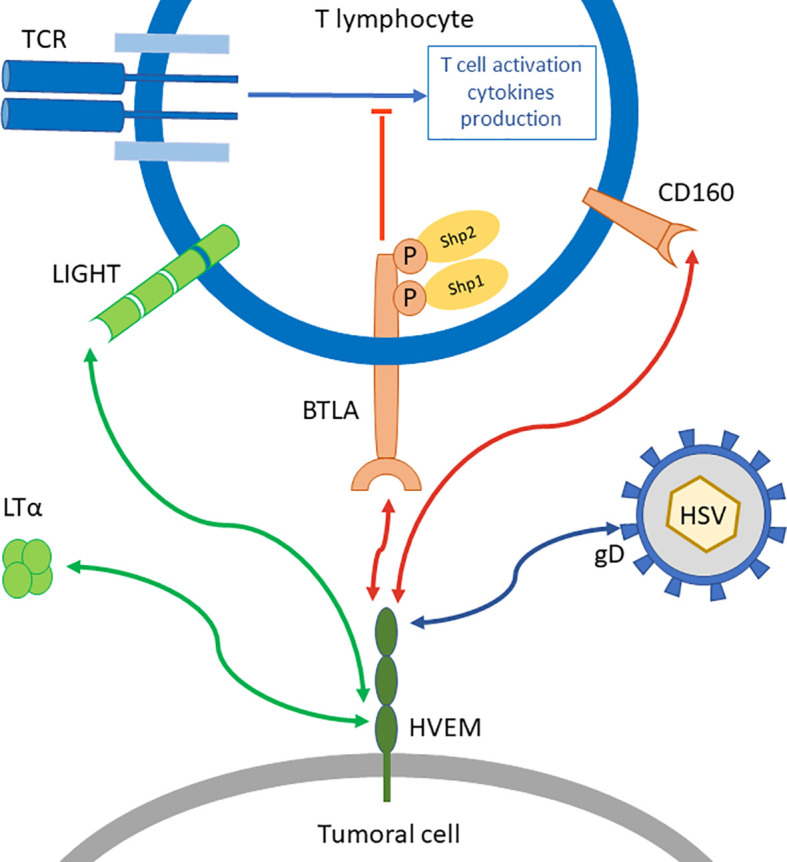
Lung cancer is the leading cause of cancer deaths worldwide. Immunotherapies (IT) have been rapidly approved for lung cancer treatment after the spectacular results in melanoma. Responses to the currently used checkpoint inhibitors are strikingly good especially in metastatic diseases. However, durable responses are observed in only 25% of cases. Consequently, there is an urgent need for new immunotherapy targets. Among the multiple checkpoints involved in the tumor immune escape, the BTLA-HVEM couple appears to be a promising target. BTLA (B- and T- Lymphocyte Attenuator) is a co-inhibitory receptor mainly expressed by B and T cells, repressing the activation signal transduction. BTLA shares similarities with other immune checkpoints such as PD-1 and CTLA-4 which are the targets of the currently used immunotherapies. Furthermore, BTLA expression points out terminally exhausted and dysfunctional lymphocytes, and correlates with lung cancer progression. The ligand of BTLA is HVEM (Herpes Virus Entry Mediator) which belongs to the TNF receptor family. Often described as a molecular switch, HVEM is constitutively expressed by many cells, including cells from tumor and healthy tissues. In addition, HVEM seems to be involved in tumor immuno-evasion, especially in lung tumors lacking PD-L1 expression. Here, we propose to review the role of BTLA-HVEM in immuno-escape in order to highlight its potential for designing new immunotherapies.
肺癌是全球癌症死亡的主要原因。在黑色素瘤治疗取得显著成果后,免疫疗法(IT)已迅速获批用于肺癌治疗。目前使用的检查点抑制剂的疗效显著,尤其是在转移性疾病中。然而,只有25%的病例观察到持久反应。因此,迫切需要新的免疫治疗靶点。在肿瘤免疫逃逸涉及的多个检查点中,BTLA-HVEM配对似乎是一个有前景的靶点。BTLA(B和T淋巴细胞衰减因子)是一种主要由B细胞和T细胞表达的共抑制受体,可抑制激活信号转导。BTLA与其他免疫检查点如PD-1和CTLA-4有相似之处,而它们是目前使用的免疫疗法的靶点。此外,BTLA表达指出终末耗竭和功能失调的淋巴细胞,并与肺癌进展相关。BTLA的配体是HVEM(疱疹病毒进入介质),它属于肿瘤坏死因子受体家族。HVEM常被描述为一个分子开关,由许多细胞组成性表达,包括肿瘤和健康组织的细胞。此外,HVEM似乎参与肿瘤免疫逃逸,尤其是在缺乏PD-L1表达的肺肿瘤中。在此,我们建议综述BTLA-HVEM在免疫逃逸中的作用,以突出其在设计新免疫疗法方面的潜力。