Department of Surgery, Leiden University Medical Center, Leiden, The Netherlands.
Department of Pathology, Haaglanden Medical Center, The Hague, The Netherlands.
Int J Colorectal Dis. 2021 Dec;36(12):2729-2737. doi: 10.1007/s00384-021-04023-4. Epub 2021 Sep 17.
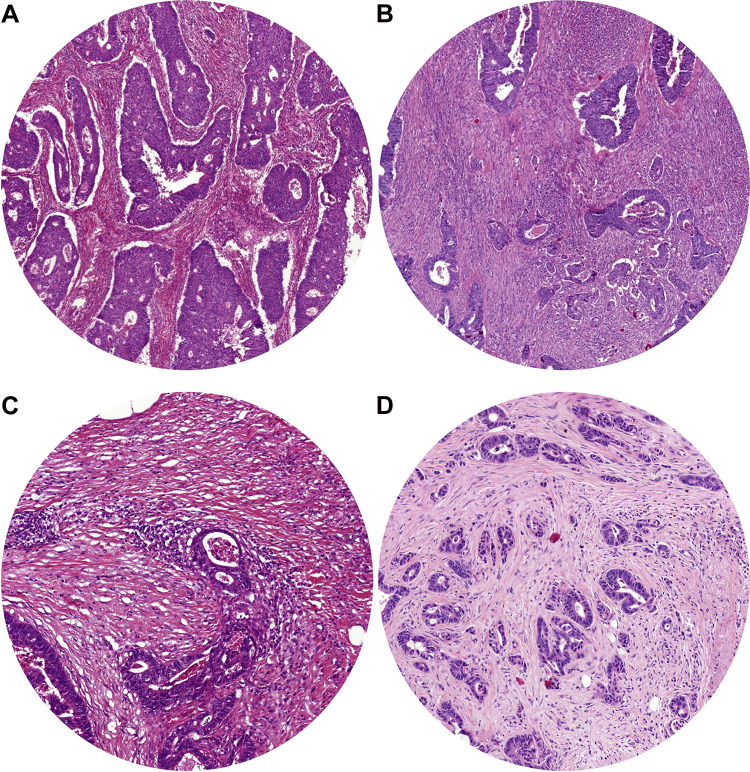
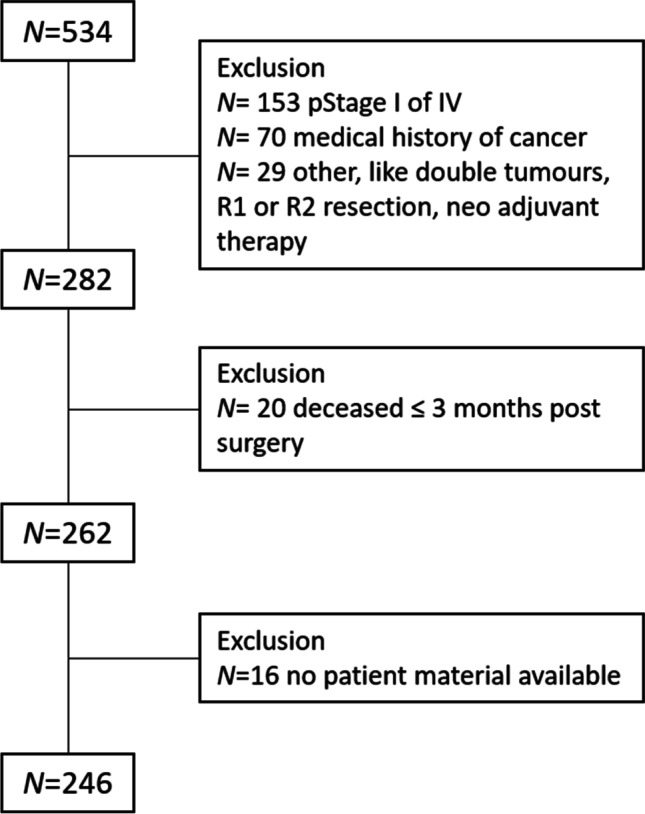
The tumour-stroma ratio (TSR) and tumour budding (TB) are two high-risk factors with potential to be implemented in the next TNM classification. The aim of the current study was to evaluate the practical application of the two biomarkers based on reproducibility, independency and prognostic value. Patients diagnosed with stage II or III colon cancer who underwent surgery between 2005 and 2016 were included. Both TSR and TB were scored on haematoxylin and eosin-stained tissue sections. The TSR, based on the relative amount of stroma, was scored in increments of 10%. TB was scored following the consensus guidelines; a bud was defined as ≤ 4 tumour cells. For analysis, three categories were used. Cohen's kappa was used for reproducibility. The prognostic value was determined with survival analysis. In total, 246 patients were included. The TSR distribution was N = 137 (56%) stroma-low and N = 109 (44%) stroma-high. The TB distribution was TB-low N = 194 (79%), TB-intermediate N = 35 (14%) and TB-high N = 17 (7%). The reproducibility of the TSR was good (interobserver agreement kappa = 0.83 and intraobserver agreement kappa = 0.82), whereas the inter- and intraobserver agreement for scoring TB was moderate (kappa 0.47 and 0.45, respectively). The survival analysis showed an independent prognostic value for disease-free survival for TSR (HR 1.57; 95% CI 1.01-2.44; p = 0.048) and for TB-high (HR 2.01; 95% CI 1.02-3.96; p = 0.043). Based on current results, we suggest the TSR is a more reliable parameter in daily practice due to better reproducibility and independent prognostic value for disease-free survival.
肿瘤-基质比(TSR)和肿瘤芽(TB)是两个具有潜在应用于下一个 TNM 分类的高危因素。本研究的目的是评估基于重复性、独立性和预后价值的这两个生物标志物的实际应用。纳入 2005 年至 2016 年间接受手术治疗的 II 期或 III 期结肠癌患者。在苏木精和伊红染色的组织切片上对 TSR 和 TB 进行评分。TSR 基于基质的相对量,以 10%的增量评分。TB 根据共识指南评分;芽定义为≤4 个肿瘤细胞。为了进行分析,使用了三个类别。Cohen's kappa 用于评估重复性。通过生存分析确定预后价值。共纳入 246 例患者。TSR 分布为 N=137(56%)基质低和 N=109(44%)基质高。TB 分布为 TB-低 N=194(79%)、TB-中 N=35(14%)和 TB-高 N=17(7%)。TSR 的重复性较好(观察者间一致性kappa=0.83,观察者内一致性 kappa=0.82),而 TB 评分的观察者间和观察者内一致性为中度(kappa 分别为 0.47 和 0.45)。生存分析显示 TSR 对无病生存率具有独立的预后价值(HR 1.57;95%CI 1.01-2.44;p=0.048)和 TB-高(HR 2.01;95%CI 1.02-3.96;p=0.043)。基于当前结果,我们建议 TSR 是一种更可靠的参数,因为其在无病生存率方面具有更好的重复性和独立的预后价值。